Key Points
- Getting CNA certified takes four steps: meet your state's requirements, finish training, pass the exam, and get listed on the nurse aide registry.
- The credential is technically a state certification, not a professional license, and your active listing on the registry is your legal proof of it.
- Training runs 75 to 180 hours depending on your state, and most states require you to be 16 to 18 with a background check and a TB test.
- The competency exam has a written part and a hands-on skills part, both of which you usually take in one day.
- The full process takes about one to four months, and it requires no college degree.
How Do You Get a CNA Certification?
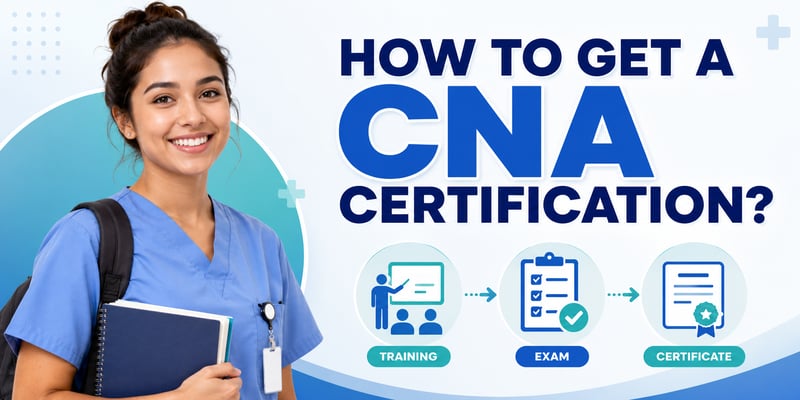
You get a CNA certification by completing a state-approved training program and passing your state's competency exam, after which your name is added to the nurse aide registry. The Centers for Medicare & Medicaid Services confirms the core path: finish training, pass the exam, and you are certified. In practice, it breaks into four steps.
- Meet your state's basic requirements.
- Complete a state-approved training program.
- Pass the written and skills exam.
- Get listed on your state's nurse aide registry.
Step 1: Meet Your State's Basic Requirements
Before you start training, you have to meet a few basic requirements, and they vary by state. In most states, you need to:
- Be at least 18, though some states allow 16, sometimes with parental consent.
- Have a high school diploma or GED, though not every state requires one. California, for example, does not.
- Pass a criminal background check, often fingerprint-based.
- Complete a physical exam, a TB test, and standard immunizations.
There are no college courses to take first, which is part of what makes CNA one of the fastest ways into healthcare.
Step 2: Complete a State-Approved Training Program
Next, you finish a state-approved training program, which is the core of getting certified. Programs run from the federal minimum of 75 hours up to about 180 hours depending on your state, with Maine on the high end at 180. Training combines classroom instruction, covering things like vital signs, infection control, patient rights, and communication, with hands-on clinical hours working directly with patients under a nurse's supervision.
You can train at a community college, a vocational school, or a nursing home, and many programs offer a hybrid format with the lectures online. To find approved programs near you, browse CNA classes near you, and our guide on what to buy for a CNA class helps you show up prepared on the first day.
Step 3: Pass the Competency Exam
After training, you take your state's competency exam, which has two parts: a written test and a hands-on skills test. The written part is usually multiple-choice questions on patient care, safety, infection control, and residents' rights. For the skills part, an evaluator watches you perform several real nursing-assistant tasks, like taking vital signs or helping a patient move, and you have to do them correctly.
A state-approved vendor such as Prometric or Credentia administers the exam, and in most states you can take both parts in one day. If you do not pass one part, most states let you retake just that part, usually after a short waiting period. Our guide on how to prepare for the CNA exam covers what to study and how to pass on your first try.
Step 4: Get Listed on Your State Nurse Aide Registry
Passing the exam is not quite the finish line; getting on the registry is. Once you pass, your results go to your state's nurse aide registry, and your name is added in active status. That registry listing, more than any printed certificate, is the official proof that you are certified and legally allowed to work. Processing can take anywhere from a few days to about two weeks after you pass.
After that, you are a certified nursing assistant and can start applying for jobs. Many people treat the role as a launchpad, so if you are already thinking ahead, what comes after CNA maps out the common next steps like LPN and RN.
Is a CNA a License or a Certification?
A CNA credential is technically a certification, not a license, even though people often call it a "CNA license." The difference matters less than it sounds: you earn it by passing the state exam and getting listed on the nurse aide registry, and that active registry listing is what legally lets you work, whether your state calls it a license or a certificate. In many states there is no separate printed license at all, and the registry entry is the credential.
This is also why, if you ever need to prove your status or get a copy, you go through your state's registry rather than hunting for a paper certificate. And if you move, your certification does not automatically follow you, so how to transfer your CNA license explains how to apply for reciprocity in a new state.
How Much Does CNA Certification Cost?
CNA certification costs far less than most healthcare credentials. Paid programs typically run from a few hundred dollars up to around $1,500 for tuition, and you will also pay a state exam fee, usually around $100 to $150. The good news is that free routes exist: many nursing homes pay for your training in exchange for working for them, and government workforce funding can cover it too. Our roundup of the cheapest and fastest CNA programs compares the lowest-cost ways to get certified.
CNA Programs on Dreambound
To get certified, you need a state-approved program, and Dreambound lets you compare them by cost and length. Here are three to start with.
- Format: Hybrid
- Length: 5 weeks
- Tuition: $274 to start, $920 total
- Covers first aid, CPR, vital signs, and infection prevention