Key Points
- The cheapest CNA program featured here costs $920 total, and the fastest finishes in 3 weeks.
- CNA training often runs $800 to $2,000 in tuition, plus a state exam fee of about $100 to $150 ($125 in Texas) and a background check.
- Accelerated programs finish in about 3 to 5 weeks, while part-time tracks run 8 to 12 weeks.
- Federal rules require at least 75 training hours, including 16 supervised practical hours, and many states require more.
- Nursing assistants earn a median of $42,260 a year, about $20.32 an hour; the lowest-paid 10% earn under $33,940.
Cheapest and Fastest CNA Programs on Dreambound
The cheapest CNA program featured here is Diamond Career Institute at $920 total over 5 weeks, and the fastest is TSC Career Institute at 3 weeks for $1,050. Both are hybrid programs in the Dallas area, one in Richardson and one in Mesquite. Dreambound shows each program's tuition and length, the two numbers a cost-and-speed comparison starts with. If you live outside North Texas, start with CNA classes near me to find cheap CNA classes closer to home.
- Format: Hybrid
- Location: Richardson, TX
- Length: 5 weeks
- Tuition: $274 to start, $920 total
- Covers first aid, CPR, vital signs, and infection prevention; approved by the Texas Workforce Commission and authorized by Texas HHSC as a NATCEP
- Format: Hybrid
- Location: Mesquite, TX
- Length: 3 weeks
- Tuition: $1,050 total
- State-approved NATCEP; graduates are eligible to sit for the state exam
How Much Do CNA Classes Cost?
Tuition is only part of the bill. CNA tuition often falls between $800 and $2,000, and the two programs above sit at the lower end, from $920 to $1,050. On top of tuition, plan for a state exam fee of about $100 to $150, set by your state, and a criminal background check, plus books, scrubs, and supplies unless they are bundled in.
Line up these costs before you choose a program:
- Tuition
- State competency exam fee
- Criminal background check
- CPR certification, if the program does not include it
- Scrubs, books, and supplies
- Immunizations or health screenings, if your clinical site requires them
In Texas, the nurse aide exam fees set by Prometric as of September 1, 2026 are $125 for the written or oral exam plus the clinical skills test, $92 for the skills test alone, and $33 for the written or oral test alone. Add $125 to Diamond's $920 and the cheapest path reaches $1,045 before the background check. Once the background check is in, the cheapest realistic path to certified lands closer to $1,100 than the $920 tuition alone. Knowing the full number keeps you from being surprised at the finish line. For the supplies most programs expect you to bring, see what to buy for a CNA class.
How Fast You Can Become a CNA
You can become a CNA in about 3 weeks through a full-time program like TSC's, or about 5 weeks at Diamond. Part-time, evening, and weekend tracks stretch that to 8 to 12 weeks, which suits people training around a job.
The speed has a floor. Federal rules require at least 75 training hours, including 16 supervised practical hours, and many states require more, so a "two-week" program means full-time days, not fewer hours. After class, your competency exam and registry listing add a little time before you can work. For the full timeline from sign-up to your first shift, see how long it takes to become a CNA.
Are 2-Week and 4-Week CNA Programs Real?
A 4-week CNA program is realistic on a full-time schedule. Spread over four weeks, the 75-hour federal minimum works out to about 19 hours a week, and a 100-hour state requirement to 25 hours a week. A 2-week program is harder to fit. Meeting 75 hours in two weeks takes about 38 hours a week of instruction and supervised practice, and in Texas, which requires 100 hours, it would take 50 hours a week. Accelerated CNA programs compress the calendar, not the hours, so check your state's minimum before paying for any program that promises a two-week finish.
CNA Training Hours by State
Federal law sets the floor, and states can require more:
- Federal minimum: 75 clock hours, including at least 16 hours of supervised practical training
- Texas: 100 hours, 60 classroom and 40 clinical, per Texas HHSC
- California: 160 hours, 60 classroom and 100 supervised clinical, per the California Department of Public Health
- Florida: 120 hours, 80 classroom and 40 clinical, under Florida Administrative Code rule 64B9-15.006
- Virginia: 140 clock hours, under 18VAC90-26-50, in effect since May 12, 2023
For any other state, check its nurse aide registry or health department for the required hours.
How to Lower the Cost of CNA Training
Even the cheapest program gets cheaper with the right funding. Employers are one lever: some hospitals and nursing homes sponsor training in exchange for a work commitment. Federal rules also protect aides who train for nursing homes. A Medicare- or Medicaid-certified nursing facility cannot charge an aide who already works there, or has a job offer from it, when training starts. If a facility hires you within 12 months of finishing, the State must reimburse your training costs on a pro rata basis while you work as a nurse aide, under 42 CFR 483.152(c).
Beyond that, state workforce grants through WIOA and monthly payment plans can bring the bill down; Diamond lets you start for $274. Dreambound's guide to education funding walks through how to apply. Workforce Pell Grants, available from July 1, 2026, cover only programs of 150 to 599 clock hours that last at least 8 weeks and less than 15, according to Federal Student Aid. A 3- to 5-week CNA program falls under the 8-week minimum, so it does not qualify on its own; a longer program that pairs CNA training with other coursework may, if your state certifies it. If you specifically need a no-cost route, free CNA training exists through some employers and state programs, usually with a work commitment attached.
What to Look for in a Cheap CNA Program
A cheap program is only a deal if it actually makes you eligible to work. Four checks separate a real bargain from wasted tuition:
- State approval. The program is on your state's nurse aide registry or approved-program list. An unapproved class will not qualify you for the exam, no matter how low the price.
- Clinical hours included. The price covers the supervised clinical hours your state requires, not just online theory you then have to arrange on your own.
- The exam in the plan. The program prepares you for the competency exam your state uses, such as those run by Credentia or Prometric.
- Pass rate. Ask for the program's first-attempt state exam pass rate before you pay.
For a different format, online CNA classes run the theory remotely with in-person clinicals.
CNA Salary and Job Outlook
Nursing assistants earn a median of $42,260 a year, about $20.32 an hour, according to May 2025 BLS pay data. The lowest-paid 10% earn under $33,940, and the highest-paid 10% earn over $51,980.
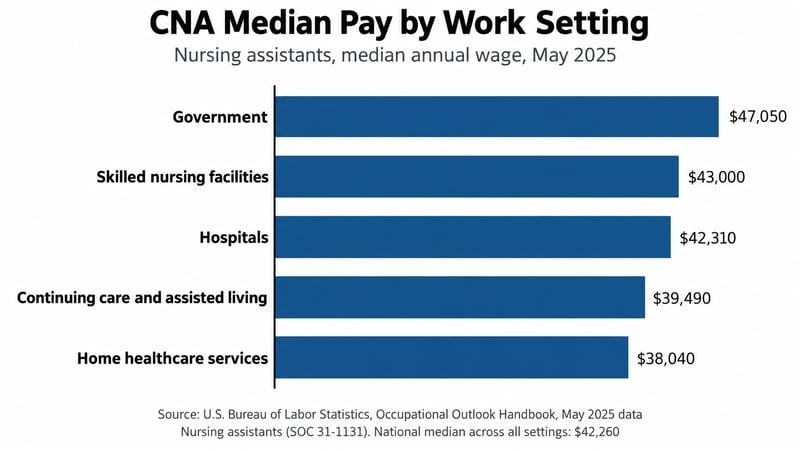
Pay also varies by work setting. Median annual wages for nursing assistants in May 2025:
- Government: $47,050
- Nursing care facilities (skilled nursing facilities): $43,000
- Hospitals: $42,310
- Continuing care retirement communities and assisted living facilities: $39,490
- Home healthcare services: $38,040
BLS projects about 3% employment growth for nursing assistants from 2025 to 2035, with about 196,200 openings a year. Those figures cover nursing assistants only, not orderlies. Most of those openings are projected to come from the need to replace workers who move to other occupations or leave the labor force.