Key Points
- Nursing assistants and orderlies post about 211,800 projected openings a year through 2034, sustained by turnover rather than the field's 2% growth.
- The median wage reached $42,260 a year ($20.32 an hour) in May 2025, with entry positions starting near $33,946.
- Training takes 4 to 12 weeks in most states, and a college degree is not required to start.
- Federal rules bar nursing homes from charging their own trainees and require states to reimburse training costs for nurse aides hired within 12 months at Medicare- or Medicaid-certified facilities.
- The credential ladders directly into LPN and RN roles, where May 2025 median pay reaches $97,550 for registered nurses.
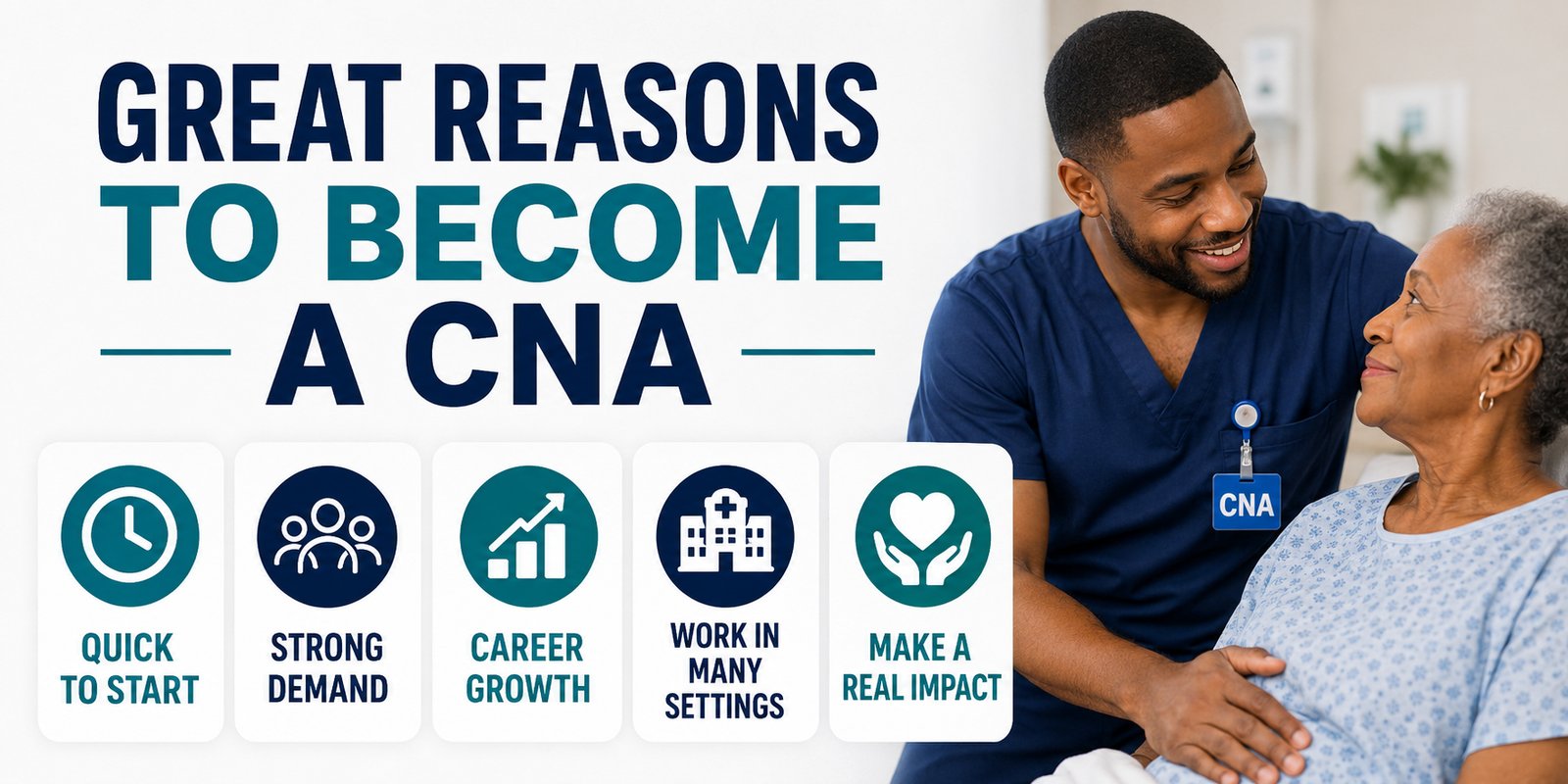
7 Reasons to Become a CNA
1. You Can Start Without a College Degree
CNA training is one of the few healthcare entry points with no degree gate. State-approved programs run 4 to 12 weeks and build on a federal minimum of 75 hours, including supervised clinical work. A high school diploma or GED covers the education requirement at most programs, and some accept eighth-grade reading and math proficiency instead. Passing your state's two-part competency exam places you on its nurse aide registry, the credential employers actually check.
Instead of committing two to four years and tens of thousands of dollars to a degree, you can be working in a healthcare setting within a few months and decide from inside the building whether you want to keep going.
2. About 211,800 Openings a Year, and Why That Number Holds
The Bureau of Labor Statistics projects about 211,800 openings per year for nursing assistants and orderlies through 2034, even though net employment growth is only 2%. Those two numbers look contradictory, and the openings figure is the easiest one in this career to misread.
Growth counts whether the total number of jobs rises. Openings count how many positions need filling each year, including every worker who changes careers, moves up the ladder, or retires. Nursing assistant work is physically demanding, so people move on, and replacement hiring dominates. Nursing assistants hold about 1.44 million of the 1.5 million combined jobs, so the openings are overwhelmingly CNA-shaped rather than orderly positions.
For someone entering the field, it means you are applying into a pool of openings that refills every year, not waiting for an industry to expand.
3. The Credential Ladder Starts Here: LPN, RN, and Beyond
CNA work is the ground floor of a ladder with published rungs. Licensed practical nurses earned a median of $64,400 in May 2025, with state-approved LPN programs typically taking about one year. Registered nurses earned a median of $97,550 as of May 2025, with entry positions near $68,931. CNA-to-LPN and CNA-to-RN bridge programs at community colleges and vocational schools are built specifically on the experience you bank at the bedside.
The common moves from here:
- LPN or LVN credentials, typically about one year of additional training
- RN credentials through an associate or bachelor's nursing program
- Specialty technician roles such as EKG or phlebotomy, often a short certificate
- Supervisory roles in long-term care, which usually ask for an additional credential
4. You Can Pick Your Setting, and Switch It
CNAs work in more settings than almost any other entry-level healthcare role. Per 2024 BLS employment data, nursing care facilities hold 35% of nursing assistant jobs, hospitals 33%, retirement communities and assisted living 11%, home healthcare 5%, and government facilities 3%, with government facilities and hospitals generally paying at the top of the range.
The setting sets the rhythm of the job:
- Nursing care facilities center on long-term residents, where you know the people you care for
- Hospitals run faster, with quicker patient turnover
- Home healthcare is one-on-one care with more schedule control
- Travel CNA contracts often pay above local staff positions, with pay varying by assignment
If a setting wears you down, switching usually means finding an opening in a different building type, not retraining.
5. Federal Rules Can Make Training Free
Free CNA training is not employer generosity. It is federal regulation. Under 42 CFR 483, nursing homes that train their own hires cannot charge them for the program, and states must reimburse training and exam costs for nurse aides hired by a Medicare- or Medicaid-certified facility within 12 months of finishing. Separately, some hospitals and home health agencies run tuition assistance or sponsorship programs in exchange for a work commitment.
Stacked against tuition that already sits near the bottom of healthcare training costs, the realistic worst case is a four-figure investment, and the documented best case is zero. Before paying anything, ask whether the program leads to a state-approved credential, how long any work commitment runs, and whether the hours count toward future nursing credentials.
6. The Work Resists Automation
CNA work is bathing, repositioning, feeding, measuring vital signs, and reporting what you noticed to the nurse. The tasks combine physical handling and judgment about a specific human body on a specific day, which is why direct care has stayed stubbornly human while parts of healthcare administration have not. BLS ties the field's steady demand to the aging population: more people over 65 means more hands-on care, every year, in every state.
The skills travel, too. Patient handling, observation, and plain communication transfer into home health, medical assisting, and nursing without resetting to zero.
7. Shifts Run Around the Clock, Which Cuts Both Ways
Care facilities staff 24 hours a day, so CNA schedules include nights, weekends, and holidays, and most CNAs work full time while some work part time, per BLS work-environment data. That is a real cost if you want every weekend off. It is a real benefit if you are building training, classes, or childcare around work: evening and overnight shifts exist everywhere the job exists, and part-time positions are normal rather than exceptional.
Few entry-level jobs let you choose between a 6 a.m. hospital shift and an overnight in long-term care with the same credential.
How to Answer "Why Do You Want to Be a CNA?"
Interviewers and program essays ask the same question this page answers, and the weak response is an adjective ("I'm passionate about helping people"). The strong response is a specific. Three patterns that hold up:
- The access answer: you want to work in healthcare now, not after four years of school, and you chose the credential that puts you at a bedside in weeks.
- The trajectory answer: you are building toward LPN or RN and want the patient-care hours that prove the goal is informed, not imagined.
- The bedside answer: BLS describes nursing assistants as often the principal caregivers in nursing and residential care facilities, and that amount of patient contact is the job you actually want, not the one you would settle for.
Whichever is true for you, attach one concrete detail: the clinical task you are most curious about, the resident population you want to work with, or the schedule you are building around. "I want the morning vitals round in a memory-care unit, because my grandmother's aides were the people who really knew her" beats a paragraph of adjectives. The qualities that make a successful CNA give you the vocabulary, and if you are still weighing the role itself, read whether CNA is a good job before the interview, not after.
One Job, Several State Titles
The Bureau of Labor Statistics files the role under "Nursing Assistant," and notes that titles vary by state. Most states issue the credential as Certified Nursing Assistant. Ohio calls it State Tested Nursing Assistant, or STNA. The career analysis on this page applies the same way regardless of what your state prints on the certificate; check your state's registry for the exact title and any extra rules.