Radiology Technician Schools in Dallas/Fort Worth: Programs, Costs, and Requirements (2026)

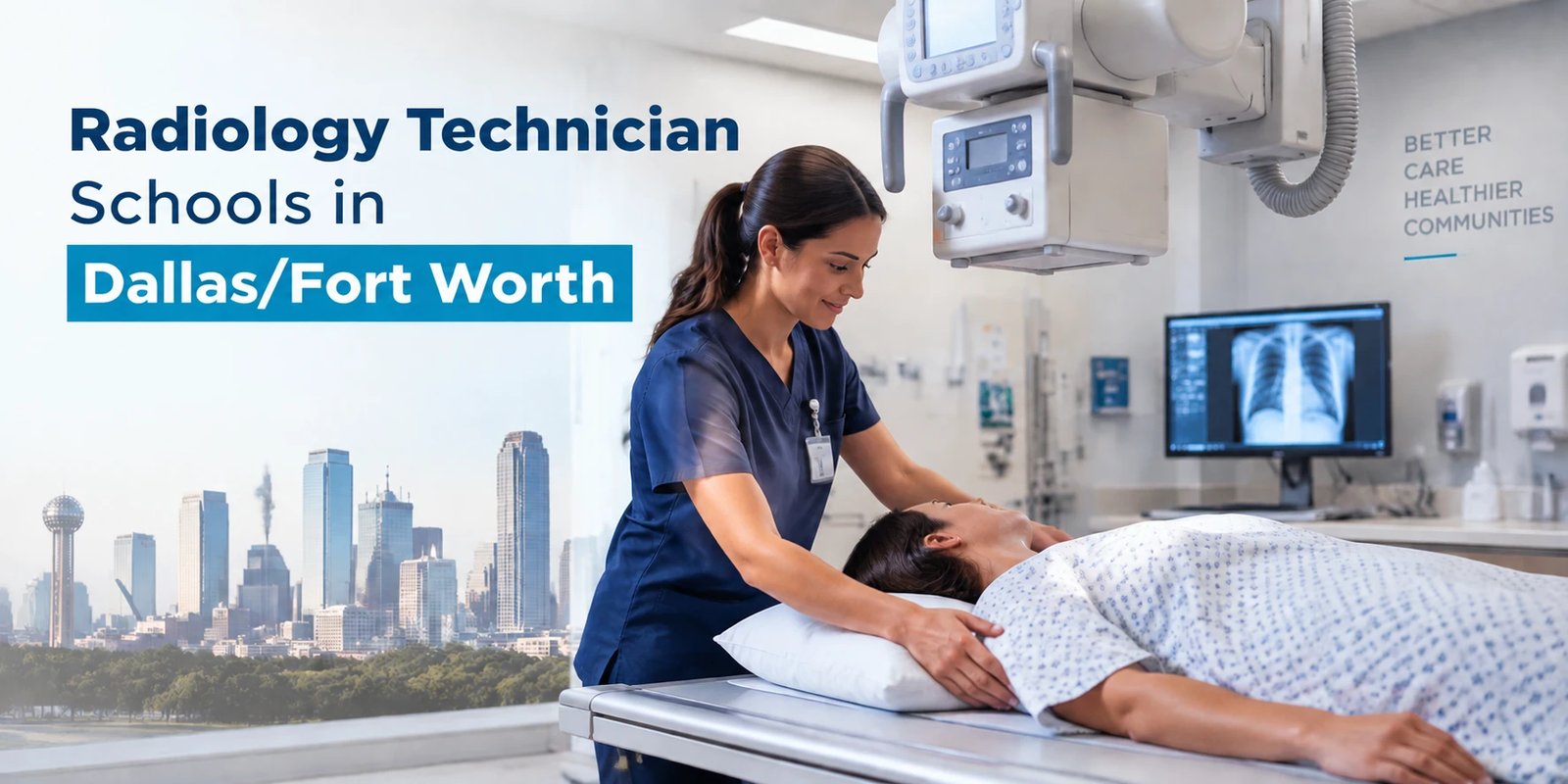
Dallas/Fort Worth has nine radiology technician programs you can apply to now, plus a tenth at Collin College that admits its first class in Spring 2027. Three are public, JRCERT-accredited associate degrees (Dallas College, Tarrant County College, and Weatherford College), four are private associate programs (Concorde, American Career College, Parker University, and Herzing), and two are shorter limited-scope routes (CHCP and CCI Training Center).
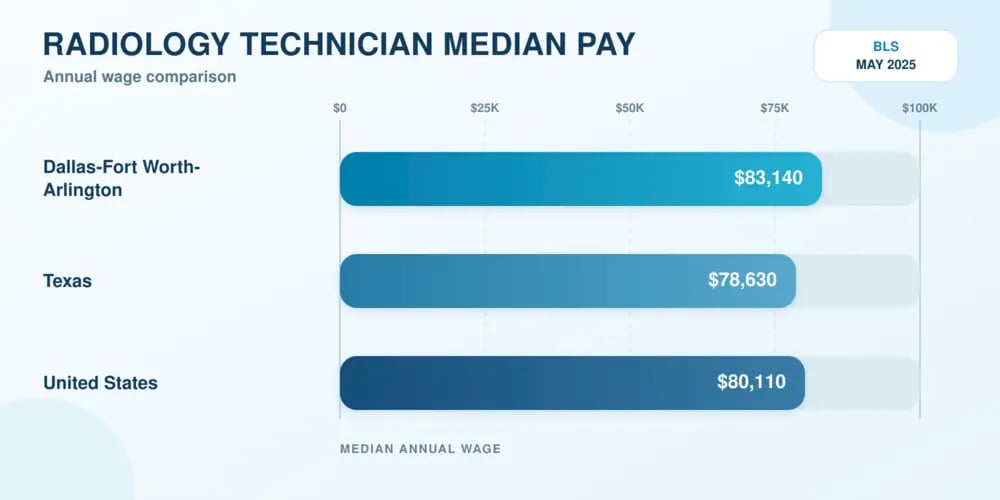
Radiologic technologists in the Dallas-Fort Worth-Arlington metro earned a median $83,140 in May 2025, above the Texas median of $78,630 and the national $80,110, according to BLS wage data.
The program you choose also decides which Texas Medical Board certificate you can hold, general or limited. Dallas College and Tarrant County College publish in-county prices under $6,000 for the full degree, the figure to keep in mind while comparing everything below.
Key Points
- Dallas/Fort Worth has nine radiology technician programs open for applications now, plus Collin College's new associate degree starting in Spring 2027.
- Dallas College and Tarrant County College are JRCERT-accredited public programs with published in-county prices of $5,940 and $4,736 for the full degree.
- Radiologic technologists in the Dallas-Fort Worth-Arlington metro earned a median $83,140 in May 2025, above the Texas and national medians.
- Texas requires a Texas Medical Board certificate: the general certificate needs ARRT certification, and the limited certificate covers x-rays of specific body areas after a shorter program.
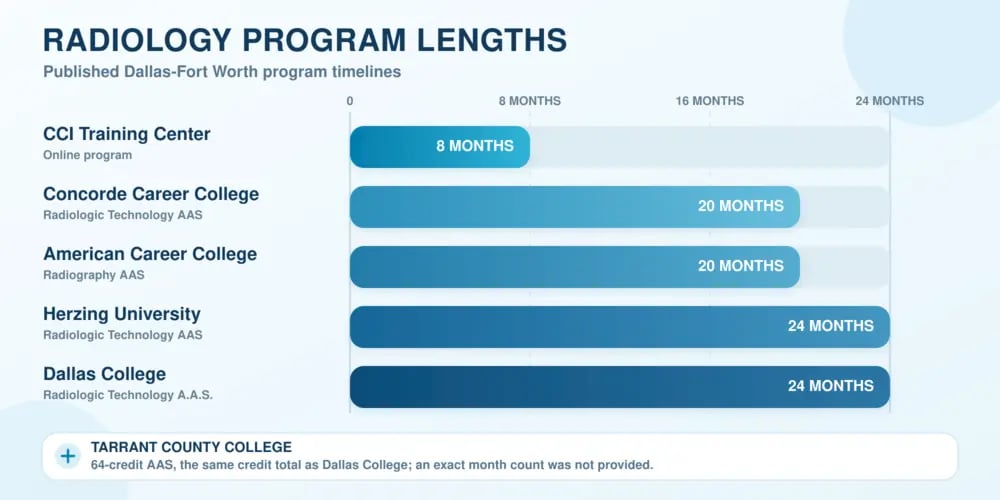
- Associate degree programs take about two years, and CCI Training Center's online limited-scope program takes eight months.
What Is a Radiology Technician?
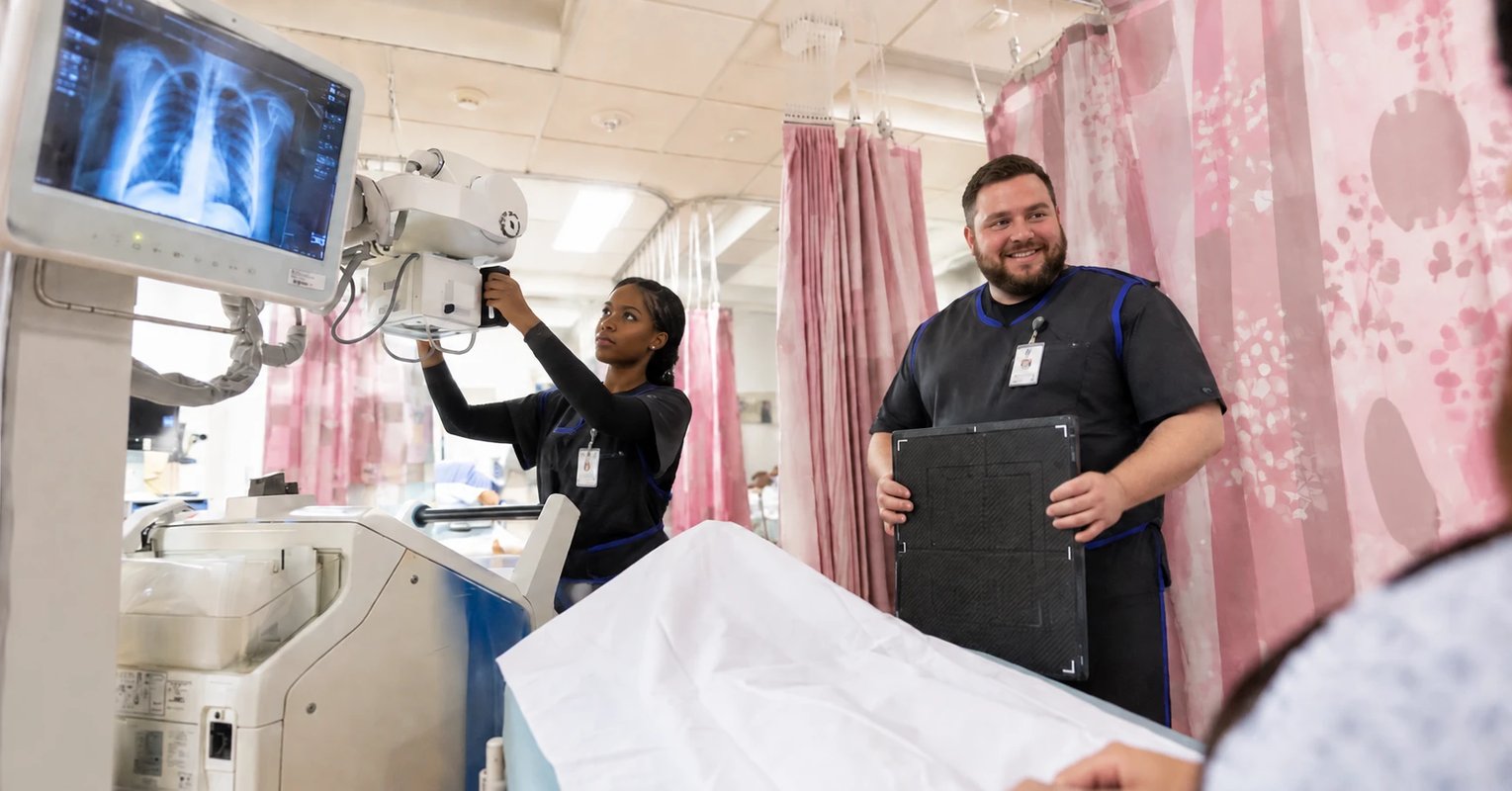
A radiology technician is the everyday name for a radiologic technologist, the healthcare professional who performs x-rays and other diagnostic imaging exams. BLS describes the role as producing the images physicians use to diagnose injury and disease, with specialties in computed tomography (CT) and mammography.
In Texas the license is a Medical Radiologic Technologist certificate and the national credential is the ARRT's R.T.(R), so school pages and job postings use all three names for the same job.
The work is as much patient care as physics. Technologists explain each procedure, position patients so the image captures the right anatomy, shield the body parts that do not need exposure, and check image quality before the radiologist reads it. Accredited coursework covers anatomy, pathology, patient care, radiation physics and protection, and image evaluation, per BLS.
Types of Radiology Technician Programs Available in Dallas/Fort Worth
Three kinds of programs operate in the metro, and they lead to different licenses:
- Associate degree programs: Associate of Applied Science degrees of 64 to 82 credit hours that take about two years. ARRT requires an associate degree or higher plus an ARRT-approved program before the radiography exam, and passing that exam qualifies you for the Texas general certificate. Seven metro schools award this degree to entry-level students.
- Certificate programs: shorter programs that prepare you for the ARRT limited-scope exam and the Texas Limited Medical Radiologic Technologist (LMRT) certificate, which covers x-rays of the chest, spine, extremities, and skull. CCI Training Center's eight-month program is online with local clinical rotations, and CHCP offers an LMRT certificate at its Texas campuses. The guide to online radiology technician classes explains which parts of this training can happen remotely.
- Advanced imaging certificates: post-credential training for technologists who already hold ARRT certification. Dallas College runs advanced technical certificates in CT (8 months, $1,683 in-county), MRI (1 year, $2,079), and vascular interventional technology (1 year, $2,376).
Best Radiology Technician Schools in Dallas/Fort Worth
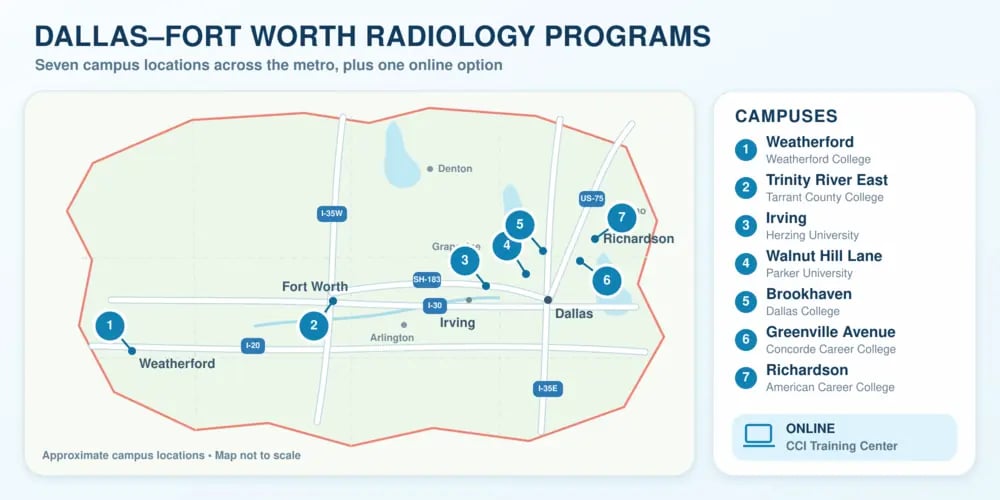
The table compares the metro's programs on what each school publishes: award, length, and campus. The four sections that follow add tuition, prerequisites, and outcomes for the programs with the most published detail.
| School | Program and length | Campus |
|---|---|---|
| Dallas College | Radiologic Technology A.A.S., 64 credit hours, 2 years full time | Brookhaven Campus |
| Tarrant County College | Radiologic Technology AAS, 64 credit hours | Trinity River Campus East, Fort Worth |
| Concorde Career College | Radiologic Technology AAS, 82 credit hours, as few as 20 months | Greenville Avenue, Dallas |
| American Career College | Radiography AAS, as little as 20 months, blended | Richardson |
| CHCP | LMRT certificate and an online AAS completion program for licensed LMRTs, about 64 weeks | Dallas and Fort Worth campuses |
| Parker University | Radiologic Technology AAS, 74 credit hours, evening classes | Walnut Hill Lane, Dallas |
| Herzing University | Radiologic Technology AAS, 76 credits, 24 months, a new start every 8 months | Irving |
| Weatherford College | Radiologic Technology, 64 credits, JRCERT-accredited | Weatherford |
Two more programs sit outside the metro or on next year's calendar. North Central Texas College's JRCERT-accredited associate degree runs on its Gainesville campus and requires a TEAS score of at least 70%. Collin College's Radiologic Technology AAS is new: 64 credit hours over 112 weeks, a first cohort expected in Spring 2027, applications in Fall 2026, approval pending with SACSCOC, and JRCERT accreditation planned.
Dallas College Radiologic Technology Program
Dallas College publishes more outcome data than any other program on this page. Its Radiologic Technology A.A.S. is a minimum of 64 semester credit hours, takes two years for full-time students, runs at the Brookhaven Campus, and holds JRCERT accreditation with a current eight-year award. Dallas College's radiologic sciences page reports five-year averages of a 93% credentialing exam pass rate (231 of 248 graduates), 97% job placement, and 80% completion.
Admission runs on the program's own timeline. Applicants finish five prerequisite courses first (Composition I, College Algebra, Anatomy and Physiology I, Introduction to Radiography, and Radiographic Imaging Equipment) with a 2.75 GPA or higher and a B or higher in Anatomy and Physiology I. They then watch an online information session and submit the application packet during the filing period.
The program requires a criminal background check and drug testing. Estimated tuition is $5,940 for in-county residents.
Concorde Career College Dallas Radiologic Technology Program
Concorde's Dallas campus at 12606 Greenville Avenue offers an Associate of Applied Science in Radiologic Technology on a compressed schedule. The program is 82 credit hours with 120 lab hours and 1,400 clinical hours over 80 instructional weeks, or as few as 20 months of full-time study. The Concorde Dallas program page states that graduates are prepared to take the ARRT examination and become Registered Technologists in Radiography.
The campus holds institutional accreditation from the Accrediting Commission of Career Schools and Colleges (ACCSC), one of the agencies on ARRT's recognized list. Program tuition appears in the campus catalog.
American Career College Dallas-Fort Worth Radiography Program
American Career College's Radiography program is in Richardson, at 2323 N Central Expressway. It awards an Associate of Applied Science in as little as 20 months, uses a blended format that mixes on-campus and online coursework, and includes more than 1,000 hours of clinical experience.
The American Career College Richardson page lists ARRT certification prep among the program's features and says financial aid and scholarships are available for those who qualify. The college is institutionally accredited by the Accrediting Bureau of Health Education Schools (ABHES), which also appears on ARRT's list of recognized accreditors.
Tarrant County College Radiologic Technology Program
Tarrant County College's Radiologic Technology AAS is Fort Worth's public program, based at the Trinity River Campus East. The degree is 64 credit hours and JRCERT-accredited, and the TCC radiologic technology page lists total 2026-27 in-county tuition and fees of $4,736, excluding textbooks and other materials, the lowest published price on this page.
Admission is selective and separate from TCC admission: you are accepted to the college first, complete prerequisites in anatomy and physiology, medical terminology, and pathophysiology, then apply to the program. TCC reports completion and certification exam pass rates above the national average, and clinicals require travel to hospitals and imaging centers.
Students can also take Midwestern State University's Bachelor of Science in Radiologic Science courses at the same time.
Radiology Technician Programs on Dreambound
Dreambound lists training programs from schools it partners with, with the format and length on each listing, so you can compare the option below against the campus programs above in one place.
Radiology Technician Training - CCI Training Center
- Format: an 8-month certificate program that blends online education with practical clinical training, listed as Online (Arlington, TX).
- Four months of interactive online instruction with live lectures and simulations, then four months of clinical rotations.
- Graduates are eligible to pursue ARRT Limited Scope certification, the school holds ACCET national accreditation recognized by the U.S. Department of Education, and the coursework covers radiation safety, patient positioning, digital imaging, and medical terminology.
Dreambound's page for radiology technician classes in Dallas/Fort Worth collects every radiology listing for the metro in one place, with the limited-versus-general license question answered alongside the programs.
Admission Requirements for Radiology Tech Programs in Dallas
Every program in the metro starts from the same four requirements, and the public colleges add competitive cutoffs on top:
- High school diploma or GED: the baseline at every school, and the first document Herzing and CHCP list.
- Prerequisites: Dallas College requires five specific courses with a 2.75 GPA and a B in Anatomy and Physiology I, and Tarrant County College requires anatomy and physiology, medical terminology, and pathophysiology before the program application. Herzing accepts prior ACT or SAT scores or college credit in place of its entrance test.
- Background check: Dallas College requires a criminal background check and drug testing, and ARRT reviews ethics questions on every application, so CHCP tells applicants with a criminal record to read ARRT's rules first.
- Health requirements: Herzing lists drug testing, immunizations, and health checks because students have patient contact. CHCP's completion program requires proof of immunizations, health insurance, a negative drug screen, BLS certification, and the vision, motor, and communication abilities the job demands.
Licensing comes after graduation. Texas rule 22 TAC 186.12 makes current ARRT certification (or NMTCB certification in nuclear medicine) the qualification for the general certificate. ARRT's eligibility requirements for radiography are an associate degree or higher, an ARRT-approved program, and an ethics review before the exam.
The Texas Medical Board's LMRT page covers the shorter route: an approved limited program, the ARRT-administered limited-scope exam with a passing score of 75%, and fingerprints. The state guide to becoming a radiology technician in Texas puts those steps in order.
How Long Does Radiology Technician School Take in Dallas?
- Associate degree: two years of full-time study at Dallas College, whose 64-credit degree matches TCC's, as few as 20 months at Concorde and American Career College, and 24 months at Herzing. Dallas College and TCC also require a prerequisite semester or more before you can apply.
- Certificate: eight months at CCI Training Center, split into four months online and four months of clinical rotations. CHCP's completion program takes licensed LMRTs to the associate degree in about 64 weeks.
- Advanced certifications: eight months for Dallas College's CT certificate and one year each for its MRI and vascular interventional certificates, all open only to ARRT-certified technologists.
The ARRT exam and the Texas certificate add a few months after graduation, and ARRT gives graduates three years from program completion to establish eligibility and apply. The national guide to how long radiology technician training takes compares those timelines.
How Much Does Radiology Tech School Cost in Dallas?
- Tuition: Dallas College and Tarrant County College publish the lowest figures on this page, $4,736 in tuition and fees for the full TCC degree in 2026-27 and an estimated $5,940 in tuition at Dallas College, both at in-county rates. Dallas College's advanced certificates run $1,683 to $2,376, and the private colleges publish tuition in their catalogs.
- Fees beyond tuition: TCC's figure excludes textbooks, Dallas College's is an estimate, and items such as the background check, drug screening, immunizations, and BLS certification that programs require sit outside the tuition line.
- Certification expenses: ARRT charges a $225 application fee for the radiography exam, the Texas general certificate costs $130 including the jurisprudence exam, and the limited certificate costs $80 plus $38.50 for fingerprinting.
- Financial aid: federal student aid is available at participating schools accredited by an agency the U.S. Department of Education recognizes, and American Career College and CHCP both state that aid is available for those who qualify.
Radiology Tech Salary in Dallas, TX
Radiologic technologists in the Dallas-Fort Worth-Arlington metro earned a median $83,140 in May 2025, according to BLS wage data for Texas, which puts the metro $4,510 above the state median and second only to Austin among the large Texas metros.
| Area | Median annual wage, May 2025 |
|---|---|
| Dallas-Fort Worth-Arlington | $83,140 |
| Austin-Round Rock-San Marcos | $83,870 |
| Houston-Pasadena-The Woodlands | $80,780 |
| Texas | $78,630 |
| United States | $80,110 |
Nationally, the lowest 10% of radiologic technologists earned less than $55,980 and the highest 10% more than $118,660. The setting moves the number: federal government jobs paid a median $97,490, outpatient care centers $84,720, and hospitals $80,650. MRI technologists, a separate BLS occupation, earned a median $95,480, the clearest case for Dallas College's advanced certificates once you hold the ARRT credential.
Radiology Tech Jobs and Career Opportunities in Dallas
BLS projects employment of radiologic and MRI technologists to grow 5% from 2025 to 2035, faster than the average for all occupations, with about 15,300 openings a year nationally. BLS ties the demand to an older population, more chronic disease, and the x-rays and CT scans that follow falls.
Texas projections published through O*NET show 18% growth from 2024 to 2034, from 18,990 to 22,360 jobs, with about 1,390 openings a year.
Hospitals employ 60% of radiologic technologists nationally, with physician offices at 17% and outpatient centers and diagnostic labs at 7% each. In Dallas/Fort Worth that means imaging departments across systems such as UT Southwestern Medical Center, Parkland Health, Baylor Scott & White Health, Texas Health Resources, Medical City Healthcare, and JPS Health Network, along with the outpatient imaging centers around them.
How to Choose the Right Radiology Technician School in Dallas/Fort Worth
- Accreditation: confirm the program is JRCERT-accredited or that the school's institutional accreditor (ACCSC, ABHES, SACSCOC, and HLC all qualify) appears on ARRT's recognized list, since ARRT eligibility unlocks the Texas general certificate. Collin College's program is still pending both approvals.
- Clinical training: compare hours and sites. Concorde lists 1,400 clinical hours, American Career College more than 1,000, CHCP's completion program 768, and Parker six months of rotations across DFW healthcare sites.
- Certification preparation: ask for first-attempt ARRT pass rates. Dallas College publishes a 93% five-year credentialing pass rate, TCC states its rates are above the national average, and CHCP ends its completion program with a registry review course.
- Cost comparison: Dallas College and TCC publish under $6,000 for the whole degree, so a private program's catalog price should buy something specific, such as a faster start, evening classes at Parker, or Herzing's new cohort every eight months.
Frequently Asked Questions
Is there a rad tech school in Dallas?
Yes, and several. Dallas College's Brookhaven Campus, Concorde on Greenville Avenue, and Parker University on Walnut Hill Lane are inside Dallas, American Career College is in Richardson, and Herzing is in Irving, all awarding an associate degree. CHCP adds a limited-scope certificate, and Dallas College and Tarrant County College are the metro's JRCERT-accredited public programs.
Are there any radiology tech programs available in Fort Worth, Texas?
Yes. Tarrant County College's Radiologic Technology AAS at the Trinity River Campus East is Fort Worth's JRCERT-accredited public program, with published 2026-27 in-county tuition and fees of $4,736. CHCP has a Fort Worth campus, and Weatherford College's JRCERT-accredited associate degree sits west of the city for students on that side of the metro.
How long is the radiology tech program at Dallas College?
Two years for full-time students, covering a minimum of 64 semester credit hours at the Brookhaven Campus. Five prerequisite courses, including Anatomy and Physiology I and College Algebra, come before the application, so plan on at least one extra semester. Dallas College also offers an eight-month CT certificate and one-year MRI and vascular certificates for ARRT technologists.
How long does it take to become a radiology technician in Texas?
About two years for the associate degree most Texas programs award, followed by the ARRT radiography exam and a Texas Medical Board general certificate application. The limited-scope path is shorter: CCI Training Center's online program takes eight months and leads to the ARRT limited-scope exam and the Texas limited certificate, which covers x-rays of specific body areas.
Does Collin College have a radiology tech program?
Not yet, but one is scheduled. Collin College's Radiologic Technology Associate of Applied Science lists a first cohort in Spring 2027, applications in Fall 2026, and 64 credit hours over 112 weeks, with SACSCOC approval pending and JRCERT accreditation planned. Until it opens, Dallas College's Brookhaven Campus and North Central Texas College in Gainesville are the nearest public programs.
Start Your Radiology Career in Dallas/Fort Worth
If you are comparing schools for the first time, start with the two public programs. Dallas College and Tarrant County College publish their prices and prerequisites, and Dallas College publishes a 93% pass rate, which makes them the yardstick every private program has to beat on speed or schedule.
If you need to be working sooner, the eight-month limited-scope route through CCI Training Center gets you into x-ray work first, and CHCP's completion program keeps the path to the full credential open afterward. If you already hold the ARRT credential, Dallas College's CT and MRI certificates are the metro's published route toward the $95,480 median that MRI technologists earn.
Whichever path fits, apply the same three checks: accreditation ARRT recognizes, clinical hours you can see in writing, and a published price. Dreambound's listings carry the format and length for each partnered program, so that comparison takes minutes.