Radiology vs. Sonography: Which Imaging Career Is Right for You?

See if you qualify for Radiology Technician programs
Answer a few questions in 2 minutes. Free, no commitment.
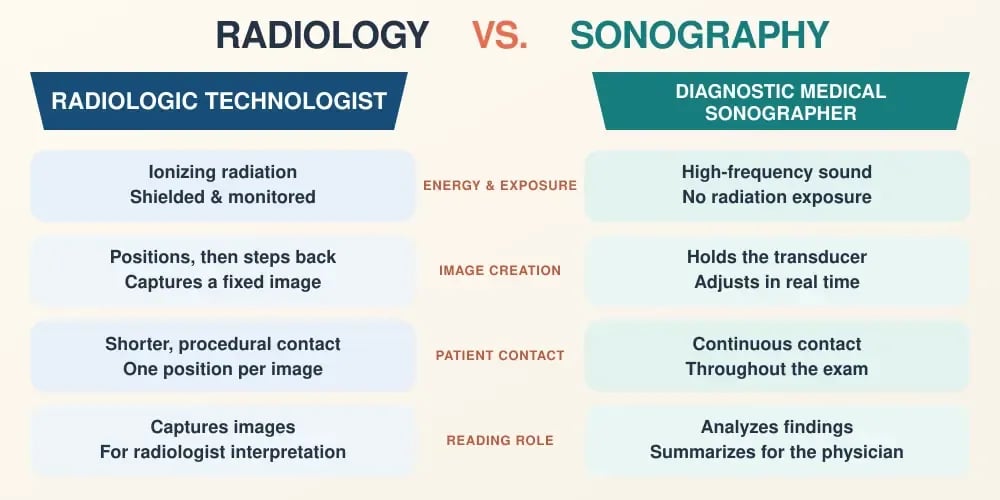
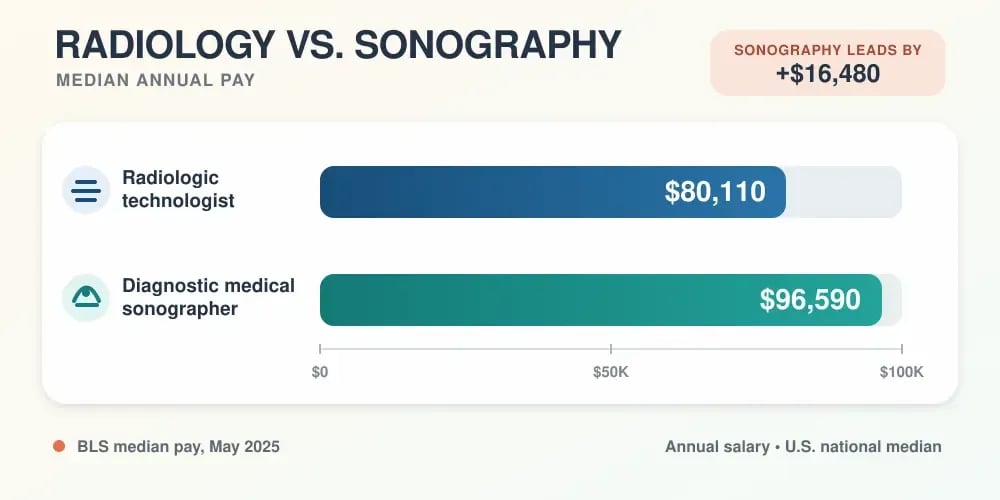
Choosing between radiology and sonography comes down to three things: the energy that makes the image, the way you spend an exam, and the pay. Radiologic technologists use ionizing radiation, X-ray and CT, to capture fixed images, then step back while a radiologist reads them. Diagnostic medical sonographers use high-frequency sound waves, hold the transducer through the whole exam, and adjust the picture in real time. Both typically start with an associate degree and a national certification exam. The pay is not a tie: sonographers earned a median $96,590 in May 2025 against $80,110 for radiologic technologists, according to the BLS. The sections below compare the training, daily work, certification, and salary side by side so the choice rests on facts rather than a job title.
Medical Radiography - Associate's - ECPI University Northern Virginia (Manassas)
- Format: Hybrid
- Length: as little as 18 months
- JRCERT-accredited, and graduates are eligible for the ARRT exam
Associate of Science in Medical Radiography - MCI Newport News
- Format: Hybrid
Radiology Technician Training - CCI Training Center
- Format: Hybrid
- Length: 8 months (4 months online, 4 months clinical)
- Prepares graduates to pursue ARRT Limited Scope certification, not the full radiologic technologist registry
Sonography
AOS in Cardiovascular Sonography - Institute for Business and Technology
- Format: Hybrid
- Length: as few as 24 months
- Prepares graduates for Cardiovascular Credentialing International and ARDMS exams (RCS, RVS, RDCS)
Associate of Applied Science in Diagnostic Medical Sonography - ECPI University Orlando (Lake Mary)
- Format: Hybrid
Associate of Applied Science in Diagnostic Medical Sonography - MCI Richmond West (Emerywood)
- Format: Hybrid
- Reduced-cost ARDMS exam vouchers for SPI, Abdomen, and OB/GYN
Frequently Asked Questions
Does sonography pay more than radiology?
Yes, at the national median. Diagnostic medical sonographers earned $96,590 in May 2025 and radiologic technologists $80,110, a gap of about $16,500, according to the BLS. The radiology-side exception is MRI: MRI technologists earned $95,480, so a radiologic technologist who adds the MRI credential lands within about $1,100 of a sonographer.
Is sonography or radiology tech school harder?
Both are associate-degree programs, so the length is similar. The difference is what gets tested. ARRT requires one certification exam after an approved program, while ARDMS requires a physics exam plus a specialty exam within five years, and scanning is a motor skill graded live. Which feels harder depends on whether physics or hands-on scanning is your weaker side.
Can a radiologic technologist become a sonographer?
Yes, by two routes. ARRT-registered technologists can add breast or vascular sonography as ARRT postprimary sonography credentials with structured education and documented clinical experience. Under ARRT, general sonography is a primary discipline, so it requires completing an approved sonography program, and certificate programs built for credentialed healthcare workers shorten that path compared with a second degree.
Does radiology involve more radiation exposure risk than sonography?
Yes. Sonography uses sound waves and involves no ionizing radiation. Radiologic technologists work with X-ray and CT, so their exposure is monitored and capped. Federal occupational dose limits hold an adult worker's total effective dose to 5 rems (0.05 sieverts) a year, and shielding, distance, and exposure settings are designed to keep a technologist's dose below that ceiling.
Which career has a better job outlook, radiology or sonography?
Sonography on growth rate, radiology on openings. The BLS projects 14% growth for diagnostic medical sonographers from 2025 to 2035, much faster than average, with about 6,000 openings a year. Radiologic and MRI technologists are projected to grow 5%, faster than average, but the larger field produces about 15,300 openings a year.
Why do people quit sonography?
The reason that appears in federal safety guidance is injury. NIOSH's guidance on musculoskeletal disorders in sonography describes tendonitis, bursitis, muscle strains, and nerve damage in the arms, neck, and back from sustained transducer pressure and static, awkward postures, and OSHA lists sonographers as an at-risk group. Adjustable tables, alternating scanning hands, and rotating exam types are the recommended controls.
Choosing Between Radiology and Sonography
Neither field is the better one, because they answer different questions. Radiology suits people who want a procedural role with radiation protocols as a daily discipline and the deepest bench of add-on credentials. Sonography suits people who want to find the image themselves, stay with patients through the exam, and earn a higher median from the first job.
Salary is a real difference at about $16,500 a year, but the work style is what you live with every shift. Compare the Dreambound programs above by field and length, and pick the exam room you want to stand in.