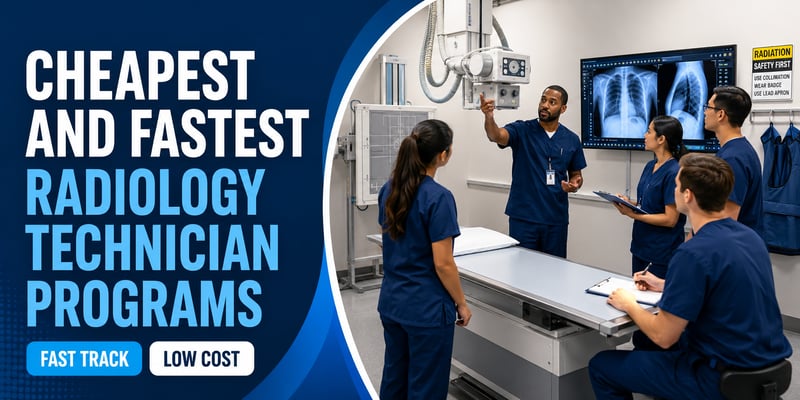
Cheapest and Fastest Radiology Technician Programs (2026)
See if you qualify for Radiology Technician programs
Answer a few questions in 2 minutes. Free, no commitment.
The fastest verified path to becoming a radiology technician is an 8-month limited-scope certificate, while the most complete path is an accredited associate degree that takes about 18 to 24 months and qualifies you for full ARRT certification. The two routes lead to different credentials and different careers, so the right pick depends on how fast you need to work and which jobs you want to qualify for. The cheapest sticker price is not always the best value once start dates and waitlists are factored in. Radiology technicians earn a median annual wage of $77,660 (BLS, May 2024), and the path you choose decides how soon you start earning it.
Stage 4: The Hidden Time Cost
- A lower sticker price loses value fast if you wait a year or more for a seat. Every six months on a waitlist is roughly half a year of a radiology technician's salary in income you never earned. A program that starts now and costs more upfront often pays for itself by getting you working sooner.
The smartest move is to compare programs side by side on Dreambound by start date, length, and total cost, so you can weigh price against how quickly you can begin earning.
Financial Aid and Scholarships for Radiology Programs
Several funding options can lower your out-of-pocket cost.
- Federal aid (FAFSA): Complete the FAFSA to apply for Pell Grants and federal loans at Title IV-eligible institutions, primarily associate degree programs.
- State workforce programs: Many states offer workforce-development grants and tuition waivers for in-demand healthcare training.
- Scholarships: The American Society of Radiologic Technologists and local hospital foundations offer awards to enrolled students.
- Employer tuition assistance: Some hospitals help cover training costs for current employees who commit to working after credentialing. See how to ask your employer to pay for your education for an approach that works.
- Payment plans: Many programs offer monthly payment options that lower the upfront cost.
For a step-by-step look at federal and state options, see Dreambound's guide to government funding for education.
Radiology Technician Salary and Job Outlook
The BLS reports a median annual wage of $77,660 for radiologic technologists and technicians as of May 2024, or about $37.34 per hour. The lowest 10% earned less than $52,360, while the top 10% earned more than $104,970, with the highest pay concentrated in high-cost states like California.
BLS projects about 4% employment growth from 2024 to 2034 for radiologic technologists and technicians, with thousands of openings each year driven by an aging population and growing use of diagnostic imaging. The role itself is hands-on and patient-facing: you position patients, operate imaging equipment, and work alongside radiologists and nurses, usually on a predictable full-time schedule. Entry-level x-ray work is also a launch point, not a ceiling. With added credentials in CT, MRI (median $88,180), or mammography, you can move into higher-paying specialties or step up to lead technologist and supervisory roles, which is one more reason the sooner you finish training, the sooner you can start building toward them.
Frequently Asked Questions
What is the fastest way to become a radiology technician?
The fastest way is an accredited limited-scope certificate program, which can be completed in about 8 months and prepares you for ARRT Limited Scope certification. This path qualifies you for focused x-ray roles. If you want the full R.T.(R) credential and the widest range of jobs, an accredited associate degree (about 18 to 24 months) is the standard route. You can compare both on Dreambound by start date and length.
How fast can you become a radiology technician?
A limited-scope certificate can take as little as 8 months, including clinical rotations. A full accredited associate degree typically takes 18 to 24 months. Start dates matter as much as program length, so a program with regular intakes can get you working sooner than a cheaper option with a long waitlist.
What's the easiest radiology program to get into?
Open-enrollment certificate and accelerated programs are generally the easiest to enter because they have rolling start dates and fewer prerequisites. Community college programs are often harder to get into because limited seats create competition and waitlists. Whichever you choose, confirm the program is accredited (JRCERT for a degree, or state-approved for limited scope) before enrolling.
What is the cheapest way to become a radiologist?
A radiologist is a medical doctor who completes a bachelor's degree, medical school, and a multi-year residency, which takes 13 years or more. That is different from a radiology technician (radiologic technologist), who operates imaging equipment and can train in 8 months to 2 years. If your goal is the technician role, compare accredited certificate and associate degree programs on Dreambound to find the best mix of cost, start date, and credential.
Choosing Your Radiology Technician Program
The fastest path is a limited-scope certificate (about 8 months), which works well if your state recognizes limited-scope operators and you want to start quickly. The most complete path is an accredited associate degree (about 18 to 24 months) that qualifies you for full ARRT certification and the widest range of imaging careers.
Accreditation and start date are the deciding factors. Compare radiology technician programs on Dreambound by format, length, total cost, and how soon you can begin, so you can start earning without paying for delays you do not need.