What Is an Orthodontic Assistant? Duties, Salary, and How to Become One
See if you qualify for training programs
Answer a few questions in 2 minutes. Free, no commitment.
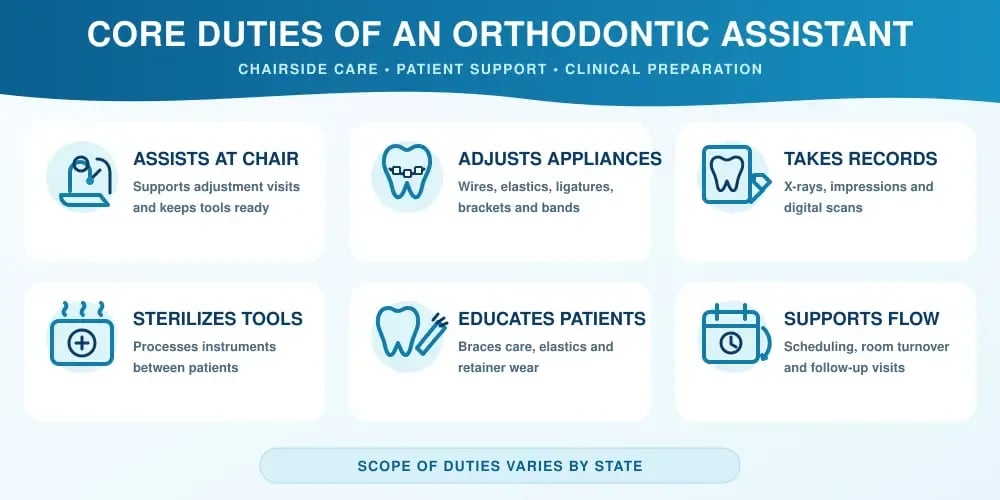
An orthodontic assistant is a dental assistant who works specifically alongside an orthodontist, supporting patients through braces, clear aligners, and other treatment that straightens teeth and corrects the bite. It is a more specialized role than general dental assisting, built around the repeat adjustment visits that orthodontic treatment requires rather than the fillings, cleanings, and exams of a general practice.
Many orthodontic assistants start out as dental assistants and learn the wire and bracket work on the job, though a few states now issue their own orthodontic assistant permit. The sections below cover what the role involves day to day, how it differs from general dental assisting, certification, and pay.
How Much Does an Orthodontic Assistant Make?
Because BLS does not separate orthodontic assistants from other dental assistants, the government figure for the job is the dental assistant median: $48,070 a year, or $23.11 an hour, as of May 2025. The lowest-paid 10% earned under $37,130 and the highest-paid 10% earned more than $62,250, and employment is projected to grow 7% from 2025 to 2035, with about 53,000 openings a year.
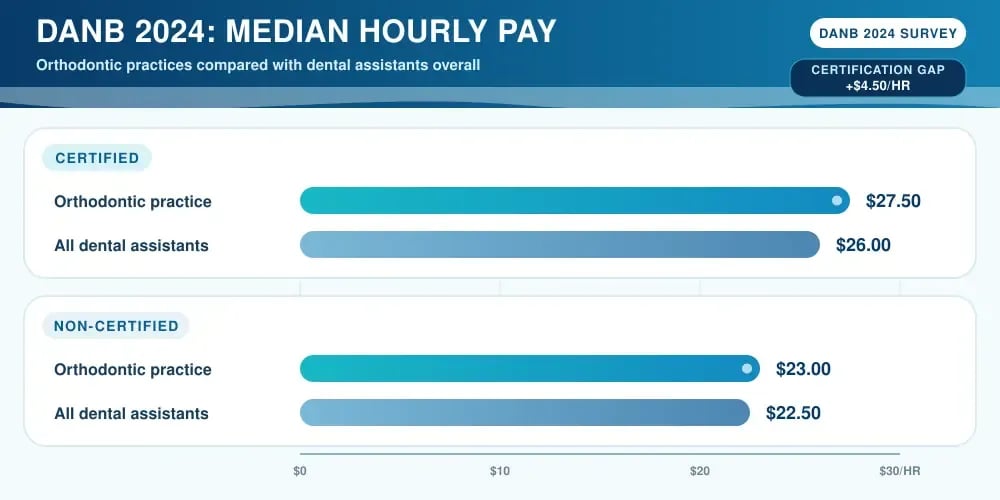
The one source that does separate the two roles is DANB's 2024 Dental Assistants Salary and Satisfaction Survey, and it shows a small premium for orthodontics. Certified assistants in orthodontic practices reported a median of $27.50 an hour, compared with $26.00 for certified dental assistants overall, and non-certified orthodontic assistants reported $23.00 against $22.50.
Both gaps are modest, so the fair description of orthodontic assistant pay is comparable to or slightly above general dental assisting.
Three things move an individual figure more than the specialty does. Experience shows up in the $25,000 spread between the 10th and 90th percentiles, and geographic market shows up in Florida, where the same dental assistant job pays a median of $57,260 in Naples and $46,480 in Orlando.
Certification matters most of all, because the DANB survey puts the certified-to-non-certified gap inside orthodontics at $4.50 an hour, three times the $1.50 orthodontic premium for certified assistants.
Skills Needed to Succeed as an Orthodontic Assistant
The technical bar is manual dexterity and attention to detail, because the hardware is small. Ligatures are tied one tooth at a time, brackets are positioned to the millimeter, and an archwire seated slightly wrong shows up as a sore spot a week later.
The second bar is communication. Many orthodontic patients are children and teens, and the American Association of Orthodontists reports that one in three is an adult, so an assistant may coach a nervous 12-year-old and a busy professional in the same afternoon. Treatment spans months to years, so the rapport built at the first visit has to last.
The third is comfort with repetitive, precision-focused chairside work. Adjustment days are a steady sequence of short, similar appointments, and the assistants who stay in orthodontics are the ones who find that pace satisfying rather than monotonous.
Frequently Asked Questions
Do you need to be a dental assistant before becoming an orthodontic assistant?
No state requires it, but it is the most common route because the infection control, radiography, and chairside basics carry over. DANB's COA experience pathway needs only a high school diploma plus 3,500 hours of orthodontic assisting, and New Jersey accepts two years under an orthodontist in place of a dental assisting program.
Do orthodontic assistants get paid more than dental assistants?
Slightly, according to DANB's 2024 salary survey. Certified assistants in orthodontic practices reported a median of $27.50 an hour against $26.00 for certified dental assistants overall, and non-certified orthodontic assistants reported $23.00 against $22.50. BLS does not separate the two roles, so its $48,070 median covers both.
How much does an orthodontic assistant make in Florida?
Florida does not report orthodontic assistant pay separately, so the closest figure is the state's dental assistant median of $47,620 a year, or $22.89 an hour, per BLS data for 2025. Pay runs higher in Naples-Marco Island at $57,260 and Jacksonville at $50,270, and near the state median in the Miami, Tampa, and Orlando metros.
How long does orthodontic-specific training take once hired?
Plan on months rather than weeks before you handle wires and brackets on your own, since the timeline depends on the practice and, in regulated states, on the board. DANB's COA experience pathway calls for 3,500 hours over at least two years, and Oregon requires sign-off on 10 archwire placements and four debonds.
Do you need a degree to be an orthodontic assistant?
No. A high school diploma or equivalent is the baseline, and the usual credential is a dental assisting certificate or diploma from a program of about a year, or on-the-job training in a state that allows it. An associate degree is optional, and the credentials tied to the role are DANB's COA and, in a few states, a permit.
Is Orthodontic Assisting Your Next Step?
Orthodontic assisting is a specialized branch of dental assisting, and most of the specialization is learned at the chair rather than in a classroom. That makes it a natural next step for a dental assistant who wants to focus on one kind of treatment.
Certification through DANB's COA is available to strengthen your qualifications, and in California, New Jersey, Oregon, and Maryland the state credential is part of the job rather than an extra.
If the role fits, the first decision is the dental assisting program that gets you into a practice, and Dreambound's dental assistant listings let you weigh a short certificate against a longer diploma before you commit.