Key Points
- Certificate and diploma programs: a few months to about 1 year, with 2-year associate degree programs less common.
- An on-the-job training path exists in states with no formal education requirement, similar to the path into medical assisting.
- In Texas, an X-ray certificate requires a course and exam; in Florida, assistants trained on the job need at least 3 months of supervised training plus a course.
- The CDA requires passing three component exams within five years.
Certificate/Diploma Program Timeline
A certificate or diploma program is the formal school route. According to the Bureau of Labor Statistics, "Many dental assisting programs take about 1 year to complete and lead to a certificate or diploma." Community colleges offer them, and vocational and technical schools may also offer them.
Some schools offer shorter certificate programs that run a few months. Compare the listed hours or months before choosing. Associate degree programs take about 2 years and, per BLS, are less common.
Accredited programs combine classroom and laboratory work. Students study the teeth, gums, and jaws, and the instruments dentists use. Graduating from a program accredited by the Commission on Dental Accreditation (CODA) also meets the education requirement for DANB's Pathway I route to the CDA exam.
The guide to the cheapest and fastest dental assistant programs compares dental assistant program cost alongside program length. Dreambound lets you filter dental assisting programs by length, format, and location.
On-the-Job Training Path (state dependent)
Not every state requires formal training. The Bureau of Labor Statistics notes that "In other states, there are no formal educational requirements, and dental assistants learn through on-the-job training." In those states, a dentist, dental hygienist, or experienced dental assistant teaches a new hire dental terminology, instrument names, daily tasks, and patient interaction.
This path works much like the one into medical assisting, where people without postsecondary education may learn their skills on the job. The medical assistant timeline follows a similar split between program and on-the-job routes.
BLS publishes no set length for on-the-job training. Other states require dental assistants to graduate from an accredited program and pass an exam, so check your state dental board's rules before choosing this route.
How Long Does X-Ray/Radiography Certification Add?
BLS notes that states may require assistants to meet specific licensing requirements to work in radiography (X-ray). In the two examples below, the added time depends on each state's rules and how you trained.
- Texas: The Texas State Board of Dental Examiners requires a Dental Assistant Radiology Certificate to position or expose dental X-rays. Applicants complete a course and exam through a board-approved provider (or hold current DANB certification), a hands-on basic life support course, and a fingerprint background check.
- Florida: Under Florida Administrative Code rule 64B5-9.011, graduates of a board-approved dental assisting program may take X-rays without a separate credential. Assistants trained on the job must complete at least 3 months of continuous on-the-job training under the direct supervision of a Florida licensed dentist, then finish a board-approved course within 12 months to be certified as dental radiographers.
In Florida, graduating from a board-approved program satisfies the X-ray requirement with no added time, while the on-the-job route adds at least 3 months plus a course.
CDA Certification Timeline
The Certified Dental Assistant credential is issued by the Dental Assisting National Board (DANB). The CDA exam combines three component exams: Radiation Health and Safety (RHS), Infection Control (ICE), and General Chairside Assisting (GC). Taken together, it runs 195 minutes and 245 questions.
How soon you can sit for it depends on your eligibility pathway:
- Pathway I: graduation from a CODA-accredited dental assisting or dental hygiene program, plus current hands-on CPR, BLS, or ACLS. Candidates who expect to graduate within 90 days can apply for the GC exam using DANB's Intent to Graduate Form.
- Pathway II: a high school diploma or equivalent, at least 3,500 hours of approved work experience, plus current hands-on CPR, BLS, or ACLS. At 40 hours a week, 3,500 hours equals about 20 months of full-time work.
Candidates can take the three exams at once or one at a time. DANB's certification roadmap states that you need to pass the component exams within five years.
Total Realistic Timeline
Adding the steps together gives these ranges:
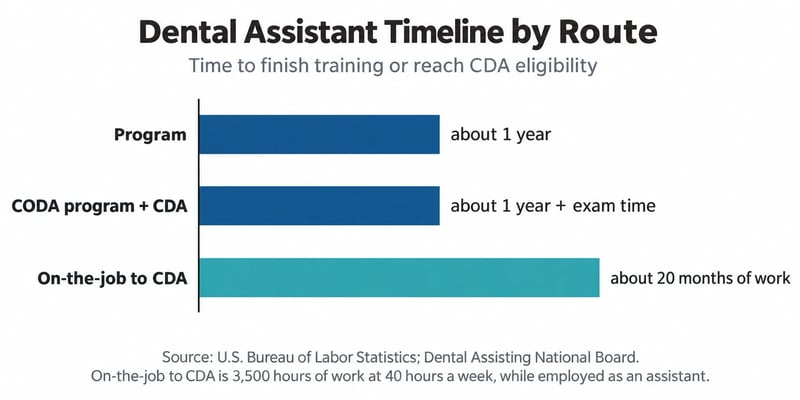
- Program graduate, no state credential required: about 1 year, the length of the program.
- Program graduate who takes the CDA: about 1 year plus exam time; CODA-accredited program students can apply for the GC exam before graduating.
- On-the-job route to the CDA: about 20 months of full-time work to reach 3,500 hours, plus exam time.
- Adding X-ray certification on the job (Florida): at least 3 months of supervised radiography training while already working as an assistant, then a board-approved course within 12 months. This time comes on top of the route that got you into the job.
The work-experience route runs closer to 2 years. Dreambound lists dental assisting programs for students taking the program route.
Frequently Asked Questions