Key Points
- California has two main levels: unlicensed dental assistant (entry level) and Registered Dental Assistant (a state license from the Dental Board).
- Carrington College's board-approved RDA program takes about 9 to 11 months and includes every required course: Radiation Safety, Coronal Polishing, Pit and Fissure Sealants, Infection Control, the Dental Practice Act, and BLS.
- The RDA application fee is $120, and the exam fee is paid separately to PSI once you're approved to test.
- According to May 2025 BLS data, California dental assistants earn a median of $50,110 a year ($24.09 an hour), vs. $48,070 nationally.
- Nationally, jobs are projected to grow 7% from 2025 to 2035, with about 53,000 openings a year.
Dental Assistant vs. Registered Dental Assistant in California
California separates dental assisting into levels, and each carries its own training requirements and permitted duties. The entry-level rules changed on January 1, 2025, when SB 1453 took effect.
The Dental Board's table of permitted duties lists each task by level and the supervision it requires.
How to Become a Registered Dental Assistant in California, Step by Step
Step 1: Meet Entry Requirements
You need a high school diploma or GED to start most dental assisting programs in California. There is no minimum age set by the Dental Board of California for RDA applicants, but most programs require students to be at least 17 or 18.
Students still in high school can use this time to take courses in biology, health science, and anatomy. These are not strict prerequisites at every school, but they make program material easier to absorb once you start. Some students begin working toward a dental assistant career while still in high school through health science electives and job shadowing.
Step 2: Complete a Training Program or Qualifying Pathway
The Dental Board of California recognizes seven pathways in total to qualify for the RDA exam. Three of the pathways work like this:
Board-Approved Program: A board-approved dental assisting program includes all of the courses the Dental Board requires for RDA licensure, so you won't need to take any of them separately:
Carrington College's board-approved certificate program runs about 9 to 11 months. Associate degree programs take longer because they include general education courses alongside dental training. Both prepare you for the RDA exam.
Work Experience: If you train on the job under a licensed dentist, you need at least 15 months and 1,280 hours of documented experience. Unlike board-approved programs, this route does not include the required courses. You will need to complete each one individually through a board-approved provider before you can apply for the RDA exam. Several of these courses have expiration windows: Radiation Safety must be completed within 10 years of your application date, Coronal Polishing and Pit and Fissure Sealants within 5 years, and Infection Control and the California Dental Practice Act within 2 years.
DANB Certified Dental Assistant (CDA): If you already hold a current Certified Dental Assistant credential from the Dental Assisting National Board, California accepts that as a qualifying pathway. You still need to complete the required board-approved courses listed above (Radiation Safety, Coronal Polishing, Pit and Fissure Sealants, Infection Control, California Dental Practice Act, and Basic Life Support/CPR) and pass the California RDA exam. This path is most relevant for dental assistants moving to California from another state who already hold national certification.
The Dental Board also recognizes four additional pathways: completion of a non-board-approved dental assisting program combined with work experience, an alternative dental assisting program (500 hours didactic plus 300 hours clinical), a preceptorship in dental assisting, and current licensure as a California registered dental hygienist, which still requires current BLS and the RDA exam. The newer pathways took effect July 1, 2025, under SB 1453. Details for each are listed on the DBC applicant page.
Step 3: Pass the RDA Exam and Get Licensed
Submit your application and the $120 fee through BreEZe, upload your pathway documentation and course certificates, and complete a Live Scan fingerprint background check. Standard processing takes up to 30 days, and the Dental Board notes that the DOJ/FBI report usually arrives within seven days.
Once the board approves you, you pay the exam fee directly to PSI (Psychological Services Incorporated) and schedule the RDA Combined Written and Law and Ethics Exam. PSI administers the exam at testing centers across California.
Two deadlines apply. You must take the exam within 2 years of the board receiving your application, and if you fail, you must retake it within 2 years of the failure notice. According to the Dental Board, missing either deadline means the application is abandoned and you start over with a new one.
After you pass the exam and clear the background check, the Dental Board issues your RDA license, a wall certificate, and a pocket ID card. There's no separate initial license fee; you pay the $120 application fee and the PSI exam fee.
Step 4: Start Your Career
As of May 2025, California has the highest employment level for dental assistants of any state, with 56,220 dental assistants working across the state. The Los Angeles-Long Beach-Anaheim metro area alone accounts for about 21,090 of those positions, and the San Francisco-Oakland-Fremont area employs roughly 7,530.
Most dental assistants work in private dental practices, but positions also open up in community health clinics, orthodontic offices, oral surgery centers, and hospital dental departments.
Board-Approved Dental Assisting Programs in California on Dreambound
Dreambound lists dental assisting programs from partner schools, with the format and campus for each listing. The program below appears on the Dental Board's approved RDA program list, so graduates meet the Step 2 course requirements in one go.
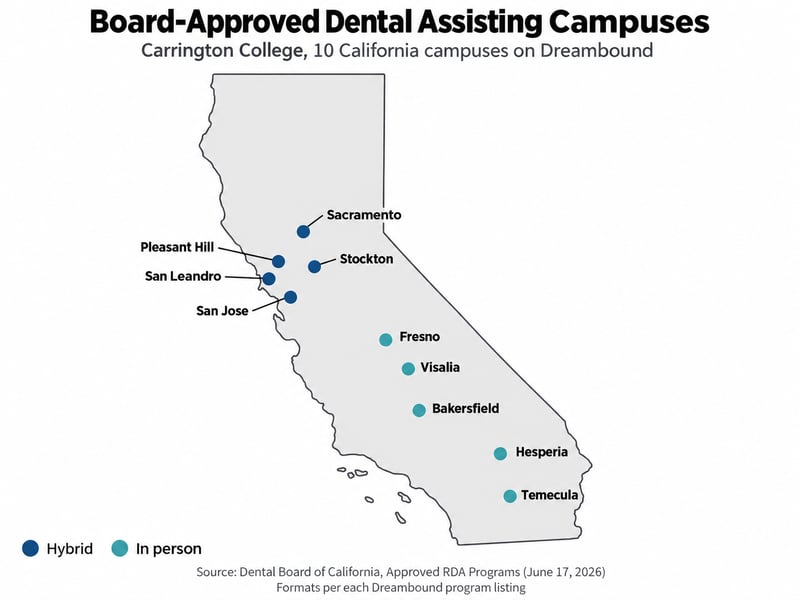
- Format: Hybrid at San Leandro, San Jose, Pleasant Hill, Sacramento, and Stockton; In person at Fresno, Visalia, Bakersfield, Temecula, and Hesperia (per each Dreambound listing)
- Length: about 9 to 11 months, according to Carrington College
- Tuition: ask the campus (not listed on Dreambound)
- Board-approved RDA program; graduates are eligible to sit for the California RDA exam
Available at ten California campuses:
Dental Assistant Salary and Job Outlook in California
According to May 2025 Bureau of Labor Statistics data, the median annual wage for dental assistants in California is $50,110 ($24.09 an hour), above the national median of $48,070. California employs 56,220 dental assistants, more than any other state. The lowest-paid 10% earn under $38,790, and the top 10% earn over $73,700.
Pay varies widely by metro area. Los Angeles has the most dental assistant jobs in the state but a median below the statewide figure, while Bay Area metros post medians of $64,390 to $74,600. San Jose-Sunnyvale-Santa Clara has the highest dental assistant median of any metro area in the country.
Nationally, dental assistant employment is projected to grow 7% from 2025 to 2035, which BLS describes as much faster than the average for all occupations, with about 53,000 openings projected each year.
Median pay across California metro areas, including those with Carrington campuses (BLS OEWS, May 2025):
Paying for Your Dental Assistant Program
Dental assistant program costs in California depend on the type of school and program length. Community college programs often cost less than private vocational schools. Associate degree programs also cost more than certificate programs due to the longer time commitment. You can compare program costs on Dreambound to see what's available in your area.
Here are ways to reduce your out-of-pocket costs:
Federal Financial Aid: Apply through FAFSA. Programs eligible for federal student aid may accept Pell Grants, which do not need to be repaid.
Workforce Development Programs: California's Employment Development Department (EDD) and local Workforce Innovation and Opportunity Act (WIOA) centers sometimes fund vocational training for eligible applicants.
Payment Plans: Some programs offer monthly payment plans that spread tuition over the length of your training.