Medical Billing Companies in Texas: How to Choose the Right Service

See if you qualify for Medical Billing and Coding programs
Answer a few questions in 2 minutes. Free, no commitment.
Choosing a medical billing company in Texas is a higher-stakes decision than it looks, because the company you hire sets your cash flow, your denial rate, and your compliance exposure in one contract. Texas adds rules of its own on top of the federal ones. State-regulated insurers must act on a clean electronic claim within 30 days, Texas Medicaid gives you 95 days to file, and since September 2023 any patient balance has to be preceded by an itemized bill. A vendor that does not work those clocks every day will cost you money without ever sending an invoice for it. The right choice comes down to specialty fit, city, fee structure, and whether the company can show you its Texas record.
What Makes a Medical Billing Expert in Texas?
Credentials come first. Look for AAPC's Certified Professional Coder (CPC), whose exam runs 100 questions in four hours, and its Certified Professional Biller (CPB) for the billing side, and ask how many certified staff will touch your account. Tenure with Texas-specific rules comes second, and it is testable. A company that bills in Texas every day should be able to explain all six of these without looking them up:
- Prompt pay: under Texas Insurance Code Chapters 843 and 1301, a state-regulated carrier must pay, deny in writing, or pay the undisputed part of a clean claim within 30 days if filed electronically and 45 days on paper, and late payment carries penalties that scale with the delay.
- The 95-day clock: Texas Medicaid claims must be received within 95 days of the date of service, and appeals within 120 days of the last denial or adjustment.
- Itemized bills: since September 1, 2023, a provider must send the patient an itemized bill within 30 days of the final insurance payment before collecting a balance.
- Surprise billing: state-regulated plans fall under Texas law and its arbitration window, while self-funded employer plans fall under the federal No Surprises Act, and the company has to tell them apart from the ID card.
- EVV: Medicaid home health claims have to match an electronic visit verification record.
- The Medicare contractor: Texas Part A and Part B claims go through Novitas Solutions, which was awarded the Jurisdiction H contract again in June 2026.
Red flags are the mirror image: a vague answer on denial rates, no clients in your specialty, no written compliance program, and a fee quoted without a definition of collections. The OIG's compliance guidance for billing companies adds one more, warning that percentage billing arrangements may implicate the anti-kickback statute and may raise the risk of upcoding, so ask how the company pays its coders.
Frequently Asked Questions
How much do medical billing companies in Texas typically charge?
Most Texas companies charge a percentage of collections. One Texas vendor that publishes its rate, HPC Billing, lists 5% to 9% of net monthly collections as of September 2026. Per-claim, flat monthly, and hybrid fees are the usual alternatives for low-volume practices. Whatever the model, get the definition of a collection in writing, since that clause decides what you pay.
Do I need a billing company that specializes in my specialty?
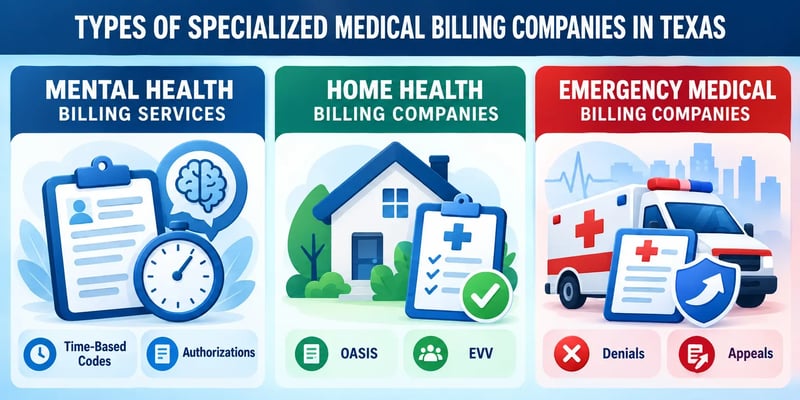
Yes if your specialty has its own rulebook, and mental health, home health, and emergency medicine all do: time-based psychotherapy codes, 30-day periods with EVV matching, and balance-billing arbitration respectively. A family medicine or general practice can use a strong generalist, but ask any company how many clients it bills in your specialty and its denial rate for them.
Are there medical billing companies that handle multiple Texas locations?
Yes. Several Dallas-Fort Worth companies serve multi-site groups, and larger firms statewide will bill multiple locations under one contract. Ask for reporting by location and by provider, a credentialing process for new sites, and a single point of contact, since multi-location billing fails on coordination more often than on coding.
How do I switch medical billing companies without disrupting cash flow?
Run the two companies in parallel for one filing cycle. The old company keeps working its submitted claims, plus any appeals inside Texas Medicaid's 120-day window, while the new company takes every date of service from the cutover forward and files inside the 95-day limit. Put the handoff date, open-claim list, and return of your data in the exit terms.
How much do medical billers make in TX?
Texas Career Check, the Texas Workforce Commission's career information site, lists a 2024 statewide average wage of $24.53 an hour for medical records specialists, the federal job category that covers billers and coders. Pay rises with certification and with hospital work, and the fuller salary picture, including entry-level and certified ranges, is in the Texas careers guide linked above.
Choosing a Texas Billing Company for the Long Run
The right billing partner is a specialty and city fit as much as a price decision, and the six Texas rules above are the fastest way to tell the two apart. A company that can walk you through the prompt-pay clock, the 95-day Medicaid limit, and the itemized-bill rule without notes has done this work in Texas before. One that cannot will learn on your claims.
Vet denial rates, the fee definition, and the compliance program before you sign, because switching later costs a filing cycle of cash flow that the first contract could have protected.