Medical Billing Audit Services: What They Are and Why Your Practice Needs One

See if you qualify for Medical Billing and Coding programs
Answer a few questions in 2 minutes. Free, no commitment.
A medical billing audit systematically reviews a practice's claims, coding, and documentation for accuracy and compliance, so that lost revenue and compliance risk surface before a payer or regulator finds them first. CMS put the Medicare fee-for-service improper payment rate at 6.55%, or $28.83 billion, for fiscal year 2025. Most of it traced back to documentation that could not support the claim rather than to fraud. An outside audit service applies that same review to your own claims, on your own schedule. Choosing one comes down to the type of audit you need, what it should include, what it costs, and how to tell an auditing specialist from a general coding shop.
How Much Do Medical Billing Audit Services Cost?
Audit services are priced three ways, and most audit firms do not publish a rate card, so expect a custom quote. A flat project fee covers a defined scope, such as a baseline audit of 10 charts for each of six providers. Per-chart or per-claim pricing scales with the sample, which makes it the usual model for focused audits and large groups. An ongoing retainer covers recurring quarterly or monthly reviews in larger practices and higher-risk specialties.
The sample size and the amount of education and follow-up bundled in move the quote more than anything else. Weigh the price against both sides of the ledger. A retrospective audit puts a number on the undercoding the practice has been absorbing, and the per-claim False Claims Act penalty alone runs $14,308 to $28,619 before damages. A review that surfaces a systematic error is not a cost line in the same sense as software or supplies. When a firm quotes, ask about the sample size, provider-level error rates in the report, and the price of a follow-up audit.
Frequently Asked Questions
What's the difference between an internal and external billing audit?
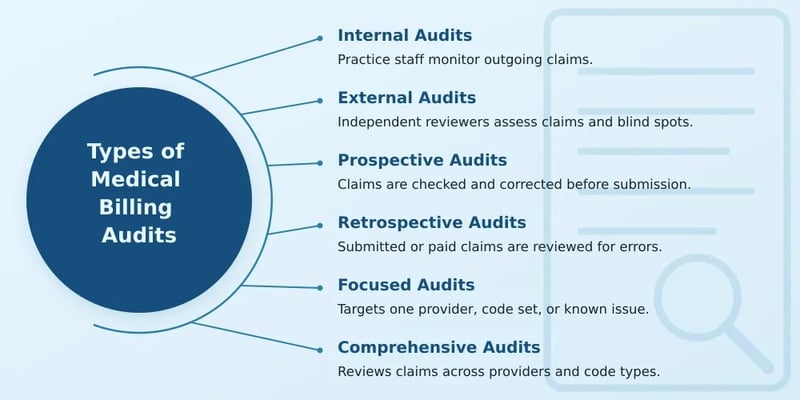
An internal audit is performed by the practice's own staff, usually a coding lead or compliance officer, and works well for ongoing spot checks. An external audit is performed by an independent third-party service, which brings specialty benchmarks and carries more weight with payers and regulators because the reviewers have no stake in the results.
How long does a medical billing audit typically take?
A few weeks for most practices. DoctorsManagement, one audit and consulting firm, publishes a typical timeline of four to six weeks from kickoff to final report for a review of 10 to 30 records per provider. The calendar stretches with the sample size and the number of providers, and a focused audit of a single code set can run faster.
What certification should a medical billing auditor have?
An auditing-specific credential, not only a coding one. The Certified Professional Medical Auditor (CPMA) from AAPC is the standard, with an exam of 100 multiple-choice questions taken in a single four-hour sitting, usually held alongside a coding credential such as the CPC or AHIMA's CCS. Ask who will read your charts, not just who signs the proposal.
Can a billing audit help before a payer initiates one?
Yes, and that is the timing the OIG built its guidance around: a baseline audit when the compliance program starts and periodic audits at least once a year. A practice that already knows its error rate and has corrected it walks into a Targeted Probe and Educate review, which samples 20 to 40 claims per round, with its documentation ready.
How often should a small practice get audited?
At least once a year, per the OIG's guidance for individual and small group practices, with a baseline sample of five to ten records per physician. Add a focused audit when a new provider joins, when billing staff or software change, or when denials spike for a single code or payer.
Auditing Before Someone Else Does
A billing audit is a proactive tool for both revenue and compliance, not just a defensive one. The review that turns up undercoding also turns up the documentation gaps CMS found behind 65% of Medicare's improper payment dollars, and finding them on your own schedule costs far less than having a contractor find them.
Weigh the auditor's credentials, the sampling method, and the clarity of the report above the price. A cheap audit that returns a pass/fail score leaves you where you started, and one that hands you provider-level findings and a corrective plan is the audit the OIG had in mind.