Types of Medical Billing Explained

See if you qualify for Medical Billing and Coding programs
Answer a few questions in 2 minutes. Free, no commitment.
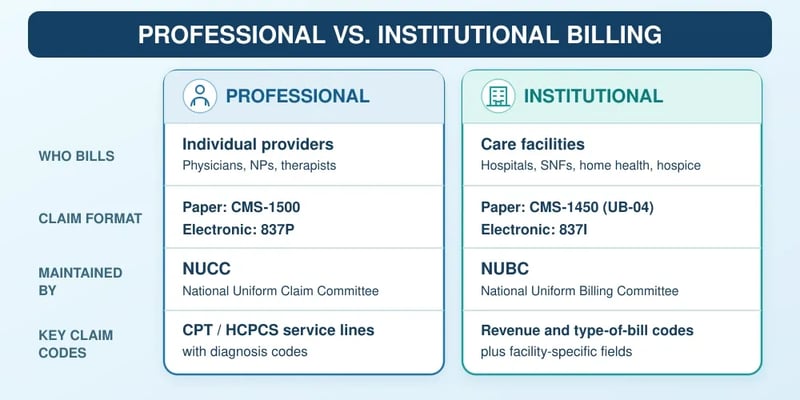
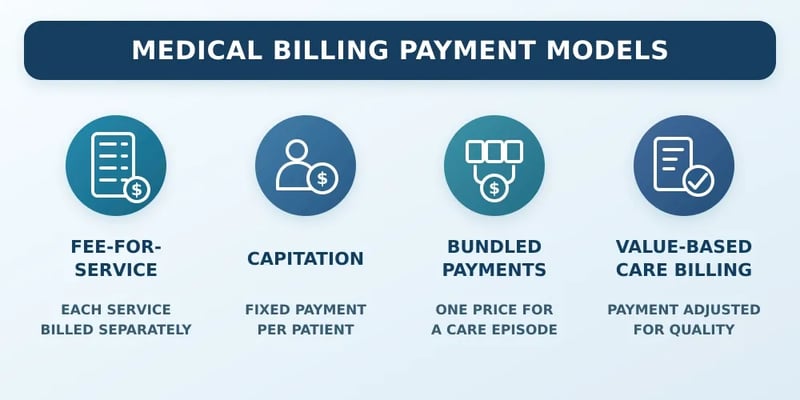
Medical billing is not one single process. It splits into a few distinct types depending on who is being billed, what kind of care was provided, and how the provider gets paid. The two categories every biller learns first are professional billing, for an individual clinician's services, and institutional billing, for a facility's charges. Payment models, the inpatient versus outpatient line, and how a billing system shares records add three more layers. Which type applies is written on the claim itself, in the form, the transaction, and the type-of-bill code.
How Medical Billing Relates to Medical Coding
Coding and billing are two steps in the same revenue cycle, not two names for one job. Coding translates the documentation from a visit into standardized codes: ICD-10-CM for diagnoses, CPT and HCPCS for procedures and supplies, and ICD-10-PCS for inpatient hospital procedures. Billing takes those codes and turns them into a claim, chooses the right form and type of bill, submits it, works the payer's response, and posts the payment.
Many people hold both roles in a small practice, but the claim is only as accurate as the codes it is built on. The guide to what medical billing and coding is walks through the code-to-claim workflow. If you are still deciding whether the career fits, the pros and cons of medical billing and coding cover training time, pay, and the daily work.
Frequently Asked Questions
What is the difference between professional and institutional billing?
Professional billing covers an individual provider's services and goes out on the CMS-1500 form or its electronic version, the 837P, while institutional billing covers a facility's charges and goes out on the UB-04 (CMS-1450) or the 837I. Institutional claims also carry fields professional claims do not, including revenue codes and a type-of-bill code.
What is a closed medical billing system?
A closed medical billing system keeps a patient's billing data and records within one practice or facility, with no sharing across outside providers, which suits solo and small practices. An open system shares records and billing across the providers involved in a patient's care, and vendors sometimes add a third label, isolated, though their definitions of it vary.
What is the most common medical billing payment model?
Fee-for-service, where each service is billed and paid separately. The AMA's 2024 Physician Practice Benchmark Survey found 82.8% of physicians in practices receiving fee-for-service payments, which supplied two-thirds of practice revenue, while 62.4% also reported some alternative-payment revenue.
Is inpatient billing more complex than outpatient billing?
Usually, yes. An inpatient claim covers an entire admission, is paid as one diagnosis-related group under Medicare Part A, and carries ICD-10-PCS codes for any procedures, a type-of-bill code, and a discharge status. One coding choice can change the payment for the whole stay. Outpatient claims are paid per service through ambulatory payment classifications under Part B.
Is medical billing the same as medical coding?
No. Coding converts a provider's documentation into ICD-10-CM, CPT, and HCPCS codes, and billing uses those codes to build, submit, and follow up on the claim. They are separate steps in the same revenue cycle, and while one person often does both in a small office, larger organizations split them into different teams with different certifications.
Knowing Which Type of Billing Applies to a Claim
Most real billing work touches more than one of these categories at once. A single hospital admission produces a professional claim for the surgeon and an institutional claim for the facility, is paid as an inpatient diagnosis-related group under Part A, and may sit inside a bundled episode or a value-based adjustment. Reading the claim tells you which rules apply: the form gives you professional or institutional, the type-of-bill code gives you the setting, and the contract behind it gives you the payment model.
If you are weighing the career rather than a claim, this vocabulary is what training programs teach first, and Dreambound lists medical billing and coding programs you can compare by length, format, and cost.