Key Points
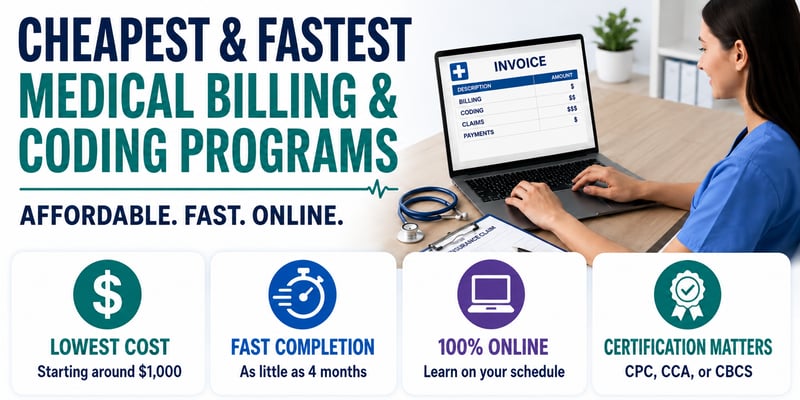
- The lowest-cost route is self-study paired with a certification exam, roughly $500 to $900 if you already have healthcare experience; the cheapest guided option is a self-paced online diploma starting around $1,000.
- Most accredited online programs run about four to nine months, and the fastest accredited tracks, like a 16-week CPC boot camp for those with an allied-health background, finish in as little as four months.
- A typical online program costs about $1,000 to $4,500 in tuition, before exam and membership fees are added.
- Programs advertised as four weeks exist, but the only genuinely four-week option is not accredited, which can limit your exam eligibility and the jobs you qualify for.
- No state license is required to work as a biller or coder, but most employers want a recognized certification such as the CPC, CCA, or CBCS.
How Much Do Medical Billing and Coding Programs Cost in 2026?
Tuition for a typical online program runs about $1,000 to $4,500, and what you actually pay depends on the route you take. The lowest-cost option is self-study paired with a certification exam, roughly $500 to $900, which works best if you already have some healthcare experience. The most affordable guided route is a self-paced diploma starting near $1,000; Penn Foster's program, for instance, folds the certification exam voucher into tuition. Accelerated and boot-camp-style programs usually run $2,000 to $4,000.
What surprises most people is the cost that lands after tuition. Certification is billed separately, and so is the membership some credentials require:
- The AHIMA CCA exam is $199 for members or $299 for non-members, with no separate membership required to sit for it.
- The AAPC CPC exam is $425 for one attempt or $499 for two, and AAPC requires a $229 annual membership before you test.
- Current-year code books add more unless your program includes them.
Budgeting for tuition alone can leave you a few hundred dollars short, so build the exam and any membership in from the start.
How Fast Can You Become a Medical Biller or Coder?
Most accredited online programs take about four to nine months, and how fast you finish depends mostly on your schedule and your starting point. The quickest routes wrap up in roughly four to six months; CCI Training Center's program runs 26 weeks, with a 16-week CPC boot camp track for students who already have an allied-health background. A few accredited community-college courses run shorter still, as little as about 12 weeks, though those are typically self-paced and built for students who can study close to full-time. If you want a realistic sense of the full timeline from start to certified, this breakdown of how long it takes to become a medical biller and coder walks through each stage.
You have probably seen programs advertised as four weeks. They exist, but the only genuinely four-week option on the market is not accredited by CAHIIM or AAPC, and that gap can limit which certification exams you qualify for and how employers view your training. For most people, a slightly longer accredited program is the faster route to an actual job, because it keeps every door open.
The quickest way to find your fit is to compare real programs side by side on price and length. You can do that free on Dreambound.
Cheapest and Fastest Medical Billing and Coding Programs on Dreambound
Dreambound is free to use and lets you compare medical billing and coding programs in one place, lining up the format, length, and credential each one prepares you for so your budget and timeline are easy to weigh. It does not push you toward any single school. Here are three accredited online programs, ordered from shortest to longest.
- Format: Online
- Length: 26 weeks, with a 16-week CPC boot camp track for students who have an allied-health background
- ACCET-accredited, with curriculum aligned to the AAPC Certified Professional Coder (CPC) exam
- Format: Online
- Length: 36 weeks with full-time study
- Prepares for certification as a Medical Billing and Coding Specialist, Medical Administrative Assistant, or Electronic Health Records Specialist
- Financial aid available for those who qualify
Compare these and other accredited programs on Dreambound to find the price, schedule, and start date that work for your situation.
What to Look for in a Medical Billing and Coding Program
A low price only pays off if the program actually prepares you to get certified and hired. Weigh these factors before you choose:
- Accreditation: Look for a program backed by a recognized accreditor or built on an AAPC- or AHIMA-aligned curriculum. For a short certificate, that industry alignment carries more weight with employers than a college's regional accreditation.
- Certification exam prep: The program should map to a recognized exam (CPC, CCA, or CBCS). Programs that cover the exam itself, not just the prep, save you a separate fee later.
- Format and pace: Self-paced online programs let you finish faster if you can commit the time, while scheduled cohorts add structure. Match the format to how you actually study.
- Payment options and aid: Payment plans, employer reimbursement, and funding programs can lower the real cost, so weigh those alongside the sticker price.
- Job-placement support: The strongest programs offer career services, resume help, or employer connections. For a career-changer, that support is often what turns a certificate into an actual first job.
How to Pay for Medical Billing and Coding Training
Training rarely has to be paid all at once, and several options can lower what you owe out of pocket:
- Federal financial aid: Title IV grants and loans may be available at accredited colleges that participate, though many short certificate programs do not qualify, so check each program directly.
- WIOA funding: The Workforce Innovation and Opportunity Act can cover training at eligible providers for those who qualify, usually through a local workforce board.
- MyCAA: Military spouses may be eligible for up to $4,000 in tuition assistance for portable careers like medical billing and coding.
- GI Bill benefits: Veterans and some dependents may use education benefits at approved schools.
- Payment plans and employer reimbursement: Many schools offer monthly plans, and some employers reimburse training costs for current staff.
Medical Billing and Coding Salary and Job Outlook
Medical records specialists, the BLS category that covers billers and coders, earned a median of $50,250 a year as of May 2024. The lowest 10% earned under $35,780 and the highest 10% earned more than $80,950, so pay rises meaningfully with experience and credentials. Employment is projected to grow 7% from 2024 to 2034, much faster than the average for all occupations, with about 14,200 openings a year, according to the U.S. Bureau of Labor Statistics. Much of the work can be done remotely, which is part of why the field draws career changers.