Key Points
- The right custom software development partner should have direct experience in your industry or a technically comparable one.
- Pricing models (fixed price, time and materials, dedicated team) each fit different project types and risk tolerances.
- A strong partner asks as many questions about your business goals as you ask about their process.
- Red flags like vague timelines, no clear communication cadence, or refusal to share references are worth taking seriously early.
Define Your Project Scope and Goals First
Vendor selection starts inside your company, not on a vendor's website. Before the first call, write the business problem down in a paragraph, split the feature list into must-haves and nice-to-haves, set a target timeline, and name a budget range you can defend. That document is what every vendor will price, so the clearer it is, the more the quotes mean.
Vague requirements are where evaluations go wrong. Two proposals against a loose brief cannot be compared, because each vendor has quietly priced a different project, and the cheaper one often assumed less. A must-have list with acceptance criteria ("a patient can reschedule from the confirmation email in under a minute") lets you line up quotes, timelines, and team sizes against the same target.
Part of scoping is confirming that custom software is the right answer at all. If a packaged product covers the workflow with small gaps, buying it is cheaper than building, and the 18F de-risking guide warns that heavy customization of a commercial product raises failure risk while removing the main benefit of buying one. Custom makes sense when the workflow is the thing your customers pay for, or when integrations and workarounds cost more than the licenses. If a packaged product is enough, the same requirements-first approach applies, as the guide to choosing medical invoice software shows for one common purchase.
How to Choose the Right Custom Software Development Company: Key Criteria
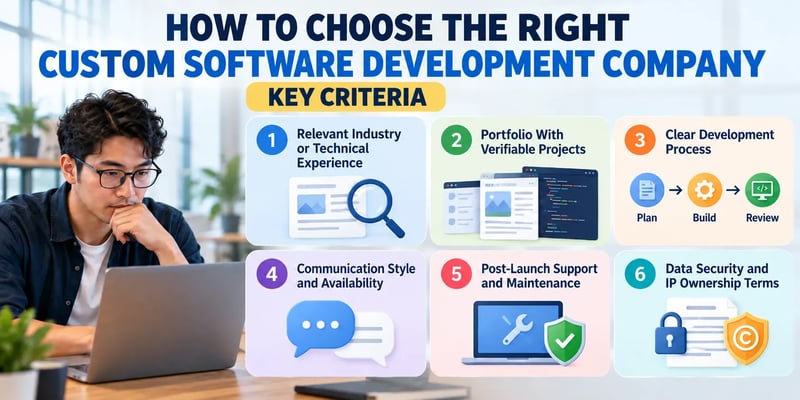
Six criteria separate a partner from a vendor, and each one has a test you can run before you sign.
- Relevant industry or technical experience, not just general software experience. A team that has built for your regulatory environment or integration set (patient data rules, payment processing, a warehouse system) starts months ahead. Ask which of their last five projects resembled yours, and whether those people are still there.
- A portfolio with verifiable, similar-scope projects. Case studies are marketing, and code is evidence. The 18F guide tells government buyers to request two or three source code repositories, because actual code predicts how a team performs far better than a bake-off or a hackathon. Have someone technical read them, and call the clients behind the case studies.
- A clear, documented development process (agile, sprints, milestones). Look for fixed-length work cycles, a demo of working software at the end of each cycle, and a written definition of done. 18F writes a delivery standard into its contracts: at the end of each cycle, all code lands in a repository the buyer owns and is complete, tested to at least 90% coverage, accessible, deployed, documented, and secure.
- Communication style and time zone or availability fit. Find out who your day-to-day contact will be, how many working hours overlap with yours, where the updates live, and how quickly the team answered during the sales process, which is the pace to expect after signing.
- Post-launch support and maintenance terms. The proposal should name a defect warranty period, support hours and response times, who hosts and monitors the system, and what a maintenance retainer covers. The FTC's business security guide treats keeping security current as a standing duty, so the contract should say who patches what, and how fast.
- Data security and IP ownership terms in the contract. For security, ask which of the four practice groups in NIST's Secure Software Development Framework the team can show evidence for. For ownership, paying for code does not make you its owner. Under the Copyright Office's work made for hire rules, a contractor's work belongs to the buyer only when it falls into one of nine listed categories and a signed agreement says so, and general business software is not on that list. The contract needs an explicit copyright assignment plus a license to anything the vendor already owned.
Understanding Custom Software Development Pricing Models
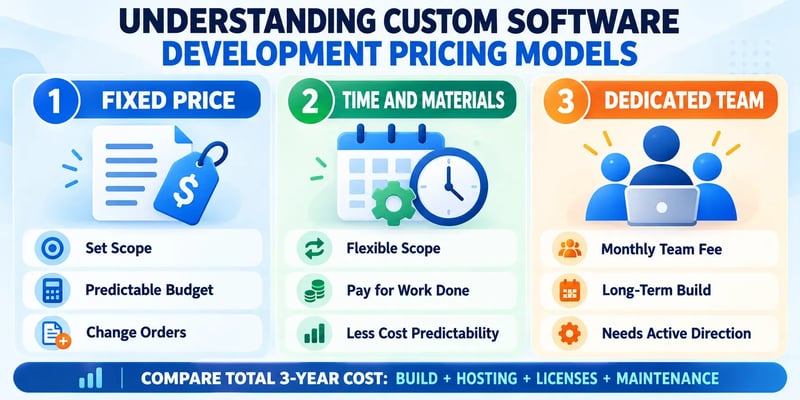
Three pricing models cover most custom software contracts, and the right one depends on how well-defined the project is rather than on which sounds cheapest up front.
Fixed Price
Fixed price works best for well-defined, smaller-scope projects where requirements are unlikely to change. You pay a set amount for a set scope, so the vendor carries the estimation risk and prices it in, and every change after signing becomes a change order. It suits a project that already has a specification, approved designs, and acceptance criteria. Without those, a fixed price is a guess with a signature on it.
Time and Materials
Time and materials fits projects with evolving requirements. You pay agreed hourly or daily rates for the work actually done, which lets you reorder priorities as you learn, at the cost of less budget predictability. 18F prefers this model for software built in cycles, because the buyer can change direction and end the contract early while keeping every line of delivered code. Keep it under control with an hours cap and a demo every cycle.
Dedicated Team
A dedicated team is a fixed monthly fee for named people who work only on your product, which suits long-term, ongoing development where the partner functions as an extension of your internal team. You own the backlog and set priorities, so it works when someone on your side can direct the work every week. An empty backlog means paying for idle capacity.
Whichever model you choose, price the first three years rather than the build alone. Hosting, third-party licenses, maintenance, and the changes you will want after launch belong in the comparison.
Questions to Ask a Custom Software Development Partner
Five questions, one per category, surface most of what a proposal leaves out, and how a vendor answers matters as much as what it says.
- Process: How do you handle scope changes mid-project? A good answer describes a written change process that states the cost and timeline impact before the work starts, with an example of a change the team pushed back on.
- Team: Who will actually be working on this, and what's their experience level? A good answer gives names and roles, says whether the people on the sales call are the people on the build, and explains what happens if someone leaves. 18F scores staffing approach as one of its four evaluation factors for this reason.
- Communication: What does a typical week of updates look like? A good answer has a fixed demo day, a short written status note, a task board you can read without asking, and one named person who replies within a business day.
- Risk: What happens if a milestone is missed? A good answer includes an early warning rule (they tell you when the estimate slips, not after the date passes), a replan, and a plain statement of what you pay for the late work.
- Ownership: Who owns the code and IP once the project is delivered? A good answer is that you do, by written assignment, with a license to any framework or library the vendor brings, and that the code lives in a repository in your name throughout the project.
Red Flags to Watch For When Choosing a Development Partner
Most warning signs appear before the contract, in how a vendor sells, and they deserve more attention than the polish of the proposal.
- Reluctance to provide client references, or references that are all several years old. The reference and fee-definition tests that apply to any outsourced service, laid out in the guide to medical billing companies in Texas, apply here too.
- Unusually low quotes with no clear explanation. Ask the vendor to walk you through the estimate line by line, roles and hours included. If they cannot, the number is a placeholder, not a quote.
- No formal contract or statement of work. A vendor that wants to start on a handshake or a one-page order form is asking you to carry all of the risk.
- Poor communication during the sales process itself. Slow replies, missed calls, and answers that dodge the question are a preview of the project, not an exception to it.
- Pressure to sign quickly without a discovery phase. A partner that trusts its own estimate has little reason to refuse a paid discovery of two to four weeks that produces a scope, a design, and a firmer price before the full contract.