EKG Technician Program Cost: Cheapest and Fastest Options in 2026
See if you qualify for Electrocardiogram (ECG/EKG) programs
Answer a few questions in 2 minutes. Free, no commitment.
EKG Technician Program Cost: Cheapest and Fastest Options in 2026
EKG technician program cost usually runs about $500 to $2,000, and programs that add an externship can reach about $4,100. The certification exam adds another $119 to $175 unless tuition includes it, so the total matters more than the sticker price.
The fastest courses are short, scheduled classes that finish in six days to about eight weeks, while self-paced online courses usually take four to nine months. Before you count a course as finished, check whether it includes the 10 live EKGs that NHA's CET certification requires. Cardiovascular technologists and technicians, the group that includes EKG techs, earned a median of $74,310 in May 2025, though entry-level EKG work pays well below that.
Key Points
- Most EKG technician programs cost $500 to $2,000, partner programs on Dreambound start at $495, and programs with an externship can reach about $4,100.
- Certification exams add about $119 to $175, and NHA's CET also requires 10 EKGs on live people.
- The fastest courses run six days to about eight weeks as scheduled classes, while self-paced online courses usually take four to nine months.
- Most EKG courses are too short for federal student aid, so payment plans, WIOA, and employer-paid training matter more than Pell Grants.
- Cardiovascular technologists and technicians earned a median of $74,310 in May 2025, and the lowest 10% earned under $39,000.
How Much Does an EKG Technician Program Cost?
Becoming an EKG technician costs most people about $600 to $2,200 all in, which covers roughly $500 to $2,000 for the program plus a $119 to $175 certification exam. Programs that bundle an externship, books, and lab materials can reach about $4,100.
Where you train changes both the price and the length. Here is how EKG program cost compares by training route, using prices the schools posted as of November 2026:
Route | Typical tuition | Typical length | Live EKGs included? | Public or Dreambound example |
|---|---|---|---|---|
Community college or university extension | About $850 to $1,600 | 3 weeks to about 2.5 months | Often | Pasadena City College about $847 estimated total; Las Positas $1,249; CSU East Bay $1,615 |
Short private course (in person, hybrid, or live online) | About $500 to $2,000 | 6 days to 8 weeks | Often | Dreambound partner listings: $495 to $1,200 |
Self-paced online course | About $1,000 to $1,300 | 4 to 9 months | Rarely | San Francisco State $1,299; U.S. Career Institute $979 to $1,279 |
Private school with externship | About $4,100 | About 100 hours plus a 240 to 400 hour externship | Yes | Altamont Healthcare, $4,100 total |
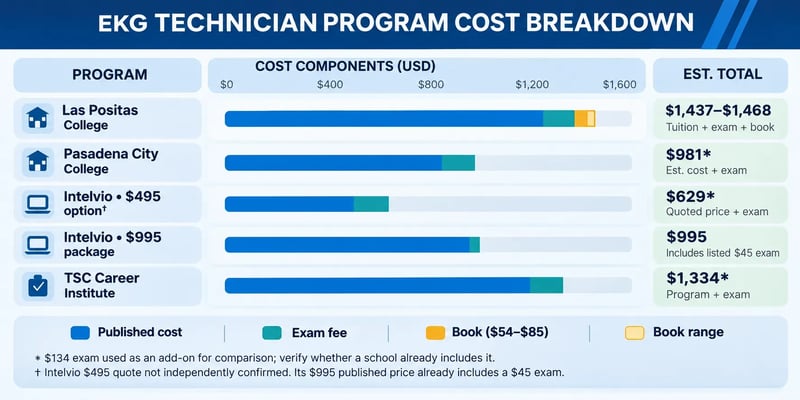
A real all-in total shows how fast the extras add up. At Las Positas College, tuition is $1,249, the NHA exam is $134, and the book is $54 to $85, or about $1,437 to $1,468 before scrubs. That course also includes the 10 live EKGs, so you would not need to arrange them separately.
Clinical requirements bring their own bills, too. Pasadena City College's cost list shows the kinds of charges that rarely appear in a headline price:
- A background check at $30
- A drug screen at $18
- A TB skin test at $15
- An American Heart Association CPR card at $65
- A uniform at $120 a set
- Any vaccines you do not already have, such as hepatitis B at $50 or MMR at $93
The first five charges alone come to $248 before any vaccines, which is why a course that looks like a bargain can end up costing more than one with a higher sticker price.
Cheapest EKG Technician Programs
The cheapest EKG programs on Dreambound start at $495, and both are in-person courses with hands-on practice. Each partner listing shows its format and total price up front, so you can weigh the real cost before you apply.
Be careful with very low headline prices. A "program" listed at $70 or $100 is usually exam prep alone, without the training and hands-on hours you need to qualify for certification.
ECG - Intelvio (Colorado Springs, CO)
- In person
- $495 total
- Covers lead placement, heart anatomy, and spotting abnormal readings, with live ECG practice on fellow students
ECG - Intelvio (California)
- In person
- $995 total
- Hands-on practice performing live ECGs on fellow students
The Riverside course is also offered at nine other California campuses, including Manteca and National City, plus Sacramento, San Jose, and San Diego. For more programs in your area, compare EKG classes near you.
Fastest EKG Technician Programs
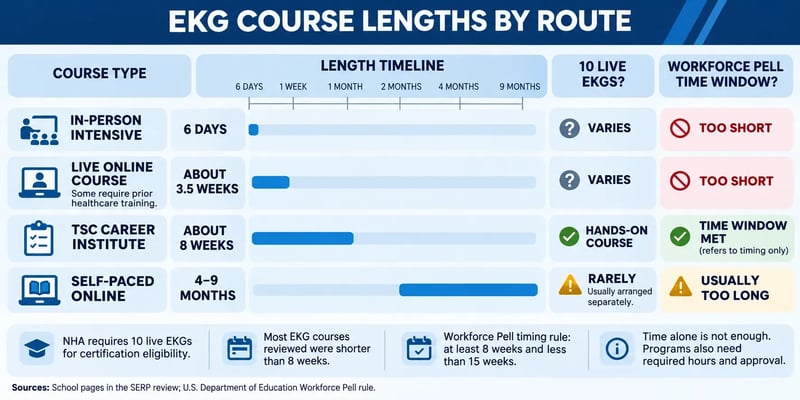
The fastest EKG courses finish in six days to eight weeks. They are short, scheduled classes, not self-paced online courses, which usually take four to nine months.
Course length also isn't the whole timeline. A course is not the finish line if it does not include the 10 live EKGs NHA requires, and some self-paced online courses leave you to arrange those EKGs yourself at a local clinic, hospital, or doctor's office.
Across the wider market, the very shortest options are intensives. Some finish in as little as six days, and some live online courses run about 3.5 weeks, though at least one of those requires previous healthcare experience or training before you can join.
Among Dreambound's partner programs, the fastest with a published length is TSC Career Institute's hybrid course, which the school lists at about 8 weeks.
EKG Technician - TSC Career Institute (Mesquite, TX)
- Hybrid, about 8 weeks
- $200 to start, $1,200 total
- Covers 12-lead placement, reading EKG grid paper, and normal and abnormal heart rhythms
The full timeline from first class to first job, including when to schedule your exam, is laid out in our guide on how long it takes to become an EKG technician.
EKG Certification Exam Costs
EKG certification cost runs about $119 to $175 per exam across NHA, NCCT, CCI, and AMCA, and their hands-on rules differ more than their prices do. Renewal fees belong in the budget too, since every body charges to keep the credential active:
Exam | Fee | Hands-on requirement | Renewal |
|---|---|---|---|
$134 | 10 EKGs on live people | $195 every two years, 10 CE credits | |
$119, plus $44 for remote testing | An NCCT-authorized program, or one year of work | $89 a year, 12 CE hours | |
$175, including a $100 non-refundable fee | None stated | $165 every three years | |
$119, study material included | None stated | Not listed |
Las Positas College lists the NHA EKG certification cost at $134, paid when you sit for the exam. School-run testing can cost more: BAMA Institute in San Francisco and San Jose lists a $185 national certification exam fee alongside its $1,575 tuition.
Exam-included tuition is not always what it sounds like, either. U.S. Career Institute's online course reimburses up to $223 toward the NHA exam, practice test, and study materials once you finish and pay in full, while Nurse Resource Training Center's $725 course in Tallahassee includes one NHA exam outright.
NHA reports a 69.66% pass rate for the CET in 2024, so it is smart to budget for a possible second attempt. Certification itself matters to hiring, since NHA's 2025 Industry Outlook found that 91% of employers require or encourage it for EKG technicians.
NHA's own prep materials are optional. The CET online practice test is $44, a study guide bundled with the practice test is $84, and you do not need either to sit for the exam.
What to Look for in a Low-Cost EKG Program
A low-cost EKG program is a good deal only if it gets you all the way to the exam. Before you pay, check that the program:
- Prepares you for a national certification exam, such as the NHA CET, NCCT NCET, or CCI CCT
- Includes at least 10 EKGs on live people, or arranges an externship, if you plan to take the NHA exam
- Covers cardiac anatomy, lead placement, and rhythm interpretation
- Is clear about the total cost, including the exam fee and any retake or materials fees
- Says whether the exam fee is a real voucher or a reimbursement cap, since some exam-included offers only refund part of it
If you want an EKG technician program with externship hours built in, check whether the externship is included in tuition or priced separately. The lowest price is not a bargain if the program skips the clinical hours or will not name the exam it prepares you for.
Free and Low-Cost Ways to Pay for EKG Training
Free EKG technician programs are rare, and most free EKG classes online are lessons without the live EKGs certification requires. WIOA funding and employer-paid monitor technician training can cover the full cost for people who qualify.
- WIOA: Workforce Innovation and Opportunity Act funding can pay for approved training. Your local American Job Center decides who qualifies and which programs are approved, and the American Job Center finder shows the closest centers by ZIP code.
- Employer-paid training: Some hospitals pay you to train as a monitor technician. BJC HealthCare's program with St. Louis Community College covers tuition, textbooks, lab supplies, and fees and pays trainees $17.75 an hour, in exchange for a one-year work commitment. Other employers repay tuition after you are hired, and our guide to employer tuition programs shows how to ask.
- SpouseWorks Scholarship (formerly MyCAA): Military spouses of all ranks and pay grades can receive up to $4,000 through Military OneSource toward a license or certification when the service member is on qualifying Title 10 orders.
- Federal aid: Regular Pell Grants at career schools require programs of at least 600 clock hours over 15 weeks. Workforce Pell Grants, which took effect in July 2026, cover state-approved programs of 150 to 599 clock hours that run at least 8 but fewer than 15 weeks, according to the Department of Education's final rule announcement and a New Mexico Higher Education Department fact sheet on the rule. Most EKG courses run 48 to 100 hours, so they do not qualify unless they are part of a longer program. Our guide on how to access government funding covers the FAFSA and other grant options.
- Payment plans: Many schools spread tuition across a few payments, and some listings show a low amount to start. TSC Career Institute lists $200 to start on a $1,200 total, and Las Positas College splits tuition into three weekly payments for a flat $45 fee.
EKG Technician Salary and Job Outlook
Cardiovascular technologists and technicians, the BLS group that includes EKG techs, earned a median of $74,310 in May 2025. That median includes higher-paid technologists, so entry-level EKG pay sits closer to the group's lower end: the lowest 10% earned under $39,000.
Job boards land in between. ZipRecruiter shows an average of $49,724 a year, or $23.91 an hour, for EKG technicians (November 2026), with the middle half of salaries running from $38,000 to $55,000.
BLS projects 4% growth from 2025 to 2035, with about 3,400 openings a year. Hospitals employ 77% of the group. Student interest is climbing as well: EKG technician training grew 83% year over year in Dreambound's 2025 Student Choice and Interest Report, making it the fastest-growing program category nationwide. If you are weighing this path against nursing assistant work, our CNA vs EKG comparison sets the two side by side.
Frequently Asked Questions
Are there free EKG courses?
Free online lessons exist, but they do not include the live EKGs certification requires. The realistic free routes are WIOA funding through an American Job Center and hospital monitor technician programs that pay you while you train. Those hospital programs can come with strings attached; BJC's, for example, asks for a one-year work commitment.
Can you get EKG certified online?
You can take the coursework online, but the NHA exam requires 10 EKGs on live people, so online courses pair with an externship or local practice. Self-paced online courses usually take four to nine months. Compare online EKG classes to see how each handles the hands-on part.
Do you need a degree to become an EKG technician?
No. BLS says EKG technicians may qualify for entry-level jobs with a high school diploma or the equivalent, and certificate programs are generally completed in under a year. Most employers look for a national certification such as the NHA CET.
Is it hard to become an EKG tech?
The coursework is short, since most certificate courses run about 48 to 100 hours. The harder parts are completing the 10 live EKGs NHA requires and passing the exam, which had a 69.66% pass rate in NHA's 2024 data. A course that builds in live-EKG practice takes care of the step online students often have to arrange alone.
Is an EKG technician program worth it?
For many people, yes. A $1,000 to $1,500 course costs less than one month of pay even at the group's 10th percentile of $39,000 a year, and short in-person courses finish in weeks. The trade-off is entry pay well below the group median, which our look at the pros and cons of EKG work covers in more depth.
Choosing a Fast, Affordable EKG Program
The cheapest and fastest EKG path is real, as long as you read the full price tag. A short certificate plus the certification exam typically totals about $600 to $2,200 all in, more with an externship, and an accelerated online program can get you exam-ready in a few weeks. The programs worth paying for name the exam they prepare you for and include the live-patient practice certification requires.
Compare EKG programs on Dreambound by tuition and format, and make sure the one you choose covers the live-EKG practice you need to get certified.