Radiology Technician Classes Near Me in Seattle

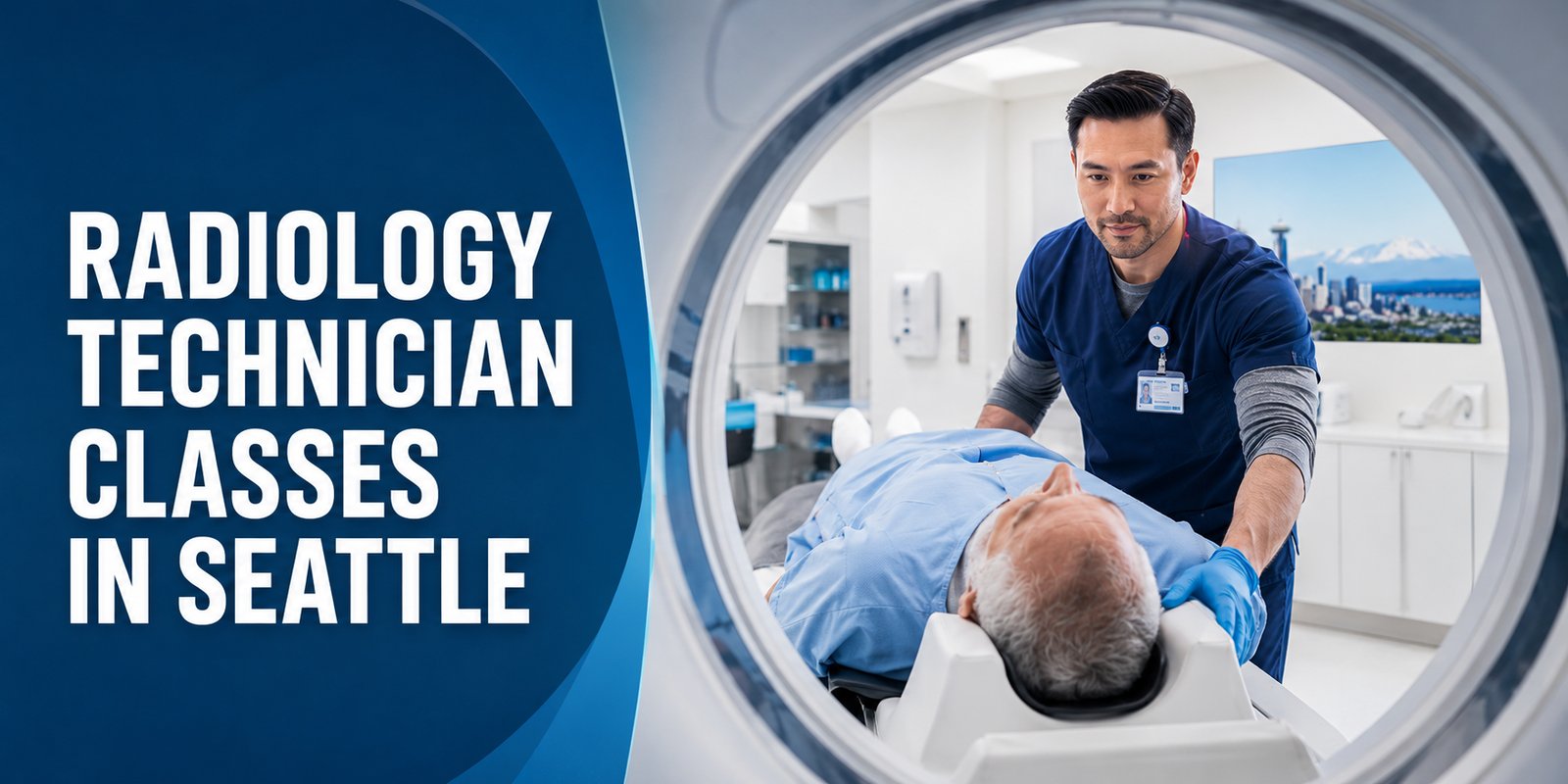
Seattle is one of the best-paying places in the country to work as a radiology technician, with a Washington median of $102,090 a year, roughly $21,980 above the national median. It is also one of the states that asks a bit more of you before you start: Washington requires its own state certification, on top of the national ARRT credential, before you can take a single X-ray. So the path here is a little different from most metros, and the payoff at the end is a little bigger. Between the community colleges and private programs around Puget Sound, you have real choices in cost and speed too. Here is how the pay, the credential, and the programs fit together.
Key Points
- The Washington median for radiology techs is $102,090 a year, about $21,980 above the national median and one of the highest of any state.
- Washington requires a state certification through the Department of Health, on top of national ARRT certification, before you can take diagnostic X-rays.
- The standard path is an accredited associate degree of about 2 years, followed by the ARRT exam and then your Washington certificate.
- Seattle-area training splits between lower-cost community colleges, which can carry waitlists, and private programs that cost more but admit faster.
- Most Seattle imaging jobs run through its big health systems, including UW Medicine, Swedish, and MultiCare.
Radiology Techs in Seattle Are Among the Best-Paid in the Country
Pay is the first reason to look closely at this career in Seattle. In Washington, a radiology tech's median pay is $102,090 a year, or $49.08 an hour, about $21,980 above the national median. That puts the state near the top of every pay ranking in the field, driven by a high cost of living and a dense cluster of hospital systems competing for imaging staff.
Those systems are where most of the work sits. UW Medicine and its Harborview Medical Center, Swedish, MultiCare, Virginia Mason Franciscan Health, Fred Hutch, and Kaiser Permanente Washington all run imaging across the metro, alongside a wide network of outpatient centers and specialty clinics. That concentration keeps demand steady, and nationally the field is projected to grow about 4 percent through 2034.
Do You Need a License in Washington?
Yes, and this is where Washington differs from a lot of states. To take diagnostic X-rays here, you need a state certification as a radiologic technologist from the Washington State Department of Health, required on top of your national credential. Some guides call Washington a state with "no license," but that is a wording technicality: the state certifies rather than licenses, and that certification is mandatory before you can work.
The route to it runs through 3 stages. You start by completing an accredited radiography program, typically a two-year associate degree with clinical rotations folded in. Next comes the national ARRT exam, a $225 test that earns you the R.T.(R) credential once you pass. Finally, you send your credentials to the Washington Department of Health and apply for the state certificate that clears you to work. After that, the certificate renews on a two-year cycle tied to your birthday, and the state adds no continuing education of its own beyond what the ARRT already requires.
How to Choose a Radiology Program in Seattle
With no shortage of programs around Puget Sound, the real question is which one fits your budget and timeline, and the tradeoff usually comes down to cost versus speed. Community and technical colleges are the most affordable route, but their radiography programs admit selectively and often carry waitlists, since clinical placements cap how many students each cohort can take. Private and for-profit programs cost more, sometimes a lot more, but tend to admit faster and start more often. Whichever way you lean, confirm the program is accredited so it leads to the ARRT exam, because that credential is the gateway to your Washington certificate.
Two practical filters help. If price and finishing soonest matter most, the cheapest and fastest radiology technician programs on Dreambound show which routes cost the least and move quickest. To line up Seattle-area options side by side, browse radiology technician classes near you and filter by length, cost, and schedule.
Frequently Asked Questions
How much do radiology techs make in Seattle?
A lot, by national standards. Washington's median for radiologic technologists is about $102,090 a year, roughly $21,980 above the national median and among the highest of any state. Pay climbs with experience and with specialized modalities like CT and MRI, and the Seattle metro sits at the higher end of the state thanks to its concentration of major hospitals.
Who gets paid more, an MRI tech or a radiology tech?
MRI technologists, on the whole. Nationally, MRI techs earn a median near $88,000 a year, above the roughly $80,000 median for general radiologic technologists. MRI is a specialty most techs add after starting in general radiography, so in a high-paying market like Seattle it usually works as a raise you grow into rather than a starting point.
Can you take radiology tech classes online in Seattle?
To a point. Most programs let you handle the lecture work, the anatomy, physics, and terminology, online or on a hybrid schedule, but the clinical rotations are hands-on and have to be done on site. There is no fully online path to ARRT eligibility, since the registry requires real supervised imaging hours. Dreambound's online radiology technician classes point you to the programs that keep the coursework remote while arranging clinical placement nearby.
What is the fastest way to become a radiology tech in Seattle?
The quickest realistic route is a two-year accredited associate degree, since the ARRT will not certify you without at least that level of schooling plus the clinical hours. Private programs that admit on a rolling basis can get you started sooner than a community college with a waitlist, though they usually cost more. Short "X-ray operator" courses exist, but they lead to limited roles rather than the full R.T.(R) credential most Seattle employers want.
Getting Into Radiology in Seattle
Seattle makes this career worth the effort it asks for. The pay sits among the best in the country, and while Washington's extra step, its state certification, means a little more paperwork than some states, it is a small price for a market this strong. Keep the sequence in mind: an accredited program, the ARRT exam, then your state certificate, in that order.
Once you know which program fits your budget and timeline, compare Seattle radiology options on Dreambound by cost, length, and schedule, and confirm your pick is accredited before you commit. That accreditation is what carries you all the way to the certification that lets you work.