Surgical Tech Certification: CST vs TS-C and How to Earn One
See if you qualify for Surgical Technician programs
Answer a few questions in 2 minutes. Free, no commitment.
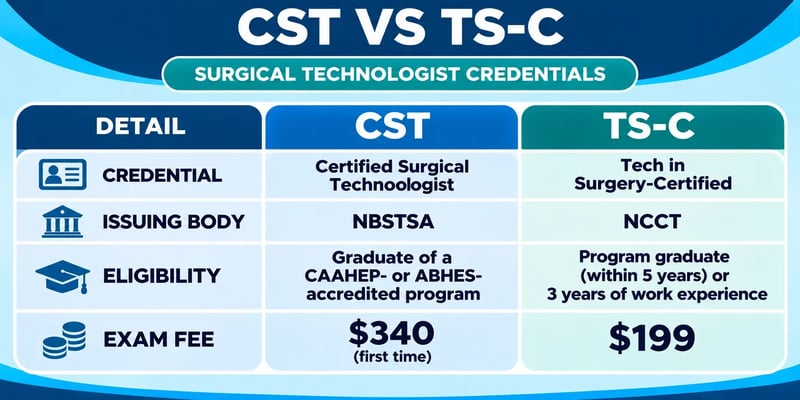
Surgical tech certification comes from two national credentials: the Certified Surgical Technologist (CST) from the National Board of Surgical Technology and Surgical Assisting (NBSTSA), and the Tech in Surgery-Certified (TS-C) from the National Center for Competency Testing (NCCT). Both require passing an exam, and the one you can sit for depends on how you trained. Some states require a credential, and employers can ask for one even where the state does not.
Certification is separate from training. A program teaches the work, the exam tests it, and CST eligibility depends on finishing an accredited program first. For a look at the job itself, see what a surgical technician does day to day. Fees and eligibility below come from NBSTSA's 2026 candidate handbook and application, NCCT's current pages, and the statutes cited in each section.
What Does Certification Cost, and What Does Renewal Cost?
According to NBSTSA's 2026 candidate handbook, the first-time CST exam costs $340, or $230 for members of the Association of Surgical Technologists (AST). Of the total, $100 is a non-refundable application processing fee. A retake costs $300, and a rush option adds $85 for first-time candidates. The TS-C exam fee at NCCT is $199.
Renewing a CST costs $40, or $140 with the $100 late fee when the application arrives 1 to 90 days after expiration. Renewal by examination costs $540. NBSTSA moves its continuing education platform on January 5, 2027. Certifications expiring from January 5 through May 31, 2027 are pointed to transition options on the NBSTSA renewals page, and expiration dates do not change. NBSTSA sets the certification cycle and the continuing education credits required, so confirm both there. Check NCCT for TS-C renewal terms.
Frequently Asked Questions
Is certification required to work as a surgical tech?
Surgical tech certification is a legal requirement in some states, such as New York and Texas, and an employer can ask for it even where the law does not. Colorado uses state registration, which is separate from national certification. Dreambound's guides cover surgical technologist rules in New York, Texas surgical technologist requirements, and Colorado surgical technologist registration.
Can you take the CST exam without graduating from an accredited program?
Yes, but only through two routes: completing a military surgical technology training program, or being a current or previous CST. Work experience alone is not a listed CST route. The TS-C from NCCT is different, with an experience route of three years of full-time, verifiable surgical technologist work within the past five years.
Does surgical tech certification expire?
Yes, the CST expires and has to be renewed through NBSTSA. Renewal costs $40, or $140 when filed 1 to 90 days after expiration. Continuing education credits cannot be earned after expiration, so a candidate without them applies to recertify by examination at $540. NBSTSA sets the cycle length, so confirm it there.
How much do surgical techs get paid?
Surgical technologists earned a median of $64,650 a year in May 2025, according to the U.S. Bureau of Labor Statistics (Occupational Outlook Handbook, updated August 27, 2026). BLS does not publish pay by credential. For percentiles, hourly rates, and workplace differences, see what surgical techs earn by percentile, hourly rate, and workplace.
Your Next Step Toward a Surgical Tech Credential
Confirm accreditation before anything else, because it decides which exam you can sit for. Then compare programs by length, cost, and location, starting with Dreambound's guide to comparing surgical tech programs by type, state, and city. Dreambound is a marketplace, not a school, so eligibility and exam results rest with NBSTSA or NCCT, not with any program listing.