Key Points
- Online usually means hybrid: coursework online, clinical work in person.
- CST eligibility generally depends on a CAAHEP- or ABHES-accredited program (NBSTSA).
- Check accreditation before you pay.
- Compare format, clinical placement, and total cost with each school.

Can You Become a Surgical Tech Online?
Partly. Lectures and coursework such as anatomy and medical terminology can be done online, but the sterile technique lab and the clinical hours in an operating room happen in person. That split is why four of the five partnered programs listed below are labeled Hybrid.
The U.S. Bureau of Labor Statistics (BLS) says surgical technologists typically need a certificate or an associate's degree from an accredited program, and that community colleges and vocational schools offer them, along with some universities and hospitals. The work explains why. A surgical tech sets up the operating room and passes instruments to the surgeon under strict sterile technique, and the programs below teach that through labs and clinical experience.
Some programs labeled fully online still include a clinical placement. Preppy's Dreambound listing, for instance, includes a local placement at a healthcare facility. Whatever the program, ask who arranges the placement and where it happens. For the whole path from program to first job, read the full steps to become a surgical tech.
What Happens Online and What Stays In Person
An online surgical tech program has two parts: the work you can do from home and the work that needs a lab or an operating room. Each program sets its own split, so treat this table as a starting point.
Sources: program pages reviewed on Dreambound; NBSTSA 2026 CST candidate handbook for exam location. Individual programs vary.
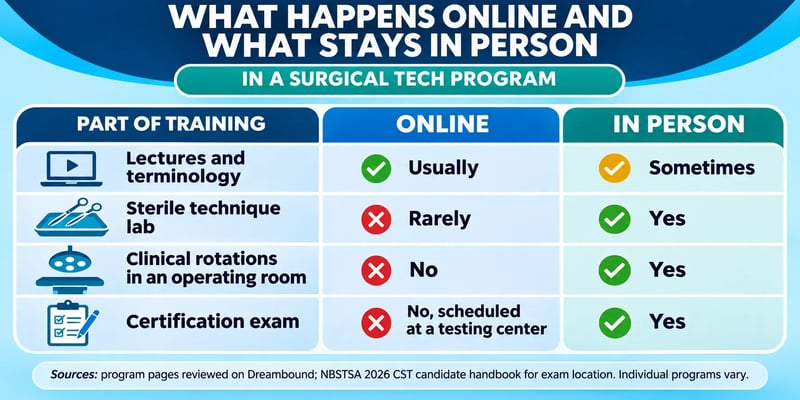
The CST exam is computer-based, yet the NBSTSA 2026 candidate handbook says exams are offered year-round at PSI testing centers. A candidate who studied entirely online still tests at one of those centers, and the handbook makes a separate arrangement only for military applicants stationed far from one.
Ask first about the clinical hours: how many the program includes and whether the school places you or you find your own site.
Are Online Surgical Tech Programs Legit? How to Check Accreditation
They can be, but legitimacy comes down to accreditation you can verify yourself, not to how a program describes itself. For anyone planning to sit for the CST exam, that means a program accredited by CAAHEP or ABHES.
NBSTSA's handbook names those two accreditors. It also accepts graduates of military surgical technology programs and people who are or were certified as a CST. The BLS likewise says certification generally requires completing an accredited education or military training program, so the accredited program is the route to plan around.
To check a program, search the CAAHEP directory of accredited programs. It lists only programs that are currently accredited or hold a Letter of Review, and it lets you search by institution name or location, then narrow by profession and degree type. If a program on your shortlist says it is among the CAAHEP-accredited online surgical tech programs, it should show up in that search.
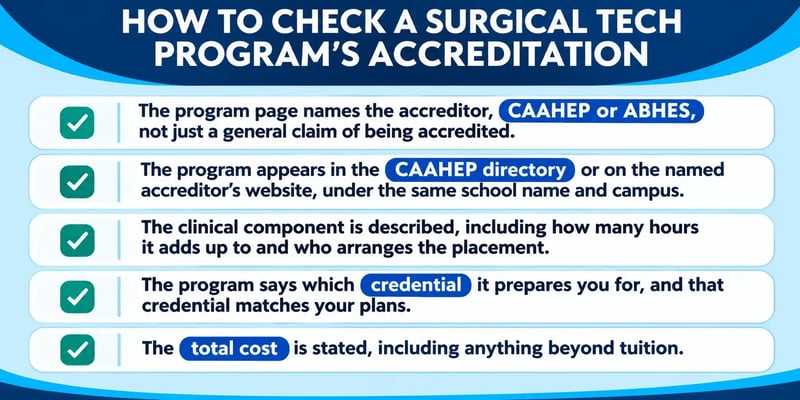
Run each program through this checklist before you pay anything:
- The program page names the accreditor, CAAHEP or ABHES, not just a general claim of being accredited.
- The program appears in the CAAHEP directory or on the named accreditor's website, under the same school name and campus.
- The clinical component is described, including how many hours it adds up to and who arranges the placement.
- The program says which credential it prepares you for, and that credential matches your plans.
- The total cost is stated, including anything beyond tuition.
Treat these as red flags:
- Some pages name only the school's own accreditor, or just say "nationally accredited," and say nothing about the program itself.
- A few university-branded online courses say in their own descriptions that they are not CAAHEP-approved.
- No clinical training is mentioned anywhere on the page.
- The page promises a job or certification within weeks.
Online Certificates, Degrees, and Standalone Courses
An online surgical tech course, a certificate, and an associate degree differ mainly in how much hands-on training they include and what they lead to. The BLS lists a certificate or an associate's degree from an accredited program as the typical way in, so start by comparing those two.
- Standalone courses focus on coursework. Some state in their own descriptions that they are not CAAHEP-approved or not an associate degree, so read what the course says it leads to.
- Certificates and associate degrees follow different timelines, and how long surgical tech school takes compares them side by side.
- An associate degree in surgical technology with part of the coursework online takes longer. Of the associate programs listed below, the two that publish a length run from a 16-month minimum to 18 months.
Whether a school calls it an online surgical technologist program or a surgical tech course, the same two questions apply: what is actually online, and who accredits it.
Which exam you can take depends on the program you finish, either the CST from NBSTSA or the TS-C from NCCT. Eligibility, fees, and renewal are covered in how surgical tech certification works.
Featured Surgical Tech Programs on Dreambound
Dreambound is a free platform that helps you compare training programs across the United States. These five partnered programs state a hybrid or online format on their Dreambound pages, and the details below are as each page states them.
- Format: Hybrid
- Combines classroom instruction, hands-on lab training, and clinical experience
- Format: Hybrid
- Length: 18 months (102 quarter credit hours)
- Includes classroom instruction, lab simulations, and clinical externships at hospitals and surgical centers
- Format: Hybrid
- Teaching approach: Learning by Doing, with labs, workshops, and practical activities