Certified Nursing Assistant Salary: Hourly Wage vs. Annual Pay Breakdown

See if you qualify for Certified Nursing Assistant programs
Answer a few questions in 2 minutes. Free, no commitment.
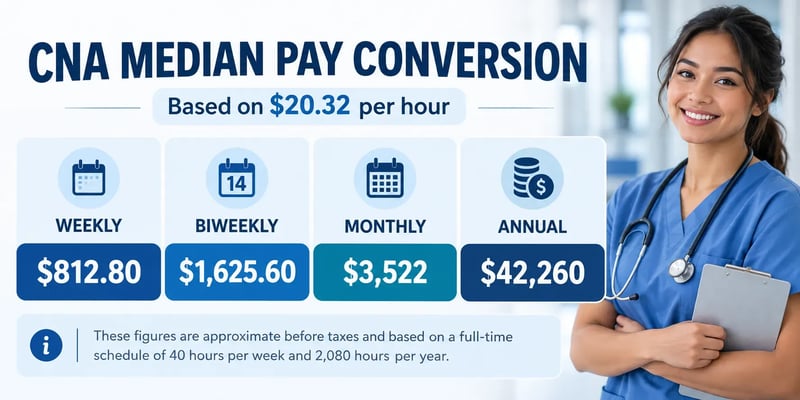
Certified nursing assistants are typically paid by the hour, so a certified nursing assistant salary is really an hourly wage multiplied by the hours you work. The median CNA salary works out to $42,260 a year, based on a median wage of $20.32 an hour on a full-time schedule, according to May 2025 data from the Bureau of Labor Statistics (BLS).
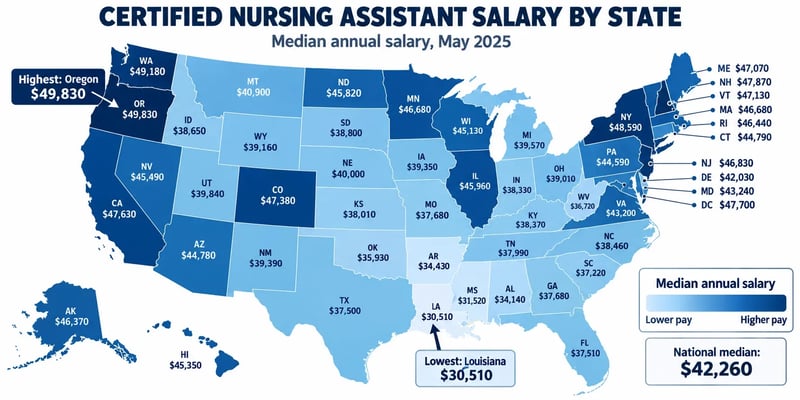
That yearly figure assumes 40 hours a week, every week, with no extra pay. Overtime, night and weekend differentials, and the choice between a staff job and contract shifts can move your real annual pay by thousands of dollars in either direction. Location matters too, since the state CNA median runs from $30,510 in Louisiana to $49,830 in Oregon.
Certified Nursing Assistant Salary by State
Oregon pays certified nursing assistants the most, with a median of $49,830 a year, or $23.96 an hour, while Louisiana pays the least at $30,510, or $14.67 an hour. That's a gap of $19,320 a year for the same certification, based on May 2025 BLS data.
Most of the highest-paying states are on the West Coast or in the Northeast. In Oregon and Washington, about 90% of CNAs earn more than the national median of $42,260, since even the 10th percentile wage in both states is higher. Overall, 23 states and the District of Columbia have CNA medians above the national figure.
Pay looks different once you factor in living costs. Adjusted with the Bureau of Economic Analysis's 2024 regional price parities, North Dakota ranks first, since its $45,820 median buys about what $51,500 would in an average-priced state. California drops from sixth to 25th, and New York falls from third to 15th. Louisiana stays last either way.
State | Median Hourly Wage | Median Annual Salary |
|---|---|---|
Oregon | $23.96 | $49,830 |
Washington | $23.65 | $49,180 |
New York | $23.36 | $48,590 |
New Hampshire | $23.02 | $47,870 |
District of Columbia | $22.93 | $47,700 |
California | $22.90 | $47,630 |
Colorado | $22.78 | $47,380 |
Vermont | $22.66 | $47,130 |
Maine | $22.63 | $47,070 |
New Jersey | $22.52 | $46,830 |
Massachusetts | $22.44 | $46,680 |
Minnesota | $22.44 | $46,680 |
Rhode Island | $22.33 | $46,440 |
Alaska | $22.29 | $46,370 |
Illinois | $22.10 | $45,960 |
North Dakota | $22.03 | $45,820 |
Nevada | $21.87 | $45,490 |
Hawaii | $21.80 | $45,350 |
Wisconsin | $21.70 | $45,130 |
Connecticut | $21.53 | $44,790 |
Arizona | $21.53 | $44,780 |
Pennsylvania | $21.44 | $44,590 |
Maryland | $20.79 | $43,240 |
Virginia | $20.77 | $43,200 |
Delaware | $20.21 | $42,030 |
Montana | $19.67 | $40,900 |
Nebraska | $19.23 | $40,000 |
Utah | $19.15 | $39,840 |
Michigan | $19.03 | $39,570 |
New Mexico | $18.94 | $39,390 |
Iowa | $18.92 | $39,350 |
Wyoming | $18.83 | $39,160 |
Ohio | $18.76 | $39,010 |
South Dakota | $18.65 | $38,800 |
Idaho | $18.58 | $38,650 |
North Carolina | $18.49 | $38,460 |
Kentucky | $18.45 | $38,370 |
Indiana | $18.43 | $38,330 |
Kansas | $18.27 | $38,010 |
Tennessee | $18.27 | $37,990 |
Georgia | $18.12 | $37,680 |
Missouri | $18.11 | $37,680 |
Florida | $18.03 | $37,510 |
Texas | $18.03 | $37,500 |
South Carolina | $17.90 | $37,220 |
West Virginia | $17.66 | $36,720 |
Oklahoma | $17.27 | $35,930 |
Arkansas | $16.55 | $34,430 |
Alabama | $16.41 | $34,140 |
Mississippi | $15.15 | $31,520 |
Louisiana | $14.67 | $30,510 |
Source: BLS Occupational Employment and Wage Statistics, May 2025, via O*NET OnLine.
Highest-Paying Metro Areas for CNAs
San Jose-Sunnyvale-Santa Clara, California, is the highest-paying metro area for CNAs, with a median of $56,840 a year, or $27.33 an hour. Four of the 10 highest-paying metros are in California, and Oregon has three, including the Portland metro.
Metro Area | Median Hourly Wage | Median Annual Salary |
|---|---|---|
San Jose-Sunnyvale-Santa Clara, CA | $27.33 | $56,840 |
San Francisco-Oakland-Fremont, CA | $26.96 | $56,080 |
Seattle-Tacoma-Bellevue, WA | $25.00 | $51,990 |
Napa, CA | $24.21 | $50,370 |
Portland-Vancouver-Hillsboro, OR-WA | $24.21 | $50,350 |
Bend, OR | $24.08 | $50,080 |
Boulder, CO | $23.97 | $49,860 |
Grants Pass, OR | $23.93 | $49,770 |
New York-Newark-Jersey City, NY-NJ | $23.69 | $49,270 |
Santa Rosa-Petaluma, CA | $23.67 | $49,240 |
In the San Francisco-Oakland-Fremont metro, the BLS median is $26.96 an hour. Pay estimates from job sites vary for the same area. As of October 2026, Indeed puts the San Francisco average at $26.56 an hour, while ZipRecruiter's Bay Area estimate is $21.43. Comparing several sources, plus real local job listings, gives you a clearer picture of what an offer is worth.
Big-city pay also varies by region. At the median, a CNA in the Chicago metro earns $22.57 an hour, while one in the Houston metro earns $18.26, a difference of about $4.30 an hour.
Featured CNA Programs on Dreambound
Dreambound gathers training programs from partner schools in one place, so you can weigh them before you choose. The CNA programs featured here are in Texas, where the CNA median is $37,500 a year, or $18.03 an hour.
Pay runs a little higher in the metros these schools serve, with medians of $38,530 in Dallas-Fort Worth-Arlington and $38,550 in Austin-Round Rock-San Marcos. Texas has its own training and exam steps, which our guide on how to become a CNA in Texas lays out.
Certified Nursing Assistant - TSC Career Institute
- Format: Hybrid
- Length: 3 weeks
- Tuition: $1,050 total
- Authorized by the Texas Department of Health and Human Services to offer a Nurse Aide Training and Competency Evaluation Program (NATCEP)
Certified Nursing Assistant - Williams Career School of Excellence
- Format: Hybrid
- Tuition: $725 to start, $1,450 total
- Day, evening, and weekend schedules
Nurse Aide - Diamond Career Institute
- Format: Hybrid
- Length: 5 weeks
- Tuition: $274 to start, $920 total
- Includes hands-on clinical experience
For more options, see our guide to CNA classes near you.
Frequently Asked Questions
What is the most a CNA can make an hour?
The top 10% of CNAs nationally earn more than $24.99 an hour in base pay, based on May 2025 BLS data. In the highest-paying metro, San Jose-Sunnyvale-Santa Clara, California, the top 10% earn more than $37.04 an hour. Overtime, shift differentials, and bonuses come on top of those base rates.
Can a CNA make $30 an hour?
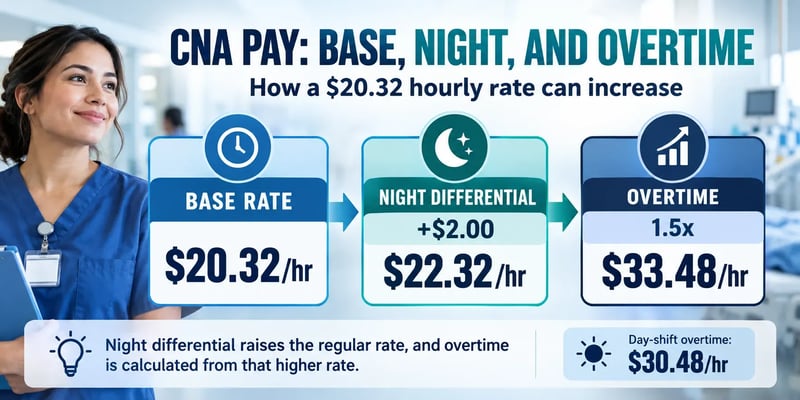
Yes, in some markets. The top 10% of CNAs earn more than $30 an hour in base pay in Washington state and in six metro areas, including San Jose ($37.04), San Francisco ($33.91), and Seattle ($32.35). Overtime gets you there too, since a CNA earning the national median of $20.32 makes $30.48 an hour in overtime.
Is becoming a certified nursing assistant worth it?
It can be if you want a short route into patient care. Federal rules require at least 75 hours of training, and BLS projects about 203,300 openings a year for nursing assistants and orderlies from 2025 to 2035. CNA work can also lead to higher-paying nursing roles, such as licensed practical nurses, who earn a median of $64,400, as our LPN salary guide shows.
Which is best, CNA or RN?
It depends on how much time and schooling you can commit right now. Registered nurses earn a median of $97,550 a year, compared with $42,260 for CNAs, but becoming an RN takes a nursing degree or diploma and passing the NCLEX-RN licensing exam, while CNA training takes weeks. You can start as a CNA and move up later, and our registered nurse salary guide shows what that step pays by state.
Comparing CNA Job Offers Beyond the Hourly Rate
Two CNA offers with the same hourly rate can end up thousands of dollars apart by the end of the year. The difference sits in the details: whether overtime runs on a 40-hour week or the 8 and 80 system, how much the night or weekend differential pays, how many hours you need to qualify for benefits, and whether a sign-on bonus comes with a work commitment.
Ask for each of those in writing before you accept, then convert every offer to a yearly figure based on the schedule you'll really work. When you're ready to train, Dreambound lets you line up CNA programs side by side, including hybrid programs.