Key Points
- The best software developer recruiters specialize by tech stack or seniority level rather than recruiting generalist roles.
- Recruiter fees are typically structured as a percentage of first-year salary, contingency-based, or retained.
- A strong technical recruiter can screen for actual coding ability, not just resume keywords.
- Response speed and candidate pipeline quality are better indicators of recruiter quality than years in business alone.

What Makes a Good Software Developer Recruiter?
Three traits separate a specialized technical recruiter from a generalist, and you can test for each of them in a first call.
The first is fluency in the stack and the role. A good recruiter knows that a frontend engineer who lives in React is not a backend engineer who lives in Go, and that DevOps and mobile are their own disciplines. They also know that "full stack" means something different at a ten-person startup than at a bank. That fluency shows up in the questions they ask about the role before they ask about the budget.
Specialization by seniority matters as much as specialization by stack, because the market has tilted toward experienced hires. In Indeed Hiring Lab's analysis, senior-level positions accounted for 69.3% of software development postings in the first quarter of 2026, while entry-level roles were 4.5%.
The second is a warm network. A specialist has spent years talking to engineers who are employed, not looking, and open to the right call, and those passive candidates are the ones a job board never reaches. Ask who they placed in the last six months and where those people came from.
The third is the ability to represent your requirements accurately. A recruiter who cannot explain your architecture, your on-call expectations, or why the role exists will either oversell it and lose the candidate at the technical interview, or undersell it and never get the candidate on the phone. The good ones push back on a vague job description before they start sourcing, because they know what a strong engineer will ask.
Types of Software Developer Recruiters
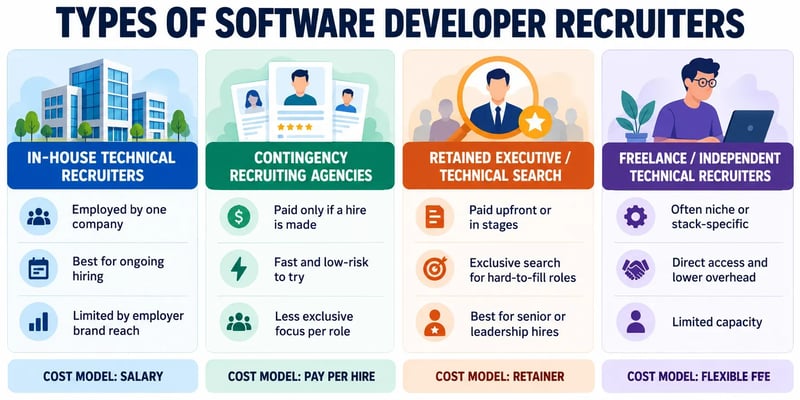
Most recruiters fall into one of four models, and the model shapes the fee, the speed, and how much attention your role gets.
In-House Technical Recruiters
An in-house technical recruiter is a salaried employee who recruits only for your company. The model fits companies with steady, ongoing hiring and the budget to build an internal talent function, because the cost is a salary and tools rather than a fee per hire. The tradeoff is reach, since an internal recruiter's network is only as wide as the company's own brand.
Contingency Recruiting Agencies
A contingency recruiting agency is paid only when you hire a candidate it submitted, so it is fast to engage and low-risk to try. Because the agency carries that risk across many clients, no single role gets its exclusive focus. Large staffing agencies such as Insight Global, TEKsystems, Robert Half, and Kforce run this model at scale. Boutique engineering recruiters such as Motion Recruitment and 180 Engineering use the same model with a narrower focus.
Retained Executive/Technical Search Firms
A retained search firm is paid upfront or in stages, often in thirds at signing, shortlist, and hire, and it works your role exclusively until it is filled. Companies use this model for senior, hard-to-fill, or leadership technical roles such as a VP of Engineering or a head of platform. Executive search firms such as Riviera Partners concentrate here.
Freelance/Independent Technical Recruiters
An independent recruiter is often a former in-house or agency recruiter who now works alone or with a small team, usually in one stack or one industry. Lower overhead means fees at the low end of the range and direct access to the person doing the sourcing. The limit is capacity, because one person can run only a few searches well at a time.
How Software Developer Recruiter Fees Work
Contingency fees are the most common structure. The agency charges a percentage of the hire's first-year base salary, generally 15% to 30% depending on seniority and whether you give the agency exclusivity, and the fee is due only when the candidate starts. In Top Echelon's analysis of placements across its recruiter network, the average fee was 21.5%, and 22% for IT roles, based on 2018 placement data.
Salary context makes those percentages concrete. The Bureau of Labor Statistics reports a median wage of $134,040 a year, or $64.44 an hour, for software developers, quality assurance analysts, and testers as of May 2025, and $135,980 for software developers alone. A 20% contingency fee on that developer median is about $27,200 per hire.
BLS projects employment in the group to grow 10% from 2025 to 2035, much faster than the average for all occupations, with about 106,100 openings a year. The fee buys speed in a market that is not getting easier.
Retained searches cost more, often 25% to 35% of first-year compensation, paid in installments over the search rather than at the hire. Some newer agencies offer flat fees or monthly subscriptions that cover a set number of hires, which can beat contingency pricing for a plan of five or more hires a year. Candidates do not pay any of this. The employer carries the fee.
The cheapest fee is rarely the best value. A 15% fee on a candidate who leaves at month four costs more than a 25% fee on one who stays, once you count the second search and the months without an engineer.
Questions to Ask Before Hiring a Software Developer Recruiter
Five questions, one per category, will tell you most of what you need to know in a 30-minute call.
- Specialization: What tech stacks or seniority levels do you focus on? A good answer names two or three stacks and a seniority band, with recent placements to match. "Everything" is a generalist's answer.
- Process: How do you technically vet candidates before submitting them? Listen for specifics, such as a code review, a take-home exercise, a technical screen run by an engineer, or a structured interview on the stack. Checking a resume and two references is not vetting.
- Pipeline: What's your average time-to-fill for a similar role? Expect a range with examples. Some large agencies advertise first candidates within 24 to 48 hours, but the number that matters is days from first submission to accepted offer.
- Guarantee: What happens if a placed candidate leaves within the first few months? Most recruiters offer a guarantee. Ask whether it is a replacement or a refund, how long it runs, and what voids it.
- Fees: Is the fee contingency-based, retained, or flat, and when is it due? Get the percentage, what it is calculated on (base salary alone, or base plus bonus and equity), and the payment terms in writing before the first candidate arrives.
Red Flags to Watch For in a Software Developer Recruiter
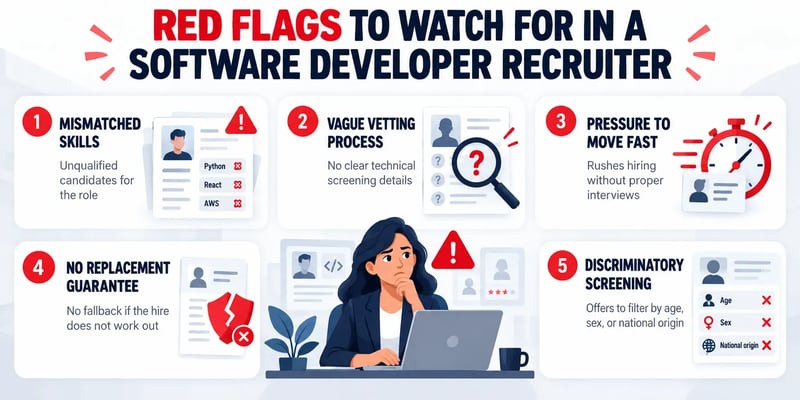
Some warning signs show up in the first week, and each one is a reason to stop before a fee is on the line.
- Candidates with clearly mismatched skills. If the first batch includes a data analyst for a mobile role, the recruiter is matching keywords rather than reading resumes.
- Vague answers about the technical vetting process. "We have a rigorous process" with no detail behind it usually means there is no process.
- Pressure to move fast without proper interviews. Urgency is sometimes real, but a recruiter who discourages a technical interview is protecting a fee, not your team.
- No replacement guarantee if a hire does not work out. In one large recruiter network's survey, 95.9% of recruiters offered a guarantee and 90 days was the most common term, so a recruiter who offers none is outside the norm.
- Offers to screen by age, sex, or national origin. Title VII makes it unlawful for an employment agency to refer or classify candidates by race, color, religion, sex, or national origin, and the Age Discrimination in Employment Act does the same for age. The EEOC's policy guidance on agencies says investigators also look at the employers who requested that screening. A recruiter who proposes it is exposing you, not helping you.
In-House Recruiting vs. Hiring a Software Developer Recruiter
The decision comes down to volume, budget, and how common the role is. If you hire developers every month, an in-house technical recruiter pays for itself quickly. SHRM's 2025 benchmarking reports put the average cost per nonexecutive hire at $5,475, against a contingency fee in the mid five figures for a single senior developer. If you hire a few times a year, or the role is niche or senior, an outside specialist with an existing network usually fills it faster.
Entry-level roles are the clearest case for doing it yourself. Agency recruiters are candid that they rarely place developers with less than a year of experience, because no client pays a five-figure fee for an unproven hire, so post those roles directly and save the recruiter for the senior search. If the real question is whether to hire developers at all or to bring in an outside firm to build the product, the guide on how to choose a custom software development partner walks through that decision.