Key Points
- Co-development software involves two or more parties actively building a product together, not one party contracting out the work.
- It differs from traditional outsourcing because both sides contribute technical expertise, resources, or IP.
- It is common when a company has domain expertise but lacks in-house engineering capacity, or the other way around.
- A clear agreement covering IP ownership, revenue or cost sharing, and decision-making authority is essential before any code is written.

What Does Co-Development Software Mean?
Co-development software means software that two or more organizations design, build, and own together under a written agreement. Each party puts something real into the work, such as engineers, funding, industry knowledge, or existing code, and each expects something back, such as revenue or a license to use the product. A work prepared by two or more authors who intend their contributions to merge into one whole is treated as a joint work under copyright law, and each author shares an undivided interest in all of it. In plain terms, two companies that write code together without a contract can both end up owning the whole thing.
The term also has a second meaning in search results and product marketing, where vendors use it for shared platforms such as GitHub, GitLab, and Jira that let separate teams plan, write, review, and ship code in one place. Those tools support a co-development arrangement, but the agreement between the parties is what makes it co-development.
Three adjacent terms get confused with it:
- Outsourced development: one party builds to the other's specification and hands over the result, and ownership usually passes to the client in full.
- Joint venture: a broader business arrangement, often a separate legal entity, that can cover sales, marketing, and operations as well as the software.
- Open-source collaboration: public code released under an open-source license that anyone may use, modify, and redistribute, usually run by a community or a foundation rather than two contracting parties.
How Does Co-Development Software Work?
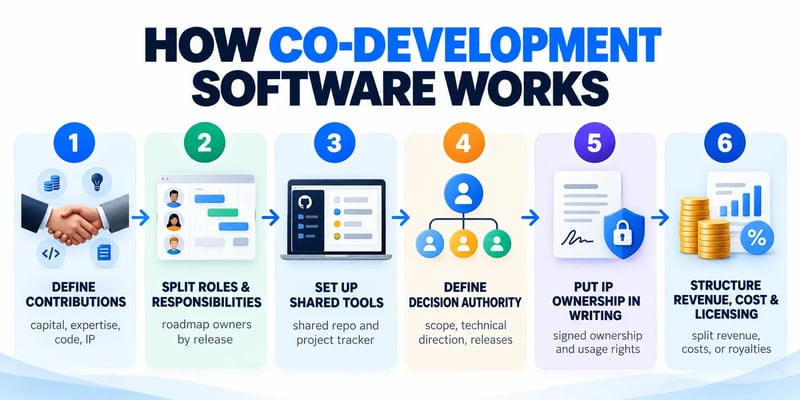
Most co-development arrangements move through six steps, in an order that matters because each depends on the one before it.
- Define What Each Side Contributes
Both parties list what they bring: capital, domain expertise, engineering resources, or existing IP such as code, data, or patents. Put numbers on the list, meaning headcount, hours, dollars, and named assets, because every later term on ownership and revenue traces back to it.
- Split Roles and Responsibilities Across the Product Roadmap
Once contributions are clear, the parties divide the work. One side might own the customer-facing product while the other builds the data layer. Each release then gets a named owner on each side so that nothing waits on an unnamed someone.
- Set Up a Shared Codebase and Project Management System
Both teams need one repository and one tracking system that everyone can reach under one set of permissions. In the 2025 Stack Overflow Developer Survey, 81.1% of respondents used GitHub, 46.4% used Jira, and 35.6% used GitLab, so most teams already share a common tool. Decide now who owns the repository account, since whoever controls it controls access to the code.
- Define Decision-Making Authority
Agree in advance who decides scope, technical direction, and release timing, and what happens when the two sides disagree. A common structure gives each party final say in its own area and routes cross-cutting disputes to a small steering group with a tie-breaking rule.
- Put IP Ownership and Future Usage Rights in Writing
Decide who will own the finished product, who may license it, and what each party may do with the code after the project ends, then put it in a signed document. Under federal law, a transfer of copyright ownership is not valid unless it is in writing and signed by the owner, so a verbal understanding moves nothing.
- Structure Revenue, Cost, or Licensing Terms
Finally, the money terms follow the contribution list from step 1. The parties can split costs and revenue in proportion to what each invested. They can also pay one party a license fee or royalty for its IP, or grant one side exclusive rights in a market in exchange for carrying more of the build cost.
Benefits of a Co-Development Software Model
When the two sides bring different strengths, co-development offers advantages that neither outsourcing nor hiring can match on its own.
- Access to specialized technical talent without building an in-house team from scratch. A company with deep industry knowledge can pair with an engineering partner and start building in weeks instead of spending months recruiting.
- Shared financial risk on R&D-heavy projects. When both parties fund the work, neither carries the full cost of a product that takes longer than planned or needs a second version before it sells.
- Faster time to market. Domain knowledge and engineering capacity run in parallel rather than in sequence, so requirements, design, and code move forward at the same time.
- Commercial upside for both parties. Because both sides hold a stake in the result, both benefit when the product sells, which keeps incentives pointed in the same direction long after launch.
Risks and Challenges of Co-Development Software
The same shared ownership that makes co-development attractive is what makes it fail when the structure is loose.
IP disputes after launch are the most expensive problem. If the agreement is silent and both sides wrote code meant to merge into one product, that code is a joint work, and each co-owner may use or license it, owing the other only an accounting of profits. Your partner could legally license the shared product to your competitor, and you would be owed a share of the fee rather than a veto.
Misaligned priorities surface when the two parties have different business goals. A startup that needs revenue this quarter and an enterprise that needs five years of stability will make different calls on scope, release timing, and technical shortcuts, and the gap widens if no one names it early.
When the parties also compete in the same market, the arrangement raises antitrust questions. The Department of Justice and the Federal Trade Commission withdrew their 2000 guidelines on competitor collaborations in 2024 and asked for public comment on additional guidance in February 2026, so antitrust counsel belongs in the planning stage.
Unclear decision-making authority causes delays rather than disputes, which makes it easy to miss until the schedule slips. If every cross-team decision needs both CEOs, the project moves at the speed of their calendars.
Dependency risk appears when one party turns out to be less technically capable than it looked at the start. The stronger side carries more of the build while the ownership split stays put, and resentment follows. Staged contributions with checkpoints, where each party's share vests as its work lands, keep that from becoming a dispute.
What to Include in a Co-Development Software Agreement
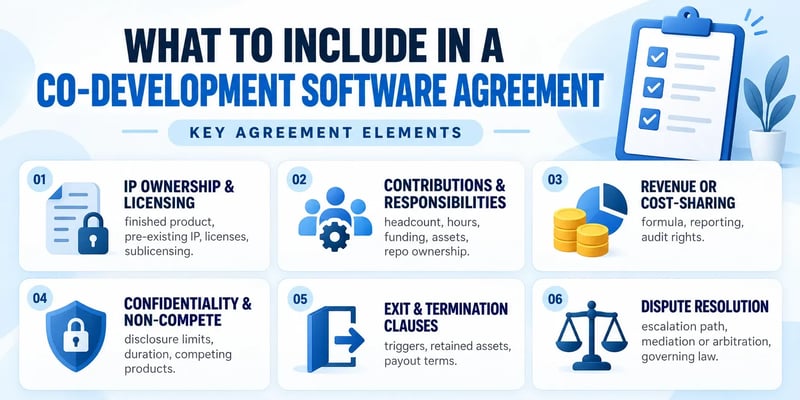
A co-development agreement does not need to be long, but it does need to answer six questions in writing before any code is committed.
- IP ownership and licensing terms. State who owns the finished product, who owns each party's pre-existing IP, and what license each side holds after the project ends, including whether either party may sell or sublicense.
- Scope of each party's contributions and responsibilities. List headcount, hours, funding, and assets by name, and say who owns the code repository. The 18F guide to de-risking government technology advises that code be delivered to a repository the buyer owns at the end of every development cycle, complete and tested, which works for either party here.
- Revenue or cost-sharing structure. Define the formula, the reporting each side owes the other, and the audit right that lets either party verify the numbers.
- Confidentiality and non-compete terms. Cover what each party may disclose, how long the obligation lasts, and whether either side may build a competing product during or after the term. The NIST Secure Software Development Framework includes protecting all forms of code from unauthorized access and tampering among its practices, a neutral standard worth writing into the agreement.
- Exit and termination clauses. Spell out what triggers termination, who keeps what when it happens, and how the departing party's contribution is valued and paid out.
- Dispute resolution process. Name the escalation path, whether disputes go to mediation or arbitration before court, and which state's law governs.
Is Co-Development Software Right for Your Project?
Co-development makes sense when both parties bring distinct, complementary value rather than one side bringing only money, and when both have a long-term interest in the product's success rather than a one-time handoff. A medical device maker with regulatory know-how and an engineering firm with embedded software experience are a natural pair. A company that only wants an app built to spec will usually do better with a vendor.
If the comparison points you toward a vendor rather than a partner, the next question is how to vet one. The guide on how to choose a custom software development partner covers technical fit, pricing models, and the red flags to walk away from.
Frequently Asked Questions
What's the difference between co-development and outsourced software development?
In outsourced development, one company pays another to build software to its specification and takes ownership under the contract. In co-development, both parties contribute resources, share decisions, and share ownership or revenue under one agreement. A quick test is to ask who carries the risk if the product fails. If only the client does, it is outsourcing.