12 Best Jobs for Nursing Students (Pay and Training)
See if you qualify for training programs
Answer a few questions in 2 minutes. Free, no commitment.
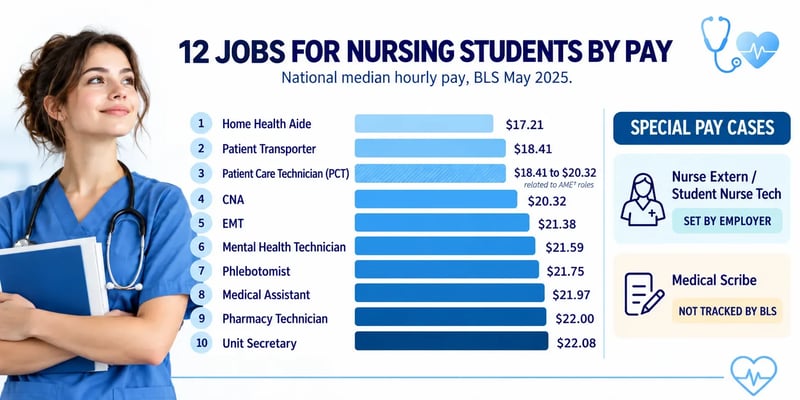
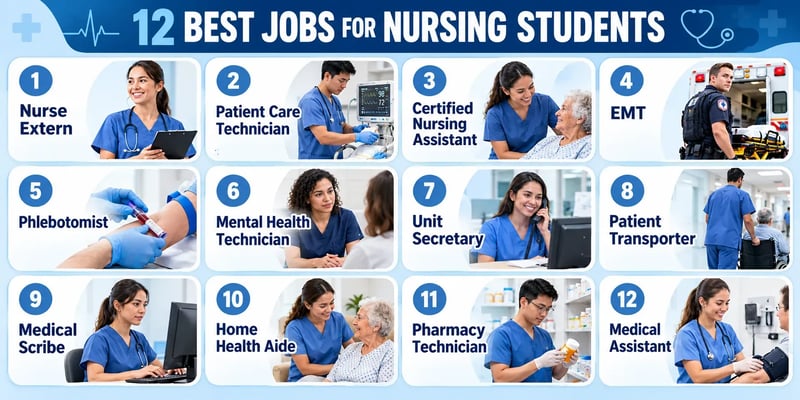
The best jobs for nursing students put you on a patient care unit and bend around clinicals, so nurse extern or student nurse tech, patient care technician, CNA, EMT, and phlebotomist lead this list. Pay sits in a narrow band. The certificate and entry-level roles here carry a national median of $17.21 to $22.08 an hour (BLS, May 2025), and hospital extern programs set their own rates, such as SSM Health's flat $18 an hour.
Timing matters as much as the title. Several of these jobs open after your first clinical semester or your Fundamentals course, and a few states let nursing students sit for the CNA exam without a separate CNA course. Each job is ranked by clinical value first, then by schedule fit and how fast you can start.
Pharmacy Technician Certification - CCI Training Center
- Format: Online
- Individual courses average three weeks, and the full program takes a few months
- ACCET accredited, with financial aid for those who qualify
Diploma in Medical Assisting - Herzing University
- Format: Online
- Requires a minimum of 24 semester credit hours
- Prepares students for the CCMA exam
Best Jobs for Nursing Students by Situation
With No Experience
The best jobs for nursing students with no experience are the ones that train on the job: patient transporter, mental health technician, unit secretary, medical scribe, and dietary or environmental services roles in a hospital. None requires a certificate, and each puts you inside a facility where you can watch for tech and extern openings, which is the real value of entry-level jobs for nursing students.
Best picks: patient transporter, mental health technician, unit secretary, medical scribe, dietary aide.
For Pre-Nursing Students
Jobs for pre-nursing students can be bigger investments, because you still have time before clinicals start. Medical assistant, CNA, phlebotomy, and EMT certificates all fit in the gap before an RN program, and hospital volunteering adds patient contact without a credential. If you want an internship for pre-nursing students, ask the hospital's volunteer office, since those programs, where they exist, are run locally.
Best picks: medical assistant, CNA, phlebotomist, EMT, hospital volunteer.
Part-Time and Flexible Jobs
Part-time jobs for nursing students work best when the employer already expects a school schedule. PRN (as-needed) tech and extern roles, weekend EMT or transporter shifts, and scribe shifts all fit, and SSM Health advertises a flexible schedule built around classes for its externs. In one widely read r/StudentNurse thread on part-time work, the most recommended picks were PRN hospital tech and nurse apprentice roles, telemetry monitoring, patient sitting, and unit clerk shifts, all chosen for the study time between tasks.
Best picks: PRN PCT or CNA, nurse extern, weekend transporter, scribe.
Remote Jobs
Remote jobs for nursing students are almost all non-clinical: remote medical scheduling, records, or prior authorization work (medical secretaries and administrative assistants, $22.08 median), remote scribing, and online tutoring. They pay and they flex, but they add no bedside hours, so treat them as the best side jobs for nursing students rather than a substitute for unit time.
Best picks: remote scheduler, telescribe, online tutor.
Summer Jobs
Summer jobs for nursing students split into two kinds. Summer externships are the main clinical option, with 10- and 11-week programs at hospitals such as University of Michigan Health and The University of Kansas Health System. Applications open the fall before, and both of those windows open in November for next summer. Full-time CNA, PCT, phlebotomy, or transport shifts are the fallback, and camp nursing assistant roles suit anyone leaning toward pediatrics. The best summer jobs for nursing students are the ones that convert into a PRN shift when classes resume.
Best picks: summer externship, full-time PCT or CNA, camp nursing assistant.
Can You Work While in Nursing School?
Yes, working while in nursing school is possible, but the evidence says hours matter more than the job title. In a 2020 inception cohort study published in Nurse Education Today, Salamonson and colleagues surveyed 1,314 first-year nursing students at four institutions in Australia and New Zealand. Students in paid work logged a median of 20 hours a week, and the more hours they worked, the lower their grades ran at the end of the first semester.
Students in non-nursing jobs also had higher odds of a high grade point average than those in nursing-related work (adjusted odds ratio 1.64). The authors' conclusion is about balance, since both the amount and the type of paid work affected performance. The study is Australasian, not American, so treat it as a signal about hours rather than a rule about which job to take.
The jobs to work while in nursing school are the ones with set, swappable shifts, and a few habits keep them from colliding with school:
- Cap your hours during clinical semesters. Working students in the study logged a median of 20 hours a week and grades fell as hours rose, so start lower and add shifts only in lecture-heavy terms.
- Pick PRN or weekend shifts so a schedule change at school does not cost you the job.
- Share your clinical schedule with the manager before you accept the offer, and again at the start of every semester.
- The best shift to work while in nursing school is the one that never collides with clinicals, which for most students means weekend or evening shifts and nothing the night before a clinical day.
- Working during nursing school is easier to sustain when the job teaches something you need, such as medications at a pharmacy or charting as a scribe.
How to Get a Job as a Nursing Student
- Get an American Heart Association BLS Provider card. The University of Kansas Health System prefers it for externs, and Johns Hopkins Howard County Medical Center requires CPR certification plus an active Maryland CNA certification, so having the card before you apply removes a common condition.
- Check whether your state lets you certify as a CNA through nursing coursework. Indiana, California, and Washington do. If yours does not, a short program from the list above gets you the certificate in a few weeks to a few months.
- Apply for summer externships in the fall. University of Michigan Health takes applications November 1 to 30, 2026, for its 2027 program, and The University of Kansas Health System opens its window in early November. Posted dates change every cycle, so bookmark the careers page.
- Ask your school and your clinical sites about student roles. Hospitals post student nurse positions under several titles. The unit's nurse manager or your clinical instructor will know whether the hospital runs a student nurse tech or apprentice program, since those roles are hired through the hospital rather than the school.
- Build a one-page resume that lists clinical rotations by unit, skills checked off in lab, and certifications with dates. On job boards, search "student nurse jobs" as well as the job title, since postings use both phrasings.
Frequently Asked Questions
What jobs can a first-year nursing student get?
A first-year nursing student can start right away as a patient transporter, mental health technician, unit secretary, or medical scribe, since each trains on the job. CNA opens after Fundamentals in states with an equivalency route, and extern programs such as SSM Health and The University of Kansas Health System want at least one clinical rotation or semester completed first.
How can I make money as a nursing student?
The steadiest money comes from PRN hospital shifts as a CNA, PCT, or tech, where you set your own availability, and from paid externships such as University of Michigan Health's $6,400 summer stipend. Employers that reimburse tuition, such as SSM Health for its externs, add value beyond the hourly rate, so ask about it before you accept.
What is the best job for a nursing student who can work less than 18 hours a week?
A PRN extern or tech role is the best fit under 18 hours, followed by weekend transport or EMT shifts and scribe shifts, because each lets you drop to one or two shifts in a heavy week. That cap is sensible. In the 2020 cohort study of first-year nursing students, more weekly work hours were linked to lower grades.
Can nursing students work as a CNA without taking a CNA class?
In some states, yes. Indiana lets students currently in a nursing program who passed Fundamentals of Nursing with a C or better skip the 105-hour course and take the written exam. California runs an equivalency route for RN and LVN students, and Washington lists nursing students as eligibility route E2. Elsewhere, plan on a program of at least 75 hours.
Can you work as an LPN while in nursing school?
In some states, yes, through practical nurse equivalency. Oklahoma lets RN students who finished at least one academic year with a 2.0 GPA and a C or higher in every nursing course, including care of adults, children, and maternal-infant nursing, apply through Form X-19 to take the NCLEX-PN. Rules differ by state, so check your board of nursing.
Choosing a Job That Fits Your Nursing School Schedule
Pick the job with the most bedside time you can fit around clinicals, and let the certificate roles be your fastest way in when the hospital has nothing open for first-year students. The best jobs while in nursing school are the ones that survive a schedule change, which usually means PRN or weekend shifts with a manager who knows your clinical calendar.
If a certificate is the missing piece, the programs listed above are short enough to finish between semesters, and Dreambound lets you compare them by format and location before you commit.