How to Find an Entry-Level Nursing Job in California

See if you qualify for training programs
Answer a few questions in 2 minutes. Free, no commitment.
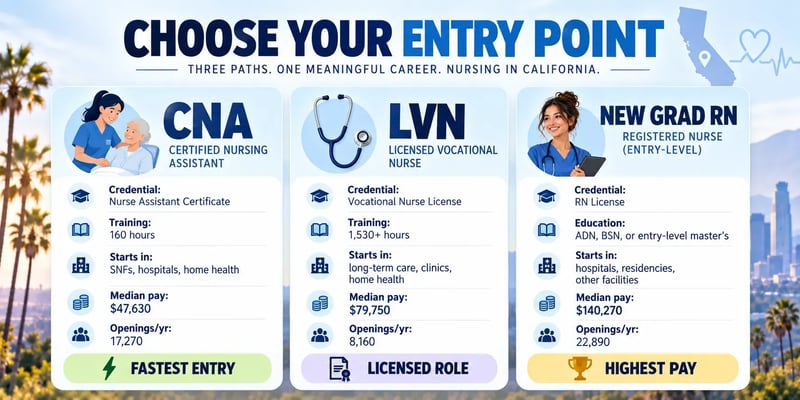
To find an entry-level nursing job in California, choose your entry point (CNA, LVN, or new grad RN) and get the California credential before you apply. Then apply to new graduate residency cohorts and entry-level roles in more than one region. The market for nursing jobs in California rewards that order. In 2024-25, 83.6% of the state's new RN graduates were working in nursing in California, but 4.9% could not find a job, the highest share since 2015-16 (BRN, August 2026).
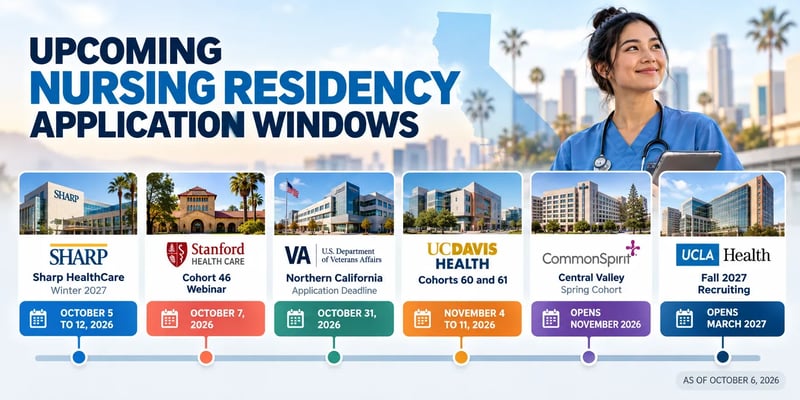
Demand has not gone anywhere: California projects about 22,890 RN, 8,160 LVN, and 17,270 nursing assistant openings a year through 2034. The calendar matters as much as the resume, though, because some residency application windows stay open for three days and many programs require an active California license by a fixed date.
Entry-Level Nursing Pay in California
Entry-level RN salary in California has no official line in the BLS tables, because BLS does not publish a new-grad rate, so the lower percentiles are the best guide. In California the 10th percentile for RNs is $48.68 an hour ($101,260 a year), and the 25th is $58.87 ($122,440).
Role | 10th percentile | 25th percentile | Median |
|---|---|---|---|
Nursing assistant | $19.28 ($40,110) | $22.04 ($45,850) | $22.90 ($47,630) |
LVN | $30.96 ($64,390) | $35.98 ($74,840) | $38.34 ($79,750) |
RN | $48.68 ($101,260) | $58.87 ($122,440) | $67.44 ($140,270) |
Hourly, with annual in parentheses, from BLS 2025 wage data for California via O*NET OnLine, including the LVN wage data for California and the nursing assistant wages for California. For scale, the national RN median is $97,550 (BLS, May 2025).
Posted public pay gives a second reference point. CalCareers lists the state Certified Nursing Assistant classification at $3,370 to $4,699 a month across three levels. Licensed Vocational Nurse (CDCR) runs $3,983 to $7,500, and Registered Nurse, Correctional Facility runs $9,510 to $13,122 depending on the assignment. VA Northern California's residency pays a $67,133 stipend over 12 months.
One more thing to use: California employers with 15 or more employees must include a pay scale in every job posting (Labor Code 432.3), so compare posted ranges before you apply.
Frequently Asked Questions
Does California hire new grad nurses?
Yes. In 2024-25, 83.6% of California's new RN graduates were working in nursing in the state, and 61.0% were hired by hospitals. The catch is that 4.9% could not find a job, the highest share since 2015-16, when it was 5.5%, so timing and a multi-region search matter more than they did a few years ago (BRN).
How much does a new grad RN make in California?
There is no official new-grad rate. The best guide is the bottom of the California RN pay range: the 10th percentile is $48.68 an hour ($101,260 a year) and the 25th is $58.87 ($122,440), per BLS 2025 wage data. Posted pay scales, which larger California employers must include in job postings, show the real range for each unit.
Is an RN residency worth it?
For most new grads, yes. A residency is a paid, structured start with precepted hours, such as Stanford Health Care's 350-plus hours of clinical orientation or UC Davis Health's year of classes followed by a year of mentorship, and many California programs hold ANCC accreditation. The trade-off is competition and fixed application windows, which makes Step 3 a calendar exercise.
Is California a compact nursing state?
No. Forty-three jurisdictions belong to the Nurse Licensure Compact, and California has not enacted it, so a multistate license from another state does not let you work here. Out-of-state RNs apply to the BRN by endorsement, which takes 10 to 12 weeks, and can request a temporary license that is valid for six months while the application processes.
Do California hospitals hire nurses with an associate degree?
Yes. Cedars-Sinai sets an ADN as its minimum and Stanford Health Care accepts ADN and ASN graduates, while Kaiser Permanente prefers a BSN and UCLA Health requires one. In 2024-25, 58.9% of ADN graduates were hired by hospitals compared with 66.3% of BSN graduates, and fewer ADN graduates were unable to find work, 4.3% versus 5.3% (BRN).
Is there an RN shortage in California?
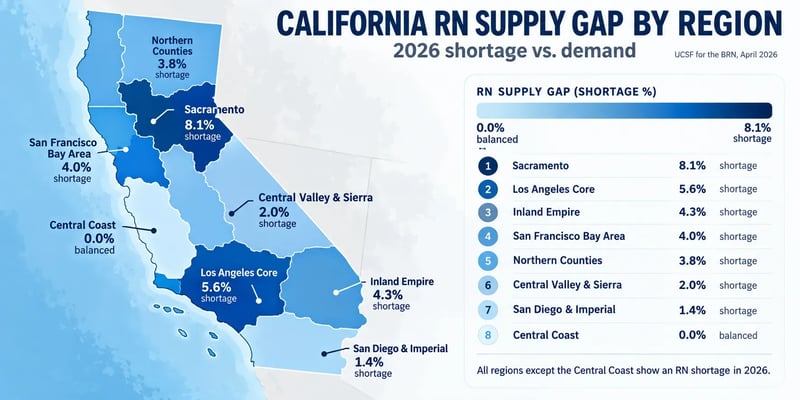
Yes, in every region except the Central Coast. The UCSF forecast for the BRN (April 2026) puts the gap at 8.1% in Sacramento, 5.6% in Los Angeles, 4.3% in the Inland Empire, and 4.0% in the Bay Area. A shortage of experienced RNs does not guarantee new grad hiring, though, and 4.9% of 2024-25 graduates could not find work.
Starting Your Nursing Career in California
Pick the entry point that fits your timeline and credentials, then treat California's residency calendar and license rules as part of the job search itself. A CNA certificate takes a few weeks to a few months of training, an LVN license about a year, and a new grad RN cohort opens on a schedule you can plan around.
Widen the search by region and by setting. Every region except the Central Coast was short of RNs in 2026, and long-term care, clinics, public health, and state facilities hire new nurses that the hospital cohorts pass over.