Key Points
- Business administration is a broad degree covering management, finance, marketing, and operations fundamentals.
- It is generally considered a moderate-difficulty major, heavier on applied and quantitative coursework than some, lighter than STEM-intensive majors.
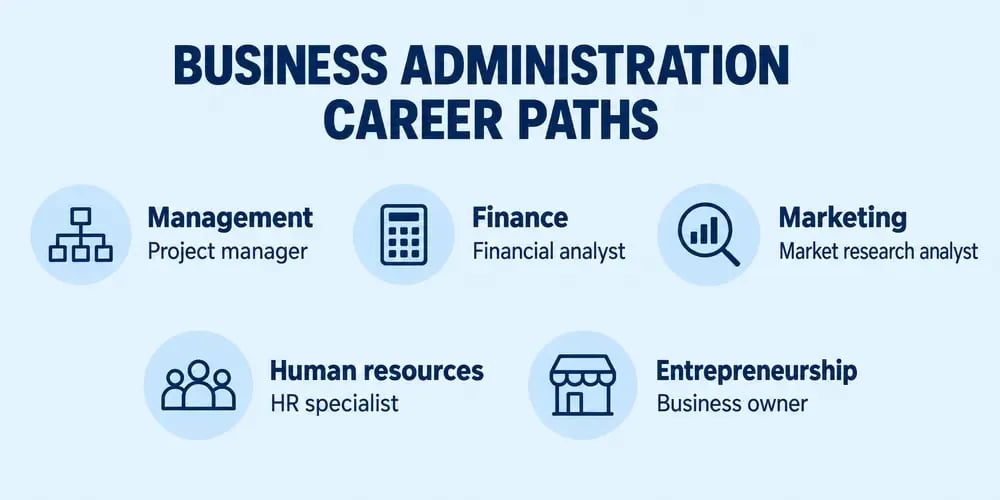
- Graduates go into roles spanning management, sales, finance, HR, marketing, operations, and entrepreneurship.
- Reported earnings vary widely by role, industry, and experience level, so "average" figures should be read as a range, not a guarantee.
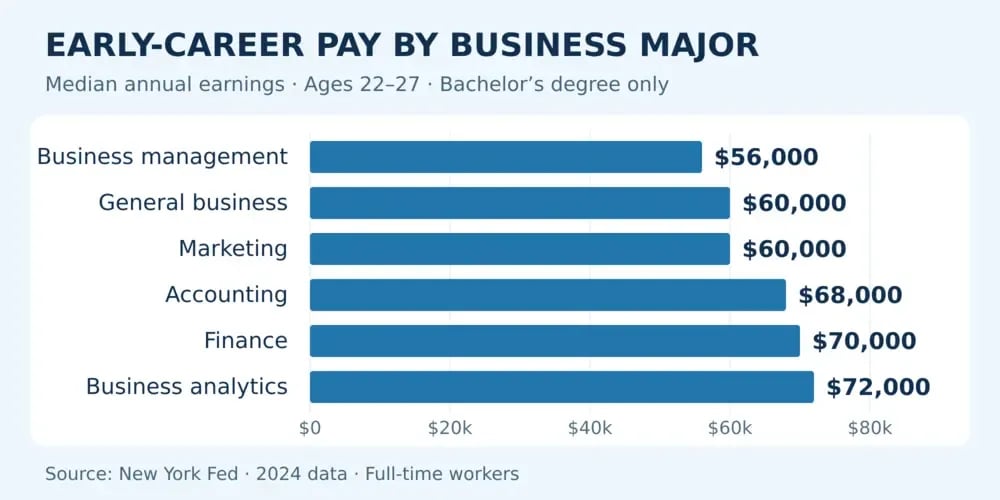
- A bachelor's takes about four years full time, and recent business management graduates earned a median $56,000 early in their careers and $82,000 by mid-career, per the New York Fed.

What Is the Business Administration Major?
The business administration major is a broad undergraduate program that covers the main business functions in one degree: accounting, finance, marketing, management, operations, and usually a general elective or concentration block such as human resources, entrepreneurship, or international business.
It is built to give you a working foundation across the whole business function rather than deep specialization in one area. That breadth is why it appeals to students who are not yet sure which business path they want.
It is a major in its own right, and a large one. Business was the most popular bachelor's field in the country at 375,400 degrees in 2021-22, 19% of all bachelor's degrees awarded, according to the National Center for Education Statistics. Within business, BLS reports that business management and administration accounts for 28% of degree holders, ahead of general business (20%), accounting (17%), marketing (12%), and finance (11%).
Schools award the degree as a BA, a BS, or a BBA, and community colleges and online universities offer a two-year AS or AA version. The letters change the balance of general education and quantitative courses more than the job outcomes, and the bachelor's in business administration guide walks through how the three bachelor's versions differ.
Is Business Administration a Hard Major?
Business administration is a moderate-difficulty major: more quantitative than most humanities and social science degrees, less math-intensive than engineering or the physical sciences, and heavy on writing, group projects, and presentations.
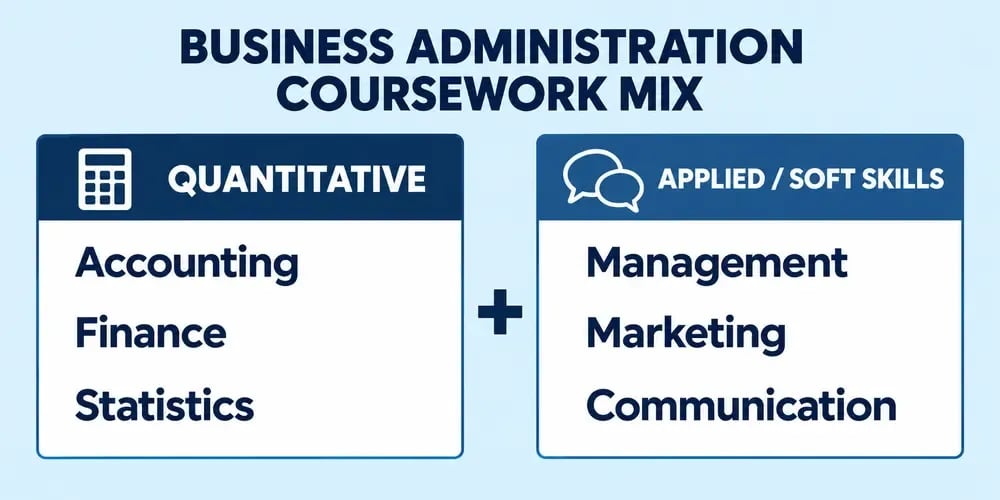
The demanding part is the quantitative sequence. Statistics, financial and managerial accounting, finance, and economics run through the first two years. Florida International University's BBA, for example, requires two business statistics courses and a financial management course alongside business law, information systems, management, marketing, strategic management, and a business communication course.
The writing load is the other half. Case studies, team projects, and presentations are graded work in most upper-division courses, not extras.
What makes it more approachable than a STEM major is that most of the material is applied. You learn accounting by building statements, marketing by writing plans, and management by working through cases about real companies, and none of it assumes a calculus-based physics or chemistry sequence.
Difficulty also depends on the school, the concentration, and your own strengths. A finance or analytics concentration adds math, and a management or marketing concentration adds writing. Some students find the quantitative side hardest, and others find the presentation load heavier.
Is Business Administration a Good Major?
Yes, for most students, because it does not lock you into one career path the way a specialized degree does, and the job market for business roles is large. The main advantages hold up in the data:
- BLS names business as a typical degree field for human resources specialists, market research analysts, management analysts, sales managers, and project management specialists, so the degree clears the education line for a wide set of entry-level corporate postings.
- Business and financial occupations are projected to open about 886,600 jobs a year from 2025 to 2035, with a median wage of $82,660 in May 2025, and management occupations about 1.1 million a year at a $126,520 median.
- The coursework doubles as job skills. Accounting literacy, statistics, and business writing transfer across employers and industries in a way a narrow technical curriculum does not.
The trade-offs are just as real:
- A generalist degree is less specialized than a finance, accounting, or engineering degree, and some fields want the targeted version. BLS says financial analysts typically need a bachelor's in finance or a related field such as business.
- Breadth shows up in the job data. In the New York Fed's outcomes by major for 2024, recent business management graduates had a 3.8% unemployment rate, below the 4.2% for all majors. Their underemployment rate was 52.6%, meaning more than half were working in jobs that typically do not require a degree. General business graduates sat at 50.4%, while accounting (21.2%), finance (27.8%), and business analytics (28.7%) graduates were far less likely to be underemployed.
- The premium for the degree alone is modest. Business bachelor's holders earn a $75,000 median against $70,000 for all fields, and the wider gaps open up by role, not by diploma.
So the honest verdict is this: business administration is a strong, safe generalist choice, best suited to students who value flexibility over early specialization, and it works best when the flexibility has an end date. If your question is about the business administrator job itself rather than the major, the business administrator pros and cons guide covers the role.
What Can You Do With a Business Administration Major?
A business administration major qualifies you for entry-level roles across management, finance, marketing, sales, human resources, and operations. The most common occupations for business degree holders, per BLS, are accountants and auditors (8%), managers (6%), financial managers (4%), chief executives (3%), and management analysts and human resources specialists (2% each). All medians below are May 2025 BLS figures.
Management and Operations
Operations manager, general manager, project manager, and administrative manager are the classic destinations, and most of them are second jobs rather than first ones.
- Project management specialists: $102,320 median, no prior experience listed by BLS, and about 76,500 openings a year, the most direct entry point in this group
- General and operations managers: $105,770 median, with BLS listing five or more years of related experience for the top executive group they belong to
- Administrative services and facilities managers: $110,500 median, with less than five years of related experience listed
Finance and Accounting-Adjacent Roles
Financial analyst, budget analyst, and accounts manager roles draw on the accounting and finance sequence of the major. BLS lists finance first as the degree field for financial analysts, with business as the related field, and notes that optional professional certification can strengthen a candidate.
- Financial analysts: $103,570 median, no prior experience listed, and 7% projected growth from 2025 to 2035, much faster than average
- Budget analysts: $91,640 median, no prior experience listed, but only about 2,900 openings a year
- Securities-related analyst roles can require FINRA licenses, which BLS notes are usually sponsored by the employer after hiring
Marketing and Sales
Marketing coordinator, sales manager, brand manager, and market research analyst are the marketing-side paths, and market research is the entry door.
- Market research analysts: $78,760 median, no prior experience listed, 7% projected growth, and about 82,000 openings a year
- Sales managers: $148,270 median, with less than five years of related experience listed, and BLS names business as a common field of degree
- Marketing managers: $166,790 median in May 2025, typically with a bachelor's in a business field such as marketing
Human Resources
HR generalist, recruiter, and human resources manager form a ladder that starts at a specialist role.
- Human resources specialists: $75,940 median, no prior experience listed, 6% projected growth, and about 73,700 openings a year, one of the largest entry-level pools open to the major
- Human resources managers: $149,280 median, with five or more years of related experience listed
Entrepreneurship and Small Business
Starting or running a business and business consulting both use the whole degree at once, which is the strongest case for studying every function instead of one. BLS does not publish a wage for business owners, and the closest measured path is consulting. Management analysts earned a $101,860 median in May 2025, with 10% projected growth from 2025 to 2035, much faster than average, and about 94,100 openings a year.
Further Education Paths
An MBA or a specialized master's builds on the generalist foundation, and it is the minority path. BLS reports that 26% of business degree holders have an advanced degree, against 38% across all fields, and the New York Fed puts the graduate-degree share for business management majors at 25.3%. For most graduates, the bachelor's is the terminal degree, and the concentration does the specializing.
If one of these lanes reads like yours, shortlist a few business administration programs on Dreambound before you commit to a school.
How Much Do Business Administration Majors Make?
Business administration majors earn across a wide range, and three sources measure it in three different ways. Employers surveyed by NACE project average starting offers of $68,831 for 2026 business administration and management graduates, up 8.4% from last year, in a year NACE expects flat hiring for the class overall.
The New York Fed puts the actual median for recent business management graduates at $56,000 between ages 22 and 27 and $82,000 between 35 and 45, based on 2024 Census data for full-time workers with a bachelor's only. BLS reports a $75,000 median for business graduates with a bachelor's, across every age.
The NACE figure is what surveyed employers plan to offer their new hires. The New York Fed figure is what the whole graduating class actually earns, including the graduates in jobs that did not require the degree, which is why it runs lower.
Source: New York Fed, Labor Market Outcomes of College Graduates by Major, 2024 data.
Earnings climb with the role, and the higher-paying roles come with experience requirements attached. The entry-accessible jobs that BLS lists with no prior experience run from $75,940 (human resources specialists) to $103,570 (financial analysts).
The management jobs that BLS lists with related experience run from $105,770 (general and operations managers) to $166,790 (marketing managers). The table above shows the concentration effect from the first job, and the experience requirements explain the rest of the spread.
Is Business Administration the Right Major for You?
Business administration is the right major if breadth is what you want from the first two years and you intend to narrow it in the last two. Consider it if:
- You want broad career options and are not yet sure which business function fits you.
- You plan to add an MBA or a specialized master's later and want a general base first.
- You want a degree offered at both the associate and bachelor's level, so you can start with two years and decide about the next two.
Consider a more specialized major if:
- You already know the function you want. Finance and accounting roles run on their own coursework, and the New York Fed data shows those graduates with lower underemployment and higher early pay.
- You want the analytical track, since business analytics graduates had a $72,000 early-career median and a 28.7% underemployment rate in 2024, against $56,000 and 52.6% for business management.
If four years is more than you can commit to right now, the two-year version is a reasonable first step, and the associate degree in business administration guide explains what it qualifies you for.
Business Administration Programs on Dreambound
Dreambound lists degree programs from partner schools side by side, so you can weigh an associate against a bachelor's, or one online program against another, without opening a dozen admissions sites. The six programs below are all online, and the platform lists more business administration degrees beyond these.
Bachelor's Degree Programs
- Format: Online
- Accredited by the Accreditation Council for Business Schools and Programs (ACBSP)