How to Become an LVN in Texas: Steps, License, and Pay
See if you qualify for Licensed Vocational Nurse (LVN/LPN) license programs
Answer a few questions in 2 minutes. Free, no commitment.
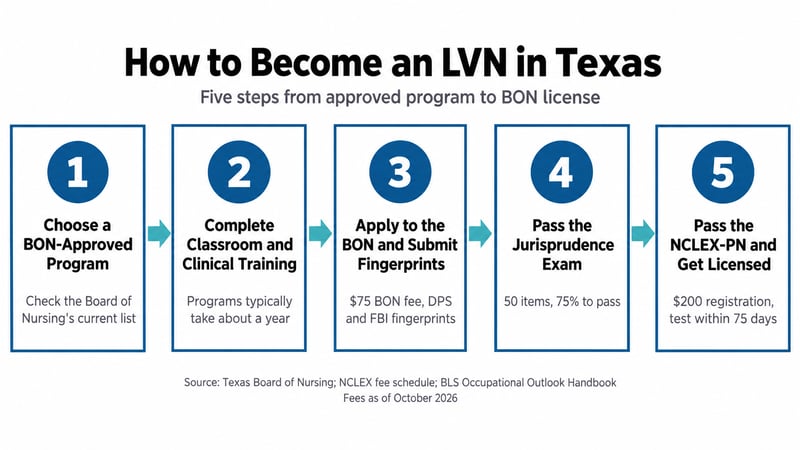
To become an LVN in Texas, you complete a vocational nursing program approved by the Texas Board of Nursing (BON), pass the Texas Nursing Jurisprudence Exam and the NCLEX-PN, and clear a fingerprint background check before the BON issues your license. Texas and California use the title licensed vocational nurse (LVN), while other states often call the same role a licensed practical nurse (LPN), and both take the same national exam. Programs typically take about a year. Texas employs 57,560 LVNs, the second most of any state, at a median of $62,240 a year, according to May 2025 federal wage data, with Austin ($64,580) and Dallas-Fort Worth ($64,370) paying the most among large metros.
Finding an Approved LVN Program in Texas
Dreambound is a marketplace where students compare healthcare and trade training programs by location, schedule, and cost before choosing one. In Texas, vocational nursing programs are offered by community and technical colleges and by career schools. Every new program must be approved or licensed by the Texas Workforce Commission or the Texas Higher Education Coordinating Board, unless exempt, and must also be approved by the BON before it admits students.
Before you apply, check three things:
- The program appears on the BON's current approved list or its Texas LVN programs map.
- The program's first-time NCLEX-PN pass rate, which you can ask the program to provide.
- Where clinical rotations are held and how far they are from where you live.
Compare LPN and LVN programs near you on Dreambound.
Career Paths and Opportunities
- Registered Nurse (RN): LVN-to-RN bridge programs build on your LVN license toward an ADN or BSN. See how to become a registered nurse in Texas.
- Specialized Nursing Roles: Add specialty certifications in fields like pediatric or geriatric nursing.
- Nursing Supervisor: Some states allow experienced LVNs to oversee other LVNs or unlicensed staff, according to BLS.
- Home Health Nurse: Provide specialized care for patients in their homes.
Moving from LVN to RN requires a formal nursing education program. The BON states that on-the-job training or continuing education cannot substitute for that education, and it encourages programs to set up articulation agreements so prior LVN coursework counts. Of the 74 BON-approved associate degree (ADN) programs in Texas, 61 list a track for LVNs, and 7 of the 62 approved BSN programs offer LVN-to-BSN, according to the BON's list of approved RN programs dated Oct. 1, 2026.
Frequently Asked Questions
How long does it take to become an LVN in Texas?
Vocational nursing programs typically take about a year, according to BLS. After you apply, the BON reviews your application within 15 business days of receiving the last required item. Your ATT and GVN permit are then valid for 75 days, and the BON issues your license within 15 business days of passing results.
How much do LVNs get paid in Texas?
Texas LVNs earned a median of $62,240 a year, or $29.92 an hour, in May 2025. The Austin metro area had the highest median at $64,580.
What are the requirements to become an LVN in Texas?
You need to graduate from a BON-approved vocational nursing program, submit DPS and FBI fingerprints, pass the Nursing Jurisprudence Exam, and pass the NCLEX-PN. The BON application fee is $75, and NCLEX-PN registration is $200.
Is LVN harder than CNA?
LVN training is longer. Vocational nursing programs typically take about a year, while Texas requires at least 100 hours of nurse aide training, above the federal minimum of 75 hours. LVN candidates must also pass the national NCLEX-PN and receive a BON license, while CNAs take a state competency exam with a written or oral test and a skills demonstration.
Can LVNs start IVs in Texas?
Yes, after completing an IV validation course. The BON's position on IV therapy is that an LVN may not perform it, including venipuncture, IV fluids, or IV push medications, until completing a validation course. The BON does not define qualifications for that course or for an "LVN IV certification," and facility policy decides which IV fluids and medications an LVN may give.
Inserting or removing PICC lines or midline catheters is outside LVN scope. Separately, Texas House Bill 3749, in effect since Sept. 1, 2025, lets a physician delegate elective IV therapy given outside physician offices and licensed health facilities only to RNs, APRNs, and physician assistants.
Starting Your LVN Career in Texas
The path to an LVN license in Texas runs through a BON-approved program, a fingerprint background check, the jurisprudence exam, and the NCLEX-PN. Because approval can be withdrawn, checking a program against the BON's current list is the step that protects your eligibility to test.
The work is hands-on and supervised, with a defined scope that can expand through IV validation, specialty certifications, or a bridge into registered nursing. Dreambound lists LPN and LVN programs by state across the United States.