Key Points
- Common prerequisite courses include biology, chemistry, anatomy and physiology, microbiology, psychology, and English composition.
- Most programs set a minimum GPA, often stricter for prerequisite science courses specifically.
- Many programs require documented hours observing a practicing dental hygienist before you can apply.
- Current CPR certification, a background check, and up to date immunizations are standard requirements.
- Some programs also require a standardized entrance exam like the TEAS.
Academic Prerequisites for Dental Hygiene Programs
The academic prerequisites are college courses you complete before you apply, and the science sequence is nearly identical from one program to the next. BLS notes that most programs require applicants to complete prerequisites that often include college-level courses.
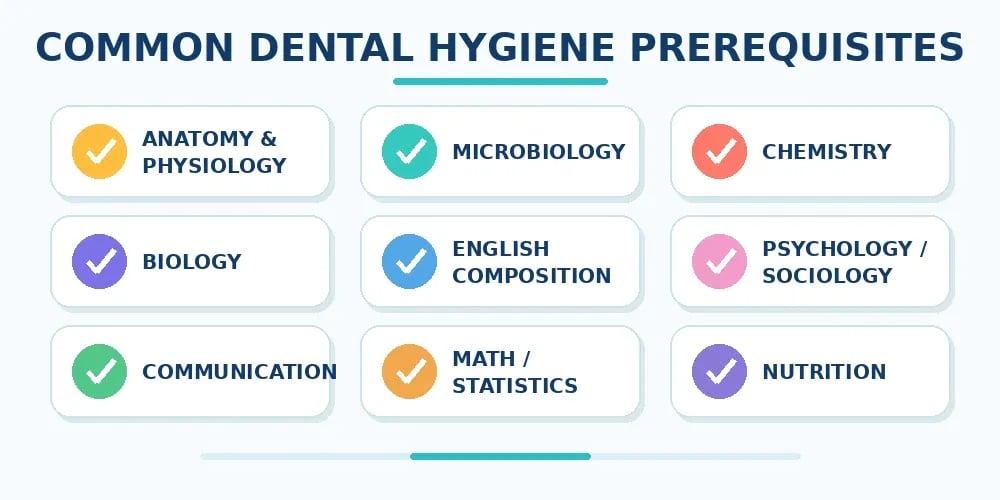
The eight admissions pages reviewed here, from Diablo Valley College and Sacramento City College in California to Johnson County Community College in Kansas and Collin College in Texas, all ask for the same three sciences. The commonly required list looks like this:
- Human anatomy and physiology, usually two semesters, often with labs
- Microbiology with lab
- General chemistry, sometimes followed by an introductory organic and biochemistry course
- Biology at some schools
- English composition
- Psychology or human development, and often introductory sociology
- Communication or public speaking
- College-level math or statistics
- Nutrition at some programs
Exact requirements vary by school, and the differences matter. Sacramento City College asks for two semesters of general chemistry plus organic and biological chemistry, while Johnson County requires a single chemistry course. Confirming the specific list with each program you are considering is essential before you register for anything.
GPA and Academic Standing Requirements
Most programs set a minimum GPA, and a 2.5 to 3.0 range covers nearly every published figure. Foothill College asks for a 2.5 cumulative college GPA, Diablo Valley College requires a 2.75 in prerequisite coursework, and University of the Pacific, Johnson County, and Sacramento City College (for its science courses) all set the line at 3.0. Each of them also requires a C or higher in every prerequisite course.
Programs often set a separate, higher minimum for the prerequisite science courses, because they treat science GPA as a strong predictor of success in a science-heavy curriculum. Foothill wants a 2.75 in the biological sciences against a 2.5 overall, and Sacramento City wants a 3.0 in the sciences against a 2.5 in everything else.
A second rule catches returning students off guard: science courses expire. Every program reviewed that states a limit caps anatomy, physiology, microbiology, and chemistry at five years (Johnson County, Collin, Harper College), six years (Foothill), or seven years (Diablo Valley, Sacramento City). A strong anatomy grade from eight years ago will have to be retaken.
Observation Hours Requirement
Many programs require a documented number of hours shadowing a licensed dental hygienist in a clinical setting before you are even eligible to apply. The numbers are modest but specific.
University of the Pacific asks for a minimum of 20 hours, Johnson County and Collin College each require 16, and UC Blue Ash College in Ohio wants 8 hours split across two dental offices. Diablo Valley College instead requires two procedure-specific observations, a cleaning and a non-surgical periodontal therapy visit, each three to eight hours long.
Programs use this requirement to confirm that applicants understand the day to day realities of the role before committing to two full-time years. The documentation rules reflect that purpose. Collin requires the hours within the last 12 months on a sealed form signed by the hygienist, Johnson County requires two different locations, and Johnson County will not count hours logged where you already work.
Arranging the hours means reaching out to local dental offices or hygienists directly, and it helps to ask early, since a practice has to fit you around its patient schedule. Your own dentist's office is the easiest first call, and a second office covers the two-location rule.
CPR Certification Requirement
Current CPR certification for healthcare providers is a standard requirement, usually at the BLS level. Collin College names the exact card, the American Heart Association's BLS for Healthcare Providers covering adult, child, and infant with AED, and does not accept online-only courses.
Most of the programs that state a timeline ask for the certification after acceptance rather than at application, and some build it in. Sacramento City College runs an on-site CPR course during new student orientation, and Diablo Valley College schedules its course alongside the physical and vision exams accepted students complete before summer. Either way, the card has to be current before clinical coursework begins.
Background Check and Immunization Requirements
Dental hygiene students work directly with patients early in their training, so programs screen them the way hospitals screen clinical staff. A criminal background check and a drug screening are standard, usually ordered after acceptance. Diablo Valley College requires both before summer courses start, Sacramento City College uses an 8-panel drug screen, and Collin College notes that random screenings can follow during the program.
Proof of immunization is the other piece. Hepatitis B and MMR appear on nearly every list, and several programs add a current flu shot. Diablo Valley's list runs longer, with Tdap, varicella, meningococcal, and COVID-19 vaccines plus a TB test, and Collin requires titers proving immunity to MMR and Hepatitis B rather than vaccination records alone. The Hepatitis B series takes months, so it is worth starting before you apply.
Entrance Exam Requirements
Some, though not all, dental hygiene programs require a standardized entrance exam, and the test varies enough by school that you have to confirm it directly rather than assume the TEAS applies everywhere. Harper College in Illinois does require the TEAS, with a total score at the 60th percentile or higher. Collin College uses the HESI A2 instead and scores five sections on a points scale.
Johnson County requires the Admission Test for Dental Hygiene, a newer American Dental Association test with 240 questions across reading, language, quantitative reasoning, perceptual ability, biology, and chemistry, given in 4 hours and 50 minutes for a $140 fee.
Diablo Valley College and Sacramento City College, by contrast, list no entrance exam at all, and Sacramento City's only HESI is an exit exam at the end of the program.
Do Prerequisites Differ by Program Type?
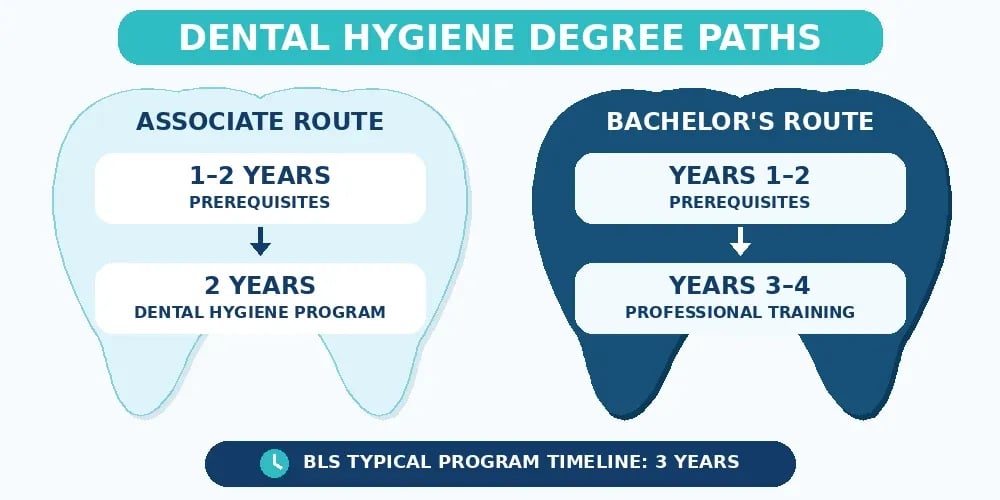
Most licensure-track dental hygiene programs award an associate degree, and BLS confirms that hygienists typically need an associate degree in dental hygiene. The American Dental Association counts more than 300 accredited programs, and the American Dental Education Association puts the entry-level associate at an average of two years and 84 credit hours, with entry-level bachelor's programs at four years and 120.
BLS says programs usually take three years to complete, which lines up with a two-year degree on top of a year or more of prerequisites.
Prerequisite expectations are broadly similar across both degree types. The difference is where the coursework sits: an associate program expects the prerequisites finished before you apply, while a bachelor's program may fold them into the first year or two.
University of the Pacific's three-year, year-round Bachelor of Science, for example, has students complete 59 units of general education and science before four semesters of professional training, with a 3.0 GPA required to advance.
What to Do If You Don't Meet the Prerequisites Yet
A gap in your prerequisites is usually a timeline issue to plan around rather than a disqualifying one. Most prerequisite courses can be completed at a community college before you apply, and programs like Diablo Valley and Sacramento City are community colleges themselves.
The one sequencing rule to respect is the recency limit: take the general education courses first and the sciences last, so anatomy, microbiology, and chemistry are still inside the five to seven year window when you apply.
Observation hours and the Hepatitis B series can both be arranged well ahead of a deadline, and prerequisite grades are worth protecting, since Collin College scores an A at three points, a B at two, and a C at one.
Seats are limited, 20 at Diablo Valley and 24 at Sacramento City and Collin, and Sacramento City places every eligible applicant into a lottery, so applying to more than one program is a reasonable hedge. CODA's accredited program finder lists every program by state.
If you are still weighing the shorter route into a dental office while you finish the coursework, Dreambound's dental assistant vs. dental hygienist comparison lays out how the two paths differ in training, licensing, and pay.