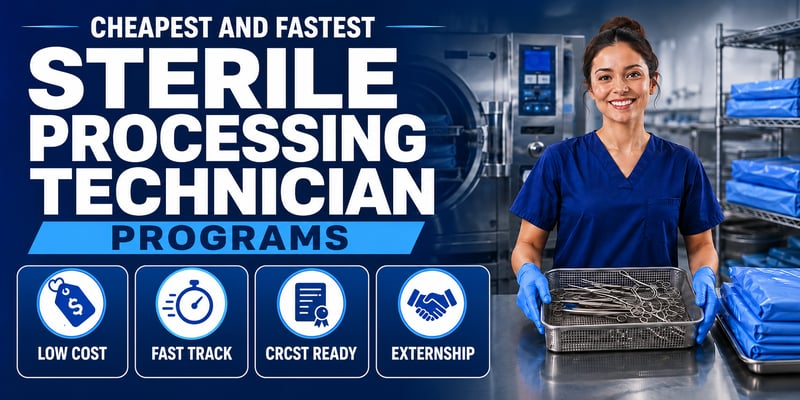
Cheapest and Fastest Sterile Processing Technician Programs
See if you qualify for Sterile Processing Technician programs
Answer a few questions in 2 minutes. Free, no commitment.
The cheapest route into sterile processing is rarely a tuition bill at all. Free workforce-funded and employer-paid programs cover the full cost for people who qualify, and when you do pay, self-paced online courses run from about $1,599 to $4,000 and wrap up in 14 to 16 weeks. Sterile processing technicians earn about $47,700 a year, or $22.93 an hour, which makes a short program one of the faster returns in healthcare.
One detail matters before you compare prices. Finishing coursework is not the same as being fully certified, because the national CRCST credential requires 400 hours of hands-on experience after you pass the $140 exam. So the fastest program on paper is not always the fastest path to a job.
Frequently Asked Questions
Can you self-study to become a sterile processing technician?
You can study the theory on your own, but self-study alone will not make you job-ready. Full CRCST certification requires 400 hours of hands-on experience, which no textbook can provide. Most low-cost online programs solve this by arranging an externship at a local healthcare facility.
What is the best certification for a sterile processing technician?
The CRCST from the Healthcare Sterile Processing Association is the most widely recognized credential in the field. The CBSPD certification is a respected alternative. Both require passing an exam and documenting hands-on experience, and the CRCST exam costs $140.
Are there free sterile processing technician programs?
Yes, though they are not the typical route. Free training usually comes through WIOA workforce grants, MyCAA benefits for military spouses, or employer-paid hospital programs. Fully free self-paced courses are rare, so most people pair a low-cost online program with workforce funding, then use Dreambound to compare their options.
Do you need certification to work as a sterile processing technician?
It depends on your state. A handful of states, including New Jersey, New York, and Pennsylvania, require certification by law. Everywhere else it is not legally mandatory, but the CRCST is the industry-standard credential for the role, so it is worth earning either way.
How fast can you actually start working as a sterile processing technician?
Coursework takes 14 to 16 weeks, but full certification adds time. After passing the exam, you have six months to log 400 hands-on hours, usually through an externship or entry-level role. Realistically, plan on four to six months from your first class to fully certified.
Choosing a Sterile Processing Program That Fits Your Budget and Timeline
The cheapest sterile processing program is rarely the one with the lowest sticker price. It is the one that gets you certified and ready to work without a wasted dollar, which often means pairing a low-cost online course with workforce funding and an externship that covers the hands-on hours you need to certify. Keep the whole path in view, not just the tuition line.
When you are ready to compare real options, Dreambound lets you weigh sterile processing programs from different schools by price, length, and funding to find the fastest affordable route for your situation.