Radiology Technician Classes Near Me in Wichita

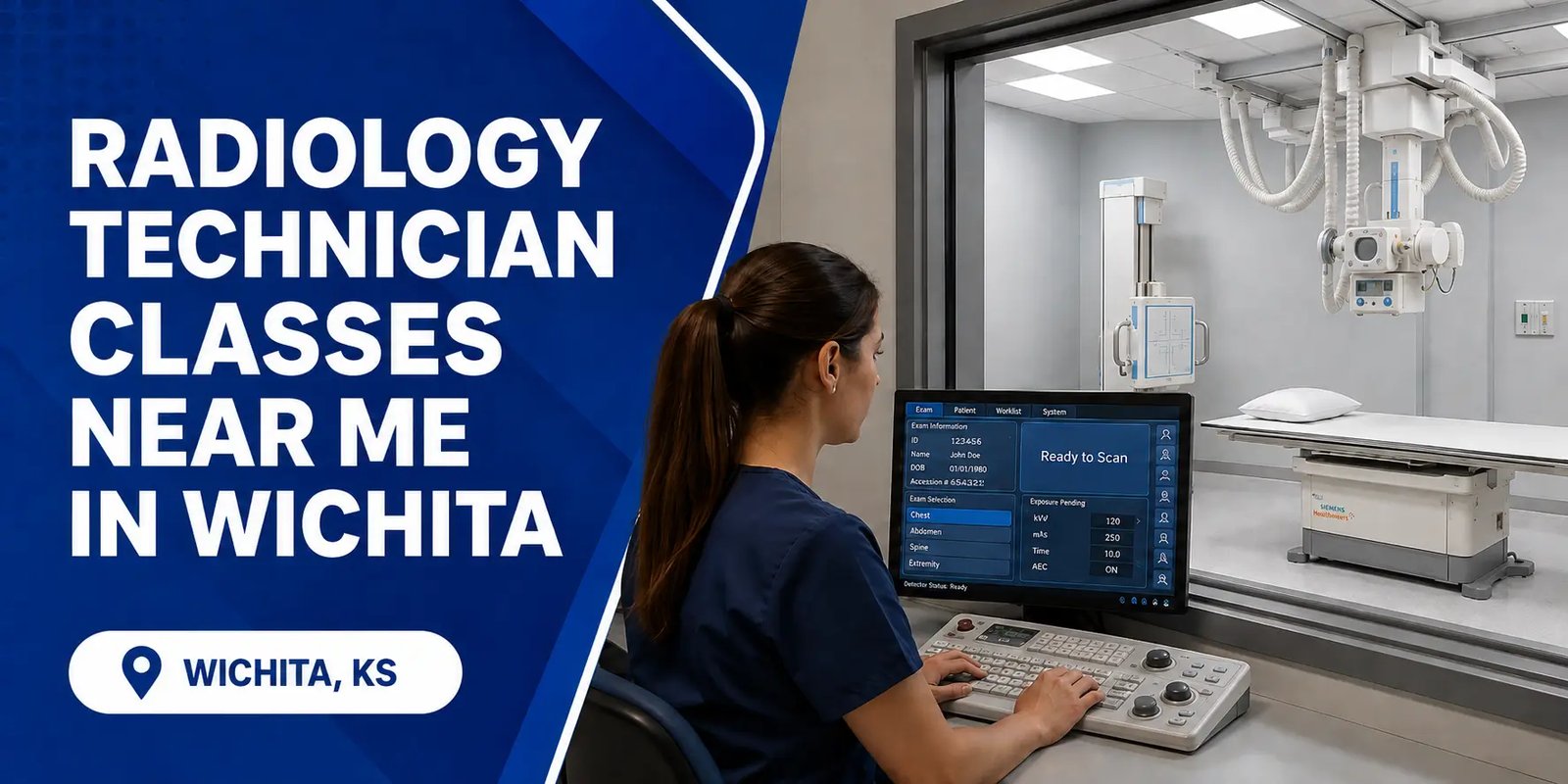
Kansas licenses radiologic technologists through the State Board of Healing Arts, and it lets you meet the exam requirement with either a nationally administered examination approved by the Board or a current ARRT certification. Radiologic technologists in the Wichita metro earn a median of $64,830 a year, or $31.17 an hour, according to May 2025 BLS data. To work in the field, you complete a board-approved radiography program in the Wichita area, then earn the Licensed Radiologic Technologist (L.R.T.) credential. Training usually takes about two years and combines classroom, laboratory, and supervised clinical work. Knowing how Kansas handles licensing before you pick a program keeps your plan on track.
Key Points
- Kansas requires a Licensed Radiologic Technologist (L.R.T.) credential for general practice, subject to statutory exemptions.
- You meet the exam requirement with a nationally administered exam approved by the Board or a current ARRT certification, after completing a board-approved program.
- Radiologic technologists in the Wichita metro earn a median of $64,830 a year; statewide, the Kansas median is $76,070, based on May 2025 BLS data.
- Most radiography programs in the Wichita area take about two years and commonly lead to an associate degree, though Kansas requires a board-approved course of study rather than a specific degree.
- Kansas may issue qualified applicants one temporary license, valid for up to 180 days or until the full license is approved, whichever comes first.
Radiologic Technology Programs Near Wichita
Radiography training near Wichita commonly takes about two years and often leads to an associate degree, pairing classroom and laboratory work with clinical rotations at area hospitals. Confirm that any program you compare meets the Kansas Board of Healing Arts educational requirements. If you plan to pursue ARRT certification, also verify the program satisfies ARRT's education standards; JRCERT accreditation is one recognized way to confirm that. Fully online radiography programs are uncommon, since the field requires supervised clinical hours on real equipment, though some programs deliver part of the coursework in a hybrid format.
Dreambound lets you compare radiology technician programs by format and location, so you can line up what is available near you and see which ones fit your schedule.
Radiology Technician Salary in Wichita
Radiologic technologists in the Wichita metro earn a median of $64,830 a year, or $31.17 an hour, according to May 2025 BLS data. Statewide, Kansas radiologic technologists earn a median of $76,070 a year, or $36.57 an hour. Pay varies with the employer, work setting, and years of experience.
Nationally, employment is projected to grow 4% from 2024 to 2034. Major healthcare employers in the Wichita area include Ascension Via Christi, with its St. Francis, St. Joseph, and St. Teresa hospitals, and Wesley Healthcare, which operates Wesley Medical Center and other imaging facilities across Greater Wichita.
Kansas Radiologic Technologist License (L.R.T.) Requirements
Kansas generally requires a state license to practice as a radiologic technologist, issued by the Kansas State Board of Healing Arts. The credential is the Licensed Radiologic Technologist (L.R.T.). State law provides exemptions for certain practitioners, supervised students, and other trained personnel working under qualifying supervision, but ordinary practice as a radiologic technologist requires the license.
To qualify, you complete a board-approved radiography program, then meet the examination requirement one of two ways: pass a nationally administered examination approved by the Board, or hold current ARRT certification, which the Board can accept in place of its own examination. Applicants must also be at least 18 and hold a high school diploma or equivalent.
Qualified applicants may apply for a temporary license that permits practice for up to 180 days while they complete the examination requirement or await action on the full application. Issuance is at the Board's discretion, and only one temporary license is allowed per person. L.R.T. licenses renew annually and expire September 30. Licensees generally document either 12 continuing-education credits during the preceding 12 months or 24 credits during an applicable ARRT-aligned 24-month reporting period, and the first renewal is exempt from the 12-month requirement.
How to Become a Radiology Technician in Wichita
Becoming a licensed radiology technician in Kansas follows a few main steps.
- Earn a high school diploma or GED, and complete the admission prerequisites your chosen program requires.
- Complete a board-approved radiography program, most often a two-year associate degree with supervised clinical rotations.
- Pass a nationally administered exam approved by the Board, or earn ARRT certification.
- Apply to the Kansas State Board of Healing Arts for your L.R.T. license.
Training commonly takes about two years of full-time study. After graduation, allow additional time for the exam and license processing, which varies based on documentation.
Frequently Asked Questions
Do Wichita employers require ARRT certification if Kansas accepts a board exam?
Kansas lets you license with either a Board-approved exam or ARRT certification. In practice, ARRT certification is widely recognized, and many radiologic technology positions list it as preferred or required, so a lot of candidates earn it even when the state route does not require it.
Do you need a college degree to become a radiology technician in Kansas?
Kansas law requires completing a board-approved radiography course of study, not a specific degree title. In practice, the common route is a two-year associate degree, and that is also the path most students take if they plan to pursue ARRT certification.
Does a Wichita radiography program have to be JRCERT-accredited?
Kansas requires a board-approved program, and JRCERT accreditation is one recognized way to confirm program quality. It is not the only route the Board accepts, but if you plan to earn ARRT certification, confirming JRCERT or an ARRT-accepted accreditation matters, since ARRT sets its own education standards.
What is the difference between an L.R.T. and ARRT certification?
The L.R.T. is the state license the Kansas Board of Healing Arts issues, and it is what legally lets you practice in Kansas. ARRT certification is a national credential from a private registry. Kansas accepts ARRT as one way to meet its exam requirement, but the L.R.T. is the license you work under in the state.
Planning Your Radiology Technician Path in Kansas
Kansas gives you more than one way to meet the same requirement: the L.R.T. license accepts a Board-approved national examination or a current ARRT certification, and a temporary license can bridge the gap while your full application is reviewed. Settling which route fits your program and timeline is the piece worth sorting before you start.
Compare radiology technician programs near you on Dreambound by format and location to find one that lines up with a board-approved path and your schedule.