Medication Aide Classes Near Me in Kansas City

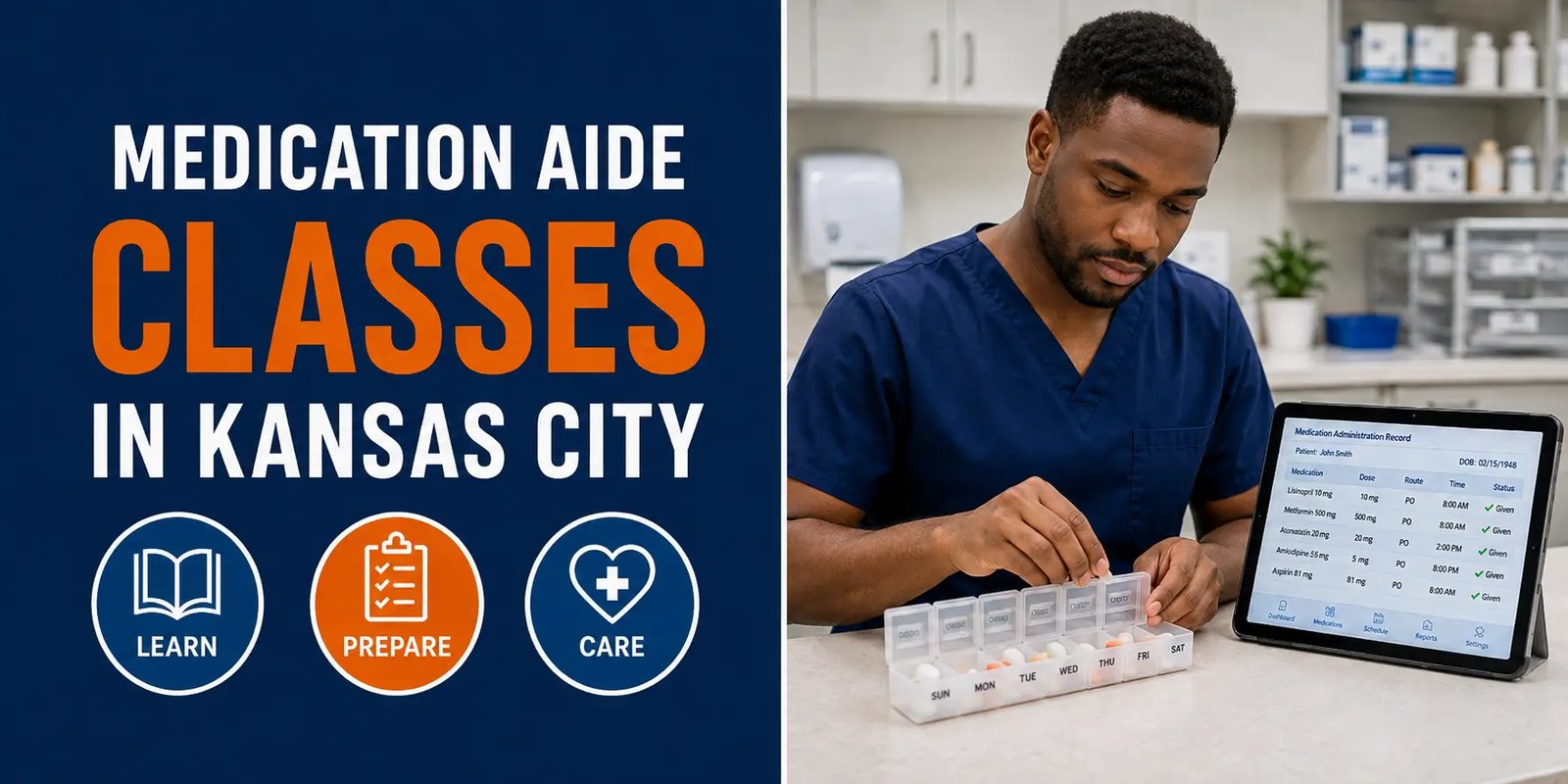
Kansas City sits in two states, and that changes how you become a medication aide here. On the Kansas side, the credential is the Certified Medication Aide (CMA). On the Missouri side, it depends on the setting: the Certified Medication Technician (CMT) for nursing homes, or the Level I Medication Aide (LIMA) for assisted living and residential care. Most of these routes expect you to be a certified nurse aide first, though Missouri's LIMA path does not. So the first thing to settle near Kansas City is which state, and in Missouri which setting, you are aiming for. Pay tracks nursing assistant wages, which in the Kansas City metro run a median of about $39,710 a year, or $19.09 an hour, according to May 2025 BLS data.
Key Points
- In the Kansas City metro, the medication aide credential you need depends on the state, and on the Missouri side it also depends on the setting.
- Kansas uses one credential, the Certified Medication Aide, which builds on a nurse aide certification and runs 75 hours, including at least 25 clinical hours.
- Missouri splits by setting: the Certified Medication Technician for nursing facilities, and the Level I Medication Aide for assisted living and residential care.
- Missouri's CMT requires you to be a CNA with six months of work first, while its Level I Medication Aide is a 16-hour course that does not require a CNA.
- Nursing assistants in the Kansas City metro earn a median of about $39,710 a year, the closest local wage benchmark for this kind of direct-care work.
Which Medication Aide Credential You Need in Kansas City
Because Kansas City spans Missouri and Kansas, there is no single medication aide credential for the metro. Which one you need comes down to the state, and on the Missouri side, the type of facility. Here is how the three routes line up.
Kansas: Certified Medication Aide (CMA)
On the Kansas side, medication aides earn the Certified Medication Aide credential, overseen by the Kansas Department for Aging and Disability Services. The Kansas medication aide course runs 75 hours, including at least 25 hours of clinical instruction, and ends with the state exam. The standard path expects you to already be a certified nurse aide on the Kansas registry in good standing, to be at least 18, and to meet a basic English reading requirement.
Missouri: CMT for Nursing Homes, LIMA for Assisted Living
Missouri uses different credentials depending on the setting. The Certified Medication Technician (CMT) is the nursing-facility path. It requires you to be an active Missouri CNA who has worked at least six months, plus a high school diploma or GED, a clear background check, and a recommendation from a long-term care employer. The course is 60 classroom hours plus at least 8 hours of clinical practice, followed by a written exam and a two-hour practical exam.
For assisted living and residential care, Missouri uses the Level I Medication Aide (LIMA). It is a shorter 16-hour course, and it does not require you to be a CNA first, which makes it the faster way into medication aide work on the Missouri side.
So the CNA question depends on your target: Kansas's CMA and Missouri's CMT both build on a nurse aide credential, while Missouri's LIMA does not. Each credential also has its own renewal, with Missouri's Level I Medication Aide taking a four-hour update every two years and Kansas medication aides completing a required update course to stay current. Since the nurse aide step matters for two of the three routes, it is worth reading CNA vs medication aide to see how the roles compare. Dreambound pulls nurse aide and medication aide programs into one place to compare, so you can line them up by the side of the metro you are targeting.
What a Medication Aide Does in Kansas City
A medication aide gives residents their scheduled medications, records each dose, and watches for reactions, working within the facility's medication system and procedures. The day-to-day is similar across the metro; what changes is the credential and the state registry you are on.
The setting often decides the credential, especially in Missouri, where Certified Medication Technicians work in nursing facilities and Level I Medication Aides work in assisted living and residential care. Kansas uses the Certified Medication Aide across its adult-care settings. These jobs sit in long-term care and residential communities on both sides of the metro, from Overland Park and Olathe on the Kansas side to Independence and Lee's Summit on the Missouri side.
Medication Aide Salary in Kansas City
Medication aide pay in Kansas City lines up closely with what nursing assistants make, a fair benchmark since the work shares the same floors and shifts. In the Kansas City metro, nursing assistants earn a median of about $39,710 a year, or $19.09 an hour, according to May 2025 BLS data. Adding medication duties expands what a direct-care worker is trained to do, though whether it raises pay depends on the employer, the setting, and the state.
The wider outlook is steady rather than booming. BLS puts growth for nursing assistants and orderlies at about 2% through 2034, but the field still turns over roughly 211,800 positions a year as people move into other work or leave the workforce, so openings keep coming.
If those numbers work for you, start by mapping the training on Dreambound to the state and setting you have in mind.
How Long Training Takes and What It Costs
Your timeline depends on the route. Missouri's Level I Medication Aide is the shortest at 16 hours with no CNA required, which makes it the quickest way into assisted living work. Kansas's 75-hour CMA and Missouri's 60-hour CMT both sit on top of a nurse aide credential, and Missouri's CMT adds six months of CNA work before the course, so those paths take longer overall. The medication course itself is never the long part; the nurse aide requirement is what sets the pace for two of the three routes.
Cost varies by the school, the state, and the setting, and there is no single price across the metro. Some employers sponsor or arrange the training, while other students sign up directly through approved schools. If you are paying on your own, compare current options on both sides of Kansas City rather than assuming one figure, since prices shift by provider.
Frequently Asked Questions
Do you need to be a CNA to become a medication aide in Kansas City?
It depends on the credential. Kansas's Certified Medication Aide and Missouri's Certified Medication Technician both require you to be a certified nurse aide first, and Missouri adds six months of CNA work before the CMT course. Missouri's Level I Medication Aide, used in assisted living and residential care, does not require a CNA. So the answer comes down to the state and the setting you are aiming for.
Who gets paid more, a CNA or a medication aide?
Medication aide training adds medication-administration duties beyond standard nurse aide work, but whether that means higher pay depends on the employer, the setting, and the state. As a local benchmark, nursing assistants in the Kansas City metro earn a median of about $39,710 a year. Individual employers set the actual difference between the roles.
Does a Kansas medication aide certification transfer to Missouri?
Not automatically. Missouri and Kansas run separate programs tied to each state's nurse aide registry. That said, both states have ways to evaluate certain out-of-state medication aide training, so an experienced aide may be able to test or seek equivalency instead of repeating the whole course. Check the specific state program before you switch sides.
Can you take medication aide classes online in Kansas City?
Not entirely. Both states require clinical hours that have to be done in person, and Missouri's CMT includes an in-person practical exam. Some approved schools offer the classroom portion in a hybrid format, but the clinical work and state testing are completed on site. Check each provider's current format.
Starting Your Medication Aide Training in Kansas City
The detail that trips people up in Kansas City is the state line, and on the Missouri side, the facility type. Kansas uses one credential, the Certified Medication Aide. Missouri uses two, the Certified Medication Technician for nursing homes and the Level I Medication Aide for assisted living, and only some of these routes run through a nurse aide credential first.
Sorting out where you want to work, and in Missouri what kind of facility, tells you which course to look for and whether the CNA step comes first. That order is what saves you time.
Compare nurse aide and medication aide training options across the Kansas City metro on Dreambound to see what lines up with the state and setting you are aiming for.