Medication Aide Classes Near Me in Harrisburg

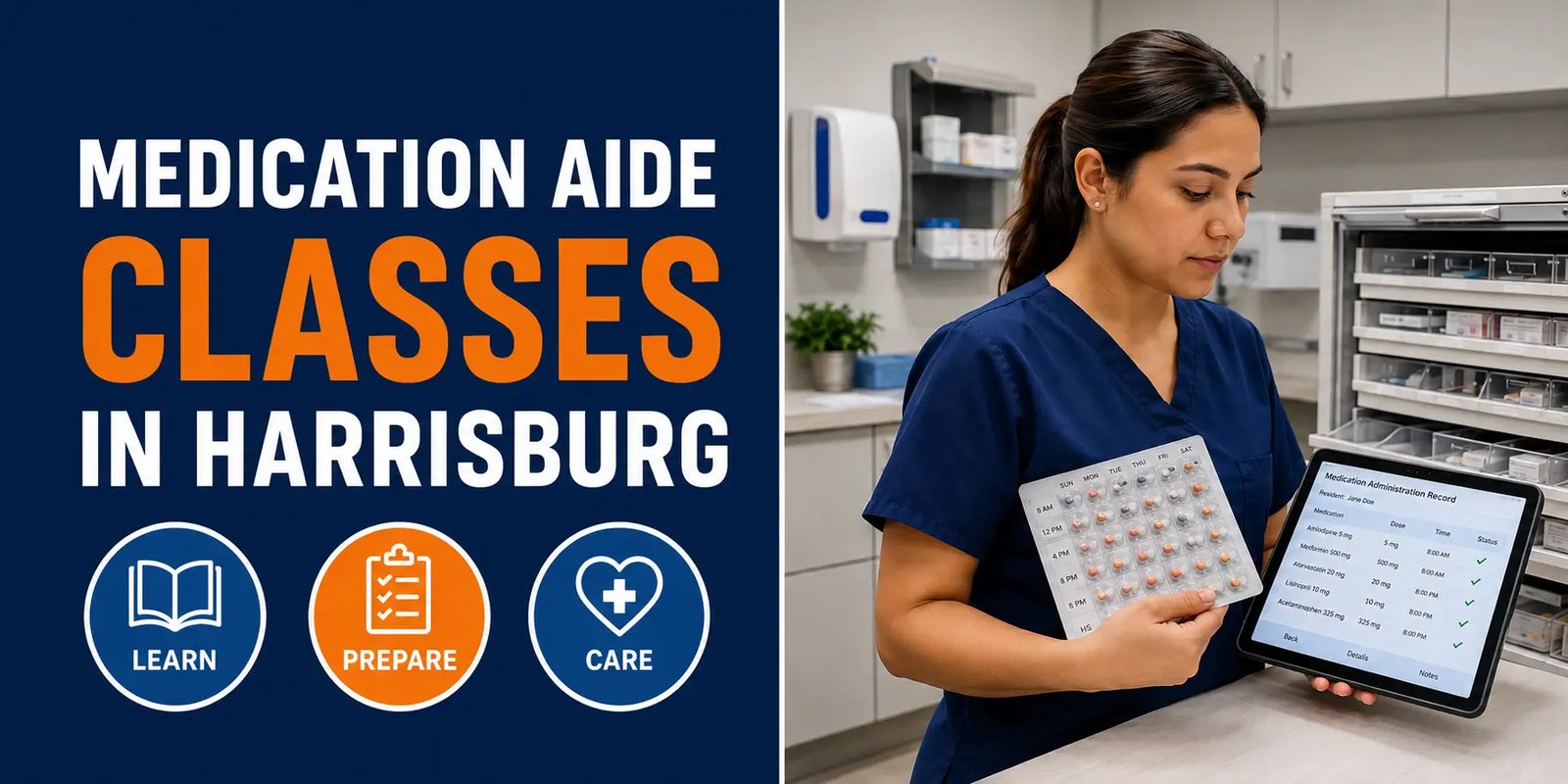
Pennsylvania changed how medication aide work operates. Under a 2024 state law that took effect in October 2025, the certified medication aide credential for long-term care nursing facilities now requires you to be a certified nurse aide first, then complete a 100-hour Department of Health program and pass its exam. A separate, older route still lets unlicensed staff in personal care homes and assisted living give medications without a CNA, through the state's Medication Administration Training. So the first thing to sort out near Harrisburg is which of the two paths fits the setting you want to work in. Either way, the pay tracks nursing assistant wages, which in the Harrisburg-Carlisle area run a median of about $43,940 a year, or $21.12 an hour, according to May 2025 BLS data.
Key Points
- Pennsylvania now has two medication aide paths, and which one you need depends on whether you want to work in a nursing facility or in personal care and assisted living.
- The certified medication aide credential, created by a 2024 law effective October 2025, requires an active Pennsylvania nurse aide certification, a 100-hour Department of Health program, and a passing exam score.
- The older Medication Administration Training still lets personal care home and assisted living staff give medications without a CNA, using a state competency test and an annual practicum.
- Certified medication aides renew every two years, and their training pairs classroom hours with hands-on skills.
- Nursing assistants in the Harrisburg-Carlisle metro earn a median of about $43,940 a year, the closest local wage benchmark for this kind of direct-care work.
The Two Ways to Become a Medication Aide in Pennsylvania
Pennsylvania now has two separate routes into medication aide work, and they lead to different settings. Which one you need comes down to whether you are aiming at a long-term care nursing facility or a personal care home or assisted living community.
Certified Medication Aide for Nursing Facilities
This is the newer path, created by Act 109 of 2024 and in effect since October 2025. To qualify, you first have to be a certified nurse aide listed on Pennsylvania's Nurse Aide Registry. From there, you complete a Department of Health program of 80 hours of classroom instruction and 20 hours of hands-on skills, then score at least 80% on the state exam. Certified medication aides work in long-term care nursing facilities, and the law also allows assisted living residences and personal care homes to employ them. The credential is renewed every two years.
Medication Administration Training for Personal Care and Assisted Living
The longer-standing route does not require a CNA. Unlicensed staff in personal care homes and assisted living residences can give medications after completing the state's Medication Administration Training and passing a performance-based competency test. Temple University administers this program statewide on a train-the-trainer model, so a certified trainer delivers the course at the facility. Passing clears staff to give oral and topical medications, eye, ear, and nose drops, and epinephrine in an emergency, with insulin adding a diabetes education requirement. Qualification is kept active through an annual practicum of medication observations and record reviews rather than a one-time certificate.
If your goal is a nursing home role, plan on the certified medication aide path and the nurse aide step that comes before it. If you are aiming at personal care or assisted living, the Medication Administration route is the shorter on-ramp. It is worth reading CNA vs medication aide if you are still deciding how the nurse aide step fits your plans. Dreambound is a marketplace for comparing vocational training across the United States, so you can line up the nurse aide and medication aide options that match the path you choose.
What a Medication Aide Does in Harrisburg
A medication aide gives residents their scheduled medications, records each dose, and watches for reactions, following the resident's orders, the facility's procedures, and Pennsylvania's medication rules. In a nursing facility, a certified medication aide does this under the direction of the nursing staff. In personal care and assisted living, trained staff handle routine medications within the facility's system.
Long-term care nursing facilities, personal care homes, and assisted living residences are the main settings across the Harrisburg area where this work happens. Communities like Homeland Center, Country Meadows, and Ecumenical Retirement Community are examples of the personal care and assisted living providers in the region.
Medication Aide Salary in the Harrisburg Area
Pay for medication aide work in the Harrisburg area tracks closely with nursing assistant wages, since the roles overlap and the certified path builds directly on a nurse aide credential. Nursing assistants in the Harrisburg-Carlisle metro earn a median of about $43,940 a year, or $21.12 an hour, according to May 2025 BLS data, the closest local read on what this kind of direct-care work pays. Adding medication duties is one of the ways direct-care staff take on more responsibility.
Nationally, BLS projects employment of nursing assistants and orderlies to grow about 2% from 2024 to 2034, slower than the average across all occupations, with roughly 211,800 openings a year across the two roles, most of them from workers moving into other jobs or leaving the workforce.
If that pay range fits your goals, line up the Harrisburg-area training options on Dreambound before you settle on a start date.
How Long Training Takes and What It Costs
Timelines depend on which path you take. The certified medication aide program runs 100 hours of combined classroom and skills training, and it sits on top of the time it takes to earn your nurse aide certification first. The personal care and assisted living route is shorter, since it is a focused course plus a competency test rather than a full credential built on a CNA. Both are ongoing: certified medication aides renew every two years, and personal care staff keep their qualification through the annual practicum.
Cost varies by the trainer, the program, and the setting, and there is no single statewide price. In practice, much of this training is arranged through an employer, since nursing facilities, personal care homes, and assisted living communities rely on trained staff. If you are covering training on your own, compare current options in the Harrisburg area rather than assuming one figure, since prices shift by provider.
Frequently Asked Questions
Do you need to be a CNA to become a medication aide in Pennsylvania?
It depends on the path. To become a certified medication aide in a nursing facility under Pennsylvania's 2024 law, you must first be a certified nurse aide on the state registry. The separate Medication Administration route for personal care homes and assisted living does not require a CNA. Choose the path based on where you want to work.
Is Pennsylvania's certified medication aide program new?
Yes. Pennsylvania created the certified medication aide credential through a 2024 law that took effect in October 2025. It is overseen by the Department of Health, which develops the training program and approves instructors. Because the program is still rolling out, class availability can vary by area and provider.
Can you take Pennsylvania medication aide training online?
Not fully. Both routes include hands-on skills and observations that a trainer has to watch in person, so a self-paced, entirely online certification is not how Pennsylvania structures this training. Some classroom coursework may be online, but the competency portions are done in person.
Does a Pennsylvania medication aide certification work in other states?
Not automatically. Pennsylvania's requirements are tied to its own law and rules, so a credential earned here does not transfer on its own. States that use a certified medication aide or CMA credential set their own training and testing. If you plan to work outside Pennsylvania, check that state's rules before you start.
Choosing the Right Medication Aide Path in Harrisburg
The thing that changed in Pennsylvania is that medication aide work now runs on two tracks, and picking the right one first saves you time. If you want a nursing facility role, the certified medication aide credential is the path, and it starts with becoming a nurse aide. If you are aiming at personal care or assisted living, the Medication Administration route gets you there without the CNA step.
Sorting that out up front tells you exactly what training to look for and in what order. From there, it comes down to finding a program that fits your schedule and the setting you want.
Compare nurse aide and medication aide training options across the Harrisburg area on Dreambound to see what lines up with the path you choose.