How to Become a Home Health Aide in New York: HHA Certification Steps
See if you qualify for Home Health Aide programs
Answer a few questions in 2 minutes. Free, no commitment.
To become a home health aide in New York, you complete at least 75 hours of training in a program approved by the state Health Department or Education Department, pass the program's written and skills evaluation, and receive your certificate through the New York Home Care Registry. There's no separate state exam and nothing to apply for on your own. Full-time programs often take about four weeks.
Training doesn't have to cost you anything. Health Department-approved programs can't charge tuition, which is why many home care agencies train new aides for free. Once you start working, state law also guarantees home care aides a higher minimum wage than most other workers in New York.
Key Points
- New York HHAs need at least 75 hours of training, 59 in the classroom and 16 supervised, in a program approved by the Health Department or Education Department.
- The training program runs your competency evaluation and issues your certificate through the Home Care Registry.
- Health Department-approved programs can't charge tuition and many agencies train for free, while public colleges charge about $610 to $1,400.
- Full-time programs take about four weeks, and Health Department programs must be completed within 60 days of your start.
- Home care aides earn at least $19.65 an hour in New York City, Long Island, and Westchester and $18.65 elsewhere in 2026, rising to $20.00 and $19.00 in 2027.
What Does a Home Health Aide Do in New York?
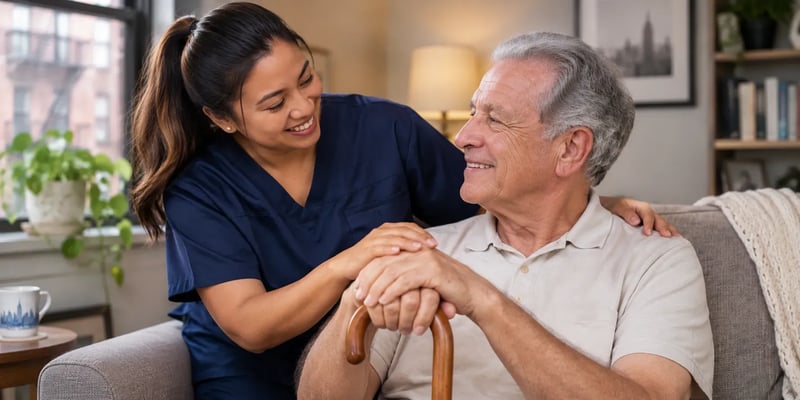
A Home Health Aide helps older adults, people with disabilities, and people recovering from illness or surgery live safely in their own homes. In New York, HHAs work under the supervision of a registered nurse or therapist. A registered nurse assesses what help each client needs, and the tasks an aide may perform are written into that client's plan of care.
On a typical shift, a home health aide in New York may handle:
- Personal hygiene: Help clients bathe, groom, and dress so they stay comfortable and keep their dignity.
- Meal preparation: Prepare meals that fit each client's dietary needs.
- Medication reminders: Remind clients when medication is due and help them take it themselves, as the nurse's care plan allows. The Health Department's HHA task matrix lets aides prompt a client, read the label, and open the container, while more hands-on help is limited to clients who direct their own care.
- Light housekeeping: Do laundry and tidy up to keep the home clean and safe.
- Medical appointments: Go with clients to appointments and support them during the visit.
- Emotional support: Offer companionship and conversation during each visit.
Who Can Become a Home Health Aide in New York?
New York doesn't require a high school diploma, and the minimum age depends on the program. Check both before you apply.
The Health Department recommends a minimum age of 18, though it doesn't require it. Education Department programs let students start clinical training at 16. Many programs set their own floor of 18, including Kingsborough Community College and NYC Workforce1 classes.
For education, the state screens trainees for the "ability to read, write, and carry out directions." Some free programs go further and ask for a diploma or GED, and each one posts its own eligibility list.
How to Get HHA Certification in New York
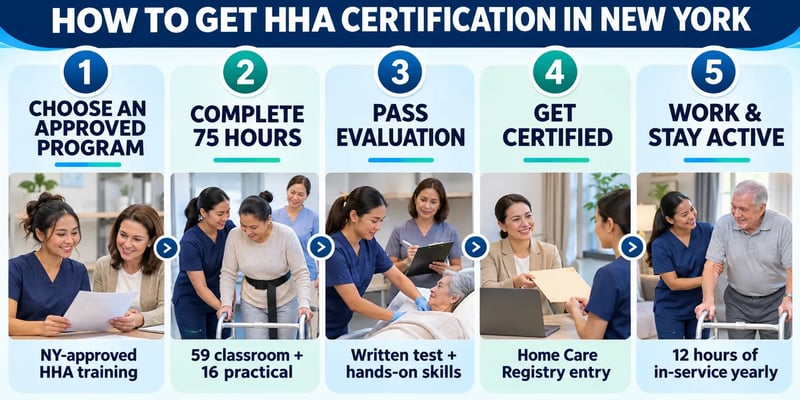
Getting HHA certification in New York takes five steps, and the training program handles the paperwork. The process is the same in New York City and upstate:
- Pick an approved program. Programs approved by the Health Department can't charge tuition, and many are run by home care agencies. Education Department-approved programs, such as those at public colleges, can charge tuition. Check the state's approved program list (updated Nov. 2, 2026) before you enroll.
- Complete at least 75 hours. That includes 59 classroom hours and 16 hours of supervised practical training. Health Department programs must be completed within 60 calendar days of your start, a deadline set in the state's HHA training program guide.
- Pass the competency evaluation. Your program's nurse instructor tests you in writing or orally and watches you perform each skill. You need a score of at least 80%.
- Get your certificate through the Home Care Registry. The program enters you in the state's Home Care Registry and issues your certificate. Under the Education Department's HHA program guidelines, the original certificate must reach you within 10 business days. You don't apply for it yourself.
- Get hired and stay active. Before you start, the agency verifies your training and requests a criminal history record check with fingerprints, which New York's Public Health Law requires for home care hires. Once you're working, HHAs need 12 hours of in-service training every year.
Some people start with credit for training they already have. Personal care aides, who complete a 40-hour course in New York, can move up to HHA with a 35-hour upgrade course (19 classroom and 16 practical hours). Certified nurse aides on New York's Nurse Aide Registry won't repeat training they've already had, though the program confirms their skills before adding home care training.
Want to be paid for caring for a relative instead? You may not need HHA training at all. New York's Consumer Directed Personal Assistance Program (CDPAP) pays family caregivers without a certificate, and our guide on becoming a caregiver in New York covers that path along with personal care aide training.
How Much Does HHA Training Cost in New York?
HHA training in New York is free at Health Department-approved programs. The state's tuition rule for training programs bars them from charging tuition and caps fees for required materials at $100. Public college programs cost about $610 to $1,400.
Some free programs, such as Selfhelp's, offer jobs to qualified graduates. Before you enroll, ask what the program expects of you once you finish.
Free HHA Training in New York City and Long Island
For free HHA certification in NYC, these programs are a good place to start. Schedules and eligibility vary from one to the next, and a quick call to confirm the details is worth it before you apply.
Program | Where | Length | Who qualifies | After training |
|---|---|---|---|---|
Manhattan, Brooklyn, Westbury | 75 hours; English, Spanish, Russian | Call to ask | Job offer if qualified | |
Queens | 4 weeks; English, Spanish | Not listed | Not hiring certified aides (Nov. 2026) | |
Bronx | About 1 month, weekdays | No diploma; placement test | Background and drug screen | |
Workforce1 centers | No class posted (Nov. 2026) | 18+, diploma or GED, income limit | Report your job placement | |
Brooklyn | 1 semester, HHA plus English | 18+, diploma, income limit | Job placement help |
A few details didn't fit the table. Bronx EOC's program runs 9 to 5 for at least 120 hours. Workforce1's May 2026 class required work authorization, Workforce1 membership, and earnings under $91,000, while Kingsborough's program is open to those earning under $62,000, unemployed, or on public assistance.
For programs outside this list, compare home health aide schools near you.
Paid Programs at Public Colleges
Kingsborough Community College, part of CUNY, charges $525 tuition, a $60 lab fee, and a $25 registration fee, or $610 in program fees. Students also buy a $51.25 textbook and $35 scrubs. Lectures are online, while labs and clinicals happen in person.
SUNY Rockland Community College charges $1,400 for its 75-hour hybrid evening course, which ran April 7 to July 2, 2026. To compare costs in other states, see the cheapest and fastest HHA programs.
How to Check Your HHA Certification in New York
Search the NY Home Care Registry by last name (at least two letters) or by your registry number. The registry lists home care workers who completed a state-approved training program, and agencies use it when they verify a new hire's training. You may also see it called the Home Care Worker Registry, the name the Education Department uses.
The Health Department's 2022 letter on certificate validity says HHA certificates carry no expiration date, but they lapse if you go 24 consecutive months without working for a New York home care or hospice agency. If that happens, you don't have to start over. The state's training guide lets aides in that situation take the competency evaluation at an approved program instead of repeating the full course.
While you're working, your agency must give you 12 hours of in-service training a year, counted from your date of hire, as a 2017 state rule on in-service training spells out.
Home Health Aide Pay in New York
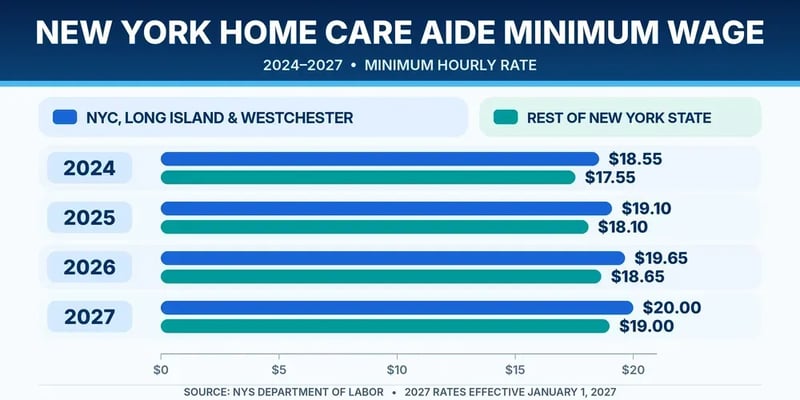
New York sets a higher minimum wage for home care aides than for other workers. In 2026 it's $19.65 an hour in New York City, Long Island, and Westchester and $18.65 in the rest of the state, rising to $20.00 and $19.00 on January 1, 2027, as the Labor Department's home care aide wage page confirms. By comparison, the state's general minimum wage for 2027 is $17.00 downstate and $16.00 elsewhere.
Home care aide minimum wage | New York City, Long Island, Westchester | Rest of the state |
|---|---|---|
2024 | $18.55 | $17.55 |
2025 | $19.10 | $18.10 |
2026 | $19.65 | $18.65 |
2027 | $20.00 | $19.00 |
The 2024 to 2026 rates come from the Labor Department's home care aide minimum wage fact sheet. Each rate takes effect on January 1.
In May 2025, home health and personal care aides in New York earned a median of $39,620 a year ($19.05 an hour). HHA salary in NYC ran slightly higher, with a New York City metro median of $39,680 ($19.08). Both are above the national median of $35,800.
BLS counts HHAs and personal care aides together. Because it builds these estimates from three years of survey data, they trail the state's recent minimum wage increases.
On Medicaid-funded cases in New York City, Nassau, Suffolk, and Westchester, the state's wage parity law adds a benefit portion on top of the base wage.
Looking ahead, BLS projects 18% growth from 2025 to 2035 for home health and personal care aides nationwide, with about 760,500 openings a year.
For a closer look at what moves pay up over time, see what affects home health aide pay.
Frequently Asked Questions
How long does it take to become a home health aide in New York?
About four weeks in a full-time program. New York requires at least 75 hours of training, and Health Department programs must be completed within 60 days of your start. Part-time and hybrid college programs take longer; SUNY Rockland's spring 2026 evening course ran about 12 weeks.
Do home health aides need to be licensed in NY?
No. New York treats HHAs as unlicensed individuals, so what you need is home health aide certification. Your approved training program issues that certificate through the Home Care Registry after you pass its competency evaluation, and there's no separate state exam.
Can you get HHA certified online in New York?
Partly. Under the Health Department's hybrid training rules, issued in 2020, approved programs can teach the classroom portion through live online classes but not through self-paced modules. Your supervised practical training and final skills check still happen in person, which means any "free online HHA training" in New York includes some in-person days. To see how hybrid formats work, read our guide to online HHA classes.
Can I work as an HHA in New York with a certificate from another state?
Not right away. If you have documented HHA or nurse aide training and a competency evaluation from another state, New York lets you skip the full course and take only the competency evaluation at an approved program. Once you pass, the program issues your certificate through the Home Care Registry.
Your Next Step Toward HHA Certification in New York
Start with a free agency program if you're ready to work for that agency, or a public college program if you need evening or hybrid classes. Either way, confirm the program is on the state's approved list and ask when your certificate will appear in the Home Care Registry.
Even paid training pays for itself quickly. Kingsborough's $610 equals about 31 hours of work at New York City's 2026 home care minimum of $19.65 an hour.
Your certificate is also a starting point. With a high school diploma and a year of home care experience, you can train as an advanced home health aide, which takes at least 125 hours of instruction and a passing score on New York's medication aide exam, and lets you handle some medication tasks under a registered nurse's supervision.
Read More
Before you enroll, these two guides can help you decide whether home health aide work is the right fit for you: