
Dental Assistant vs Phlebotomy: 2026 Career Comparison Guide
See if you qualify for Phlebotomy programs
Answer a few questions in 2 minutes. Free, no commitment.
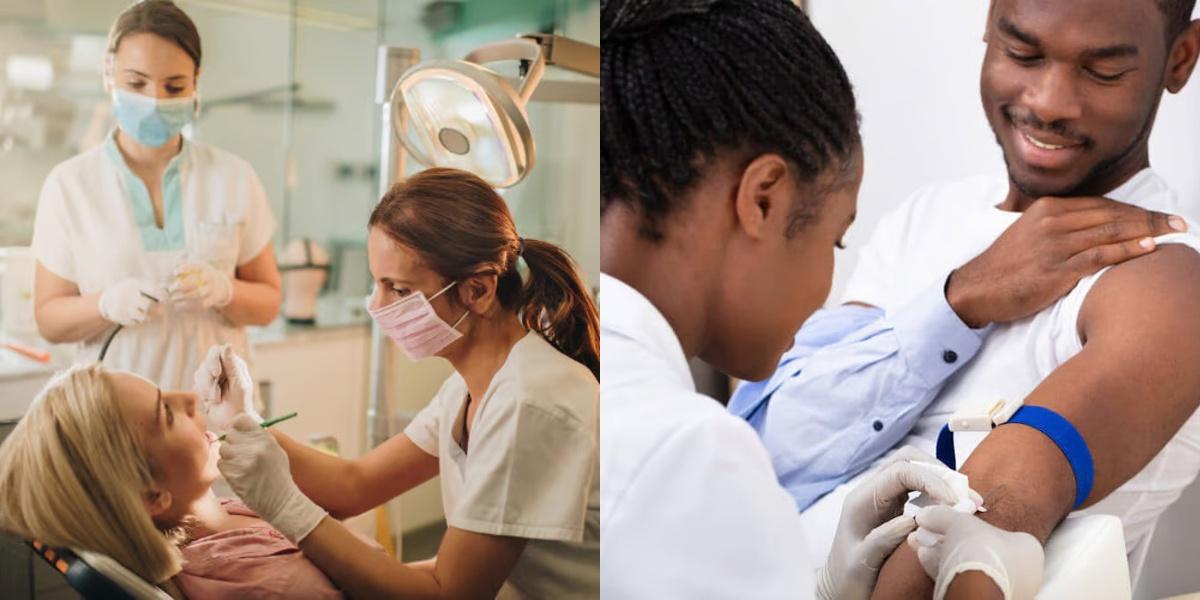
The clearest difference between dental assisting and phlebotomy is what each role actually does in a shift. Dental assistants support dentists with chairside care, sterilization, X-rays, and patient preparation inside a dental office, while phlebotomists are blood collection specialists who work across hospitals, labs, blood banks, and donor centers. Dental assistants earned a median annual wage of $47,300 in May 2024, while phlebotomists earned $43,660. Training timelines also differ: dental assisting certificate programs typically run about a year, while phlebotomy programs often finish in a few weeks to a few months. The two careers also lead in different directions, with dental assistants advancing toward expanded clinical functions or dental hygiene and phlebotomists moving into specialty roles or medical laboratory work.
Dental Assistant — Las Vegas Dental Assistant School
- Format: Hybrid
- Length: 12 weeks
- Tuition: $1,450 to start, $4,250 total
- Includes a 40-hour externship in a Nevada dental practice and BLS certification through the American Heart Association
Dental Assisting — Carrington College
- Format: Hybrid
- ACCJC/WASC accredited; high school diploma or GED required
- Carrington College also offers the dental assisting program at additional campuses across Arizona, California, Oregon, Idaho, and New Mexico.
Phlebotomy Programs
Phlebotomy Technician — Penn Foster
- Format: Online
- Self-paced; includes a hands-on externship component and a national certification exam voucher
Phlebotomy with Test Prep — CCI Training Center
- Format: Hybrid
- ACCET accredited; phlebotomy training is delivered inside CCI's Medical Assistant or Pharmacy Technician programs in Dallas and Arlington, TX, and prepares students for the NHA Certified Phlebotomy Technician (CPT) exam
Phlebotomy Technician — Williams Career School of Excellence
- Format: Hybrid
- Tuition: $600 to start, $1,200 total
- Income-based tuition model in San Marcos, TX; prepares students for national phlebotomy technician certification
Phlebotomy Technician I — HealthStaff Training Institute
- Format: In person
- Length: 6 weeks, 100 clock hours
- Tuition: $2,295 total
- California Department of Public Health-approved Certified Phlebotomy Technician I program with an externship of roughly 40 to 80 hours
- HealthStaff Training Institute also runs campuses in Orange County and Temecula.
Phlebotomy — Phlebotomy Training Specialists
- Format: In person
- Tuition: $1,995 total
- 40 hours of in-class didactic training with the National CPT Exam proctored on-site; approved by the California Department of Public Health and the Bureau for Private Postsecondary Education
- Phlebotomy Training Specialists operates additional campuses across California, Illinois, Washington, Arizona, Colorado, Georgia, Alabama, Arkansas, and Wisconsin.
If you want to see what is running in your area, browse dental assistant schools near you or phlebotomy classes near you on Dreambound to filter by location and format.
Frequently Asked Questions
Is it harder to learn dental assisting or phlebotomy?
Both are skilled trades, but the learning curves differ. Dental assisting covers a wider clinical skill set, including chairside assisting, X-rays, sterilization, and recordkeeping, across a longer program. Phlebotomy concentrates on one core technical skill, venipuncture, performed under realistic patient pressure. Many students find phlebotomy easier to start but tighter on technical accuracy.
Do dental assistants or phlebotomists need a college degree?
No, neither career requires a college degree. Both are entry-level healthcare careers reached through postsecondary certificate or diploma programs at community colleges, vocational schools, and accredited online providers. Some students later pursue an associate or bachelor's degree to move into hygiene, medical laboratory science, or nursing.
Which career offers more scheduling flexibility?
Dental assistant schedules are usually tied to standard dental office hours, with some evening or Saturday clinics available depending on the practice. Phlebotomy generally offers more scheduling variety because phlebotomists work in hospitals, donor centers, mobile units, and labs that run multiple shifts. Compare dental assistant and phlebotomy programs on Dreambound to check schedule formats for each option.
Can a dental assistant or phlebotomist move into nursing?
Yes, both roles can serve as a stepping stone into nursing because each involves direct patient contact, clinical documentation, and exposure to a healthcare team. Aspiring nurses typically still need to complete a separate nursing program and pass the NCLEX, but hands-on experience as a dental assistant or phlebotomist helps with school admission and early clinical comfort.
Is the work physically demanding for either career?
Both careers involve standing, repetitive movements, and time on your feet, but the strain points differ. Dental assistants spend most of the shift seated chairside in awkward angles, which can put pressure on the neck, shoulders, and back. Phlebotomists are usually on their feet between draws, moving between patient rooms or collection stations, with steady hand and wrist demands.
Choosing Between Dental Assisting and Phlebotomy
The fastest way to decide between dental assisting and phlebotomy is to start with where you want to land in five years, not where you start. Dental assisting takes longer to complete but plants you inside a vertical that climbs steadily toward EFDA work, RDA licensure in regulated states, and eventually dental hygiene. Phlebotomy puts you in a hospital, lab, or donor center within months, and the role opens a clear lateral path into specialty work, medical laboratory science, and adjacent clinical careers.
Both careers compensate steadily, both carry the same 6% national growth outlook, and both work as launchpads into wider healthcare. The harder question is fit: whether you want a settled team and standing patient relationships, or whether you want technical precision and variety across settings. Once that is clear, the comparison narrows quickly. Compare dental assistant and phlebotomy programs on Dreambound based on what each one lets you do next, not just what it starts you doing now.
