Key Points
- Maintenance technicians inspect, troubleshoot, and repair equipment and building systems across residential, commercial, and industrial settings.
- Most entry-level roles require a high school diploma or equivalent, and trade certifications improve pay and job prospects.
- Industrial maintenance technicians typically earn more than general facilities maintenance technicians because the machinery is more complex and the setting is usually a manufacturing plant.
- Aircraft maintenance technicians need FAA certification and earn substantially more, reflecting the licensing and regulatory requirements of the work.
What Is a Maintenance Technician?
A maintenance technician is a skilled tradesperson who keeps physical systems working: the HVAC, plumbing, electrical, and mechanical equipment in a building, or the production machinery in a plant. The BLS classifies the general version of the job as maintenance and repair workers, general, an occupation of more than 1.6 million people in 2025. O*NET lists the same job under titles such as building mechanic, facilities technician, maintenance mechanic, and maintenance technician.
The setting decides what the job looks like. In apartments, offices, hospitals, and schools, a maintenance technician handles everything from a leaking valve to a tripped breaker and is often the only trade on site. In a manufacturing plant, the same title means keeping conveyors, motors, and automated lines running, which is the industrial specialization covered below.
In aviation, the title is a regulated job that requires an FAA certificate, which is why aircraft maintenance is treated below as its own path rather than a senior version of the general role.
What Does a Maintenance Technician Do?
The daily work splits between scheduled prevention and unscheduled repair, and the balance depends on the site. A maintenance technician's responsibilities include:
- Inspecting and troubleshooting equipment to find the fault before it becomes a failure
- Performing preventive maintenance on schedule, such as filter changes, lubrication, and belt and bearing checks
- Repairing or replacing faulty parts, from a failed motor to an electrical switch, outlet, or circuit breaker
- Responding to work orders from tenants, managers, or production supervisors
- Maintaining safety and compliance standards for the building or plant
- Keeping maintenance logs and records of every repair, part, and inspection
The BLS adds planning repair work from blueprints or diagrams, ordering parts and supplies, and meeting with clients to estimate repairs and costs. Those last items separate the job from a helper role: a maintenance technician is expected to diagnose, decide, and document, not only carry out instructions.
How to Become a Maintenance Technician
General maintenance work has no license of its own, so the path is about stacking credentials employers look for. The BLS lists a high school diploma or equivalent as the typical entry education, with moderate-term on-the-job training. The diploma is the floor: in O*NET's education survey data, 63% of workers in the occupation reported that a postsecondary certificate was required for their job.
- Finish high school or earn a GED. It is the baseline that programs and employers ask for.
- Consider a trade school certificate. A facilities maintenance certificate covers electrical, plumbing, HVAC, and carpentry basics, and a dedicated HVAC technician training program or electrical technician diploma program goes deeper on the two systems maintenance technicians touch most.
- Get hands-on hours. An apprenticeship or an entry-level maintenance assistant job turns classroom skills into a work history, and O*NET puts the typical ramp at one to two years of on-the-job training alongside experienced workers.
- Add certifications for your specialization. EPA Section 608 certification is required for anyone who services equipment that could release refrigerants, comes in Type I, Type II, Type III, and Universal, and does not expire. Electrical, HVAC, and forklift operator certifications follow the same logic: each proves a skill an employer would otherwise have to train.
How Much Does a Maintenance Technician Make?
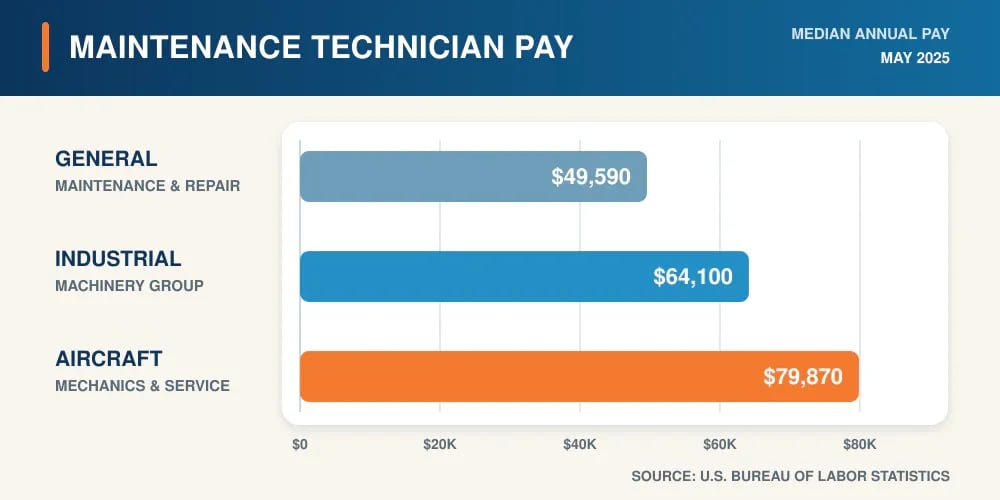
General maintenance and repair workers earned a median $49,590 a year, or $23.84 an hour, in May 2025, according to the BLS Occupational Outlook Handbook. The BLS projects 4% employment growth from 2025 to 2035, about as fast as the average for all occupations. Across 1,621,800 jobs, it expects about 148,700 openings a year, many of them from the need to replace workers who transfer to other occupations or leave the labor force.
Pay moves with the setting. The highest-paying industries for general maintenance workers in May 2025 were manufacturing at $61,500 and government at $51,160, and that manufacturing premium is the first sign of the industrial pay gap covered next.
Breadth matters too. A technician who can handle HVAC, electrical, and plumbing without calling a contractor is worth more to a property manager than one who covers only one of the three.
The two specializations below sit well above the general median for different reasons, industrial work because of the machinery and aircraft work because of the certificate.
What Is an Industrial Maintenance Technician?
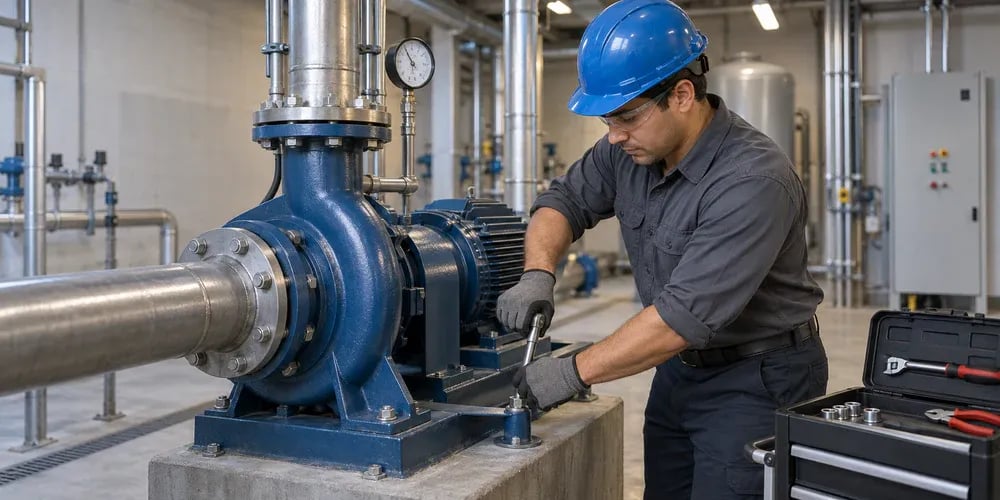
An industrial maintenance technician keeps production equipment running inside a manufacturing plant, processing facility, distribution center, or utility: conveyor systems, motors and drives, pumps, hydraulics, pneumatics, and the programmable logic controllers (PLCs) that run automated lines. The difference from general facilities work is the machine, not the building.
A stopped conveyor stops a production line, so the job leans on mechanical and electrical troubleshooting under time pressure, and on reading technical manuals and schematics before touching anything.
The BLS groups this work under industrial machinery mechanics, machinery maintenance workers, and millwrights, whose duties include disassembling machinery when problems occur, repairing or replacing components, running tests to verify the fix, and adjusting and calibrating equipment to specification.
Employers often ask for PLC and automation troubleshooting on top of the mechanical base, which is why the maintenance technician program in the Dreambound section below teaches controllers alongside power transmission and fluid power.
Industrial Maintenance Technician Salary
The BLS does not track "industrial maintenance technician" as a job title. Its closest category, industrial machinery mechanics, machinery maintenance workers, and millwrights, earned a median $64,100 a year, or $30.82 an hour, in May 2025, according to BLS industrial machinery mechanics data. Within the group, industrial machinery mechanics earned $64,520, machinery maintenance workers $60,850, and millwrights $65,700.
That is roughly $14,500 above the general maintenance median, and demand is stronger too. The BLS projects 14% growth from 2025 to 2035, much faster than average, with about 51,900 openings a year across 547,300 jobs.
What Is an Aircraft Maintenance Technician?
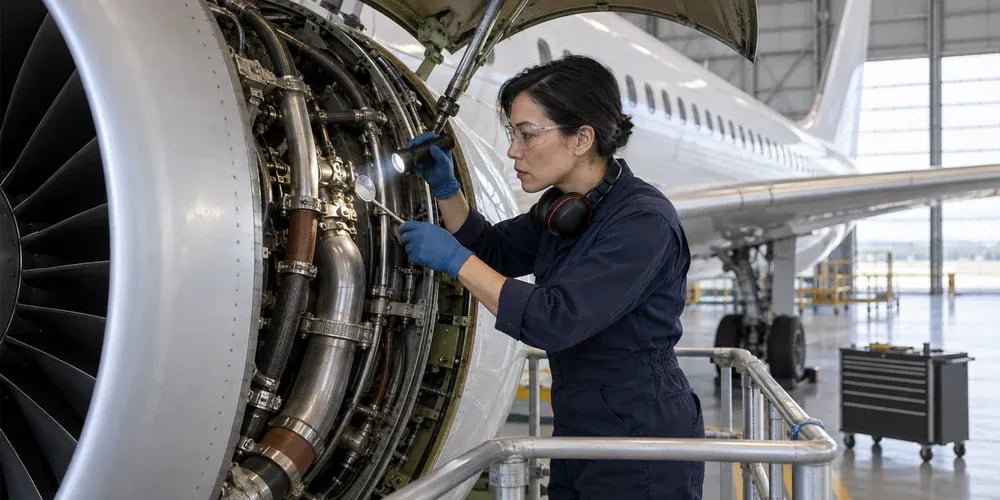
An aircraft maintenance technician inspects, services, and repairs airframes, engines, and aircraft systems, and unlike the two roles above, the job is federally regulated. The FAA requires aircraft maintenance to be performed by a certificated mechanic with the appropriate ratings, or by someone working under that mechanic's supervision. The certificate carries two ratings, Airframe and Powerplant, and employers may prefer both, which is why the job is commonly called an A&P mechanic.
The FAA's mechanic certificate requirements are specific. You must be at least 18 and able to read, write, speak, and understand English. You qualify to test either by graduating from an FAA-approved Aviation Maintenance Technician School under Part 147, or through practical experience: 18 months for a single rating, or 30 months working on both airframes and powerplants for the combined A&P.
Then you pass three written knowledge tests (General, Airframe, and Powerplant) plus an oral and a practical exam with a Designated Mechanic Examiner, all within a 24-month window.
That structure is why aircraft maintenance is a separate path, not a promotion from general maintenance. The hours have to be aircraft hours. Dreambound's guide to the cheapest and fastest aviation maintenance programs compares the school route by cost and length.
Aircraft Maintenance Technician Salary
Aircraft and avionics equipment mechanics and technicians earned a median $80,180 a year, or $38.55 an hour, in May 2025, according to BLS aircraft mechanics data: $79,870 for aircraft mechanics and service technicians and $82,280 for avionics technicians. That is about $30,600 above the general maintenance median and about $16,100 above the industrial group.
The BLS lists a postsecondary nondegree award as the typical entry education, projects 6% growth from 2025 to 2035, faster than average, and expects about 13,100 openings a year across 159,800 jobs.
Comparing Maintenance Technician Specializations
The three paths share a toolbox and little else. All three medians sit on the same BLS page for installation, maintenance, and repair occupations, which puts the group's median at $59,620 in May 2025 against $50,980 for all occupations. The setting and the certificate requirement decide which side of that line a maintenance technician lands on.
Two things the table hides. The industrial figure is a median across three BLS occupations, and the machinery maintenance workers within it earned $60,850, so read it as a range rather than a floor. And aircraft pay reflects a certificate that takes 18 to 30 months of documented experience or a Part 147 program to earn, so the gap is paid for in training time before it is paid out in wages.
Maintenance Technician Programs on Dreambound
Dreambound lists maintenance technician training by school and format in one place, and the program below is offered at three San Joaquin Valley College campuses in California. Its curriculum is industrial: programmable logic controllers, power transmission, industrial electricity, and fluid power, which is the skill set the industrial section above describes.