How to Become a Wind Turbine Technician in Pennsylvania
See if you qualify for Wind Turbine Technician programs
Answer a few questions in 2 minutes. Free, no commitment.
To become a wind turbine technician in Pennsylvania, you finish a wind technician certificate or associate program or get hired and trained on the job, earn safety credentials such as GWO Basic Safety Training, and build climbing and electrical experience. Pennsylvania does not license wind turbine technicians. The state has a real but small wind fleet: about 1,510 megawatts and 27 utility-scale wind farms, all in the southwest-central and northeastern parts of the state, and each farm needs only a small permanent crew. The Bureau of Labor Statistics counted about 50 wind turbine technicians in Pennsylvania in May 2025, earning a median of $60,830 a year. Texas alone employed 3,890 wind turbine technicians in May 2025 and Iowa 900, so be ready to travel or relocate. Nationally, BLS projects 30% job growth from 2025 to 2035.
Key Points
- Pennsylvania does not license wind turbine technicians; employers look for training plus safety credentials such as GWO Basic Safety Training.
- According to BLS, typical entry is a certificate or diploma plus long-term on-the-job training.
- Pennsylvania has about 1,510 MW of wind capacity and 27 utility-scale wind farms, and its installed capacity passed 1,000 MW in 2012.
- Pennsylvania technicians earned a median $60,830 in May 2025; the national median was $64,120.
- The state projects about 22 wind technician openings a year, so be prepared to travel or relocate.
What Does a Wind Turbine Technician Do?
Wind turbine technicians install, inspect, maintain, and repair the turbines that turn wind into electricity. Their day-to-day work includes:
- Conducting regular inspections and maintenance of wind turbines
- Diagnosing and repairing any mechanical, electrical, or hydraulic issues
- Performing preventive maintenance to avoid potential failures
- Operating specialized tools and equipment
- Collaborating with a team to ensure the smooth functioning of wind farms
Wind farms are the largest single employer, but not the only one. BLS reports that 42% of wind turbine technicians work in wind electric power generation, 15% are self-employed, 15% work in power and communication line construction, and 12% work in commercial and industrial machinery repair and maintenance.
The job is physically demanding. BLS describes the work environment as outdoors, in confined spaces, and often at great heights, and technicians may be on call in the evening or on weekends. Tower ladders are usually at least 200 feet high, and technicians maintaining mechanical systems work in the confined space of the nacelle, the housing at the top of the tower. Once hired, technicians typically receive employer- or manufacturer-provided training on the specific turbines they maintain.
The Occupational Safety and Health Administration's wind energy page lists falls, severe burns from electrical shocks and arc flashes, and crushing injuries among the incidents reported to OSHA in wind work.
Wind Energy in Pennsylvania: Where the Wind Farms and Jobs Are
Pennsylvania's wind fleet is modest. As of May 31, 2025, the state's certified installed wind capacity under the Alternative Energy Portfolio Standards was 1,510 MW, according to the Pennsylvania Public Utility Commission's 2025 AEPS report. Of the energy Pennsylvania's electric power sector consumed in 2024, renewable energy made up 2.0%, compared with 51.4% for natural gas and 39.2% for nuclear power, according to the U.S. Energy Information Administration's Pennsylvania profile.
As of fall 2024, Pennsylvania had 27 utility-scale wind farms, all in the southwest-central or northeastern parts of the state, according to Saint Francis University's Institute for Energy. Somerset County has the most, with 8 active wind farms and 198 turbines. The state's first wind farm, Green Mountain in Garrett, Somerset County, began operating in May 2000; it was deactivated in 2015 and removed in 2016.
The newest is CPV Rogue's Wind, a 114 MW project with 19 turbines built on former coal mine land in Cambria and Clearfield counties. CPV announced the start of commercial operations in July 2026.
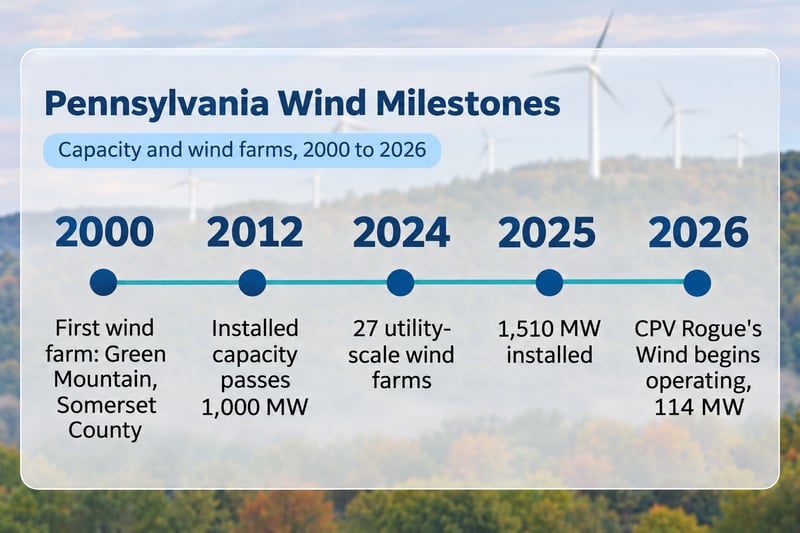
The workforce is small because each wind farm typically needs a permanent crew of up to 15 people to maintain and operate its turbines, according to the PUC. Pennsylvania's installed capacity passed 1,000 MW in 2012, and some older farms have since been repowered, meaning their turbines were refurbished or replaced with newer equipment. Repowering and routine maintenance are both technician work.
The Pennsylvania Department of Labor and Industry's long-term occupational projections estimated 160 wind turbine service technician jobs in the state in 2022 and project 210 by 2032, with about 22 openings a year.
How to Become a Wind Turbine Technician in Pennsylvania?
Pennsylvania does not license wind turbine technicians. None of the 29 professional licensing boards and commissions under the Pennsylvania Department of State covers the job, so the path runs through training, safety credentials, and employer training.
1. Finish High School or Earn a GED
A high school diploma or GED is the baseline for wind technician training. Each program sets its own admission requirements, so check them before you apply.
2. Complete Wind Technician Training
BLS says wind turbine technicians typically attend technical schools or community colleges, where they may complete a postsecondary certificate in wind energy technology or earn an associate degree. The U.S. Department of Energy's wind technician career map describes a 2-year technical program followed by on-the-job training. According to BLS, coursework includes electrical and hydraulic systems, braking and mechanical systems, programmable logic control systems, tower climbing, rescue, safety, first aid, and CPR.
3. Earn GWO Basic Safety Training
Global Wind Organisation (GWO) Basic Safety Training covers first aid, manual handling, fire awareness, and working at height, the modules that apply to land-based wind farms like Pennsylvania's.
4. Consider NFPA's WTT-I Certification
Once you have finished training in wind turbines and electrical safety, or have at least 6 months of experience as a wind turbine technician, you qualify to sit for the National Fire Protection Association's Certified Wind Turbine Technician-I exam.
5. Get Hired and Complete Employer Training
BLS classifies the on-the-job training for this occupation as long term. Hiring conditions are set by each employer: some wind farms may require technicians to possess a valid driver's license and pass a background check and drug test. On the job, technicians follow Occupational Safety and Health Administration (OSHA) guidelines.
Wind Turbine Technician Certifications: GWO and NFPA
BLS notes that certification is not mandatory, though it allows workers to demonstrate a certain level of knowledge and competence. Certification subjects include workplace electrical safety, tower climbing, and self-rescue, and BLS adds that employers often direct workers to the certifications they need.
GWO Basic Safety Training. The Global Wind Organisation's Basic Safety Training standard has five modules: First Aid, Manual Handling, Fire Awareness, Working at Height, and Sea Survival. Sea Survival applies to offshore work, so it is not needed for Pennsylvania's land-based wind farms. The current standard is Version 20, dated March 10, 2026, and each module has a refresher course.
NFPA Certified Wind Turbine Technician-I (WTT-I). The National Fire Protection Association's WTT-I certification uses a two-hour, closed-book exam with 60 multiple-choice questions, taken in person at Prometric testing centers. To qualify, you need training in wind turbines and electrical safety that covers the exam blueprint, or at least 6 months of experience as a wind turbine technician. Fees are $245 to apply, $199 to retest, and $180 to recertify.
When comparing training programs, the ANSI/ACP 5000-2-2022 Wind Technician Entry-Level Minimum Standard sets a recommended minimum curriculum for entry-level wind technician training. It guides training programs and does not certify individuals.
Wind Turbine Technician Training Options for Pennsylvania Residents
No partnered wind turbine technician program is based in Pennsylvania. Dreambound, a marketplace where students compare vocational training programs across the U.S., lists one partnered wind turbine technician program, and it is in Norfolk, Virginia.
Wind Turbine Technician - Diploma - Centura College, Norfolk, VA
- Format: In person
- Location: Norfolk, Virginia
- Length: About 12 months
Because the training is in person in Virginia, Pennsylvania residents would need to live within reach of Norfolk for the length of the program. For programs in other states, Dreambound's guide to wind turbine technician schools near me lists more options.
How Long Does It Take to Become a Wind Turbine Technician?
Training length depends on the path. The Centura College diploma runs about 12 months. The Department of Energy describes a 2-year technical program, after which employers usually provide on-the-job training lasting more than 12 months. For a breakdown by path, see the guide to how long it takes to become a wind turbine technician.
How Do I Get a Job as a Wind Turbine Technician?
Once you finish training, these steps can help you find a wind turbine technician job:
- Search for job openings: Check online job boards, industry websites, and company career pages for Wind Turbine Technician job openings. Some companies may also accept applications directly, even if they don't have any current openings. Submit your resume and cover letter for any positions that interest you. Networking with professionals in the wind energy industry, including at industry conferences or events, can also help you learn about job openings that may not be advertised publicly.
- Gain additional certifications: Consider obtaining certifications that are relevant to the wind energy industry, such as GWO Basic Safety Training and NFPA's WTT-I. This can help set you apart from other candidates and demonstrate your commitment to professional development.
- Be open to relocation: Wind turbine technician jobs may be located in different parts of the country or even internationally. Pennsylvania's Department of Labor and Industry projects about 22 wind turbine technician openings a year in the state, while BLS counted 3,890 wind turbine technicians employed in Texas and 900 in Iowa in May 2025. Being open to relocation can widen your job search.
Career Paths and Opportunities After Becoming a Wind Turbine Technician
- Wind Turbine Service Technician: In this role, you will be responsible for maintaining and repairing wind turbines, conducting routine inspections, and troubleshooting any issues that arise. This role offers the opportunity to work directly with wind turbines and gain hands-on experience in the field.
- Wind Turbine Inspector: As a Wind Turbine Inspector, you will be responsible for conducting inspections of wind turbines to ensure they are operating safely and efficiently. This role requires a thorough understanding of wind turbine systems and components, as well as knowledge of safety protocols and regulations.
- Wind Turbine Project Manager: With experience and additional training, you can progress into a project management role. As a Wind Turbine Project Manager, you will oversee the installation, maintenance, and repair of wind turbine projects. This role involves coordinating with various stakeholders, managing budgets and timelines, and ensuring compliance with industry standards.
- Wind Turbine Sales Representative: If you have strong communication and sales skills, you may consider a career as a Wind Turbine Sales Representative. In this role, you will be responsible for promoting and selling wind turbine systems to potential customers, such as utility companies or renewable energy developers.
- Wind Turbine Instructor: If you enjoy teaching and sharing your knowledge with others, you may consider becoming a Wind Turbine Instructor. In this role, you will teach aspiring Wind Turbine Technicians about the various components of wind turbines, safety protocols, and maintenance procedures. This role may require additional certifications and experience in the field.
- Renewable Energy Consultant: With your expertise in wind energy, you can work as a Renewable Energy Consultant, providing advice and guidance to individuals or companies looking to transition to renewable energy sources. This role involves assessing energy needs, recommending appropriate renewable energy solutions, and assisting with the implementation and maintenance of renewable energy systems.
Wind Turbine Technician Salary in Pennsylvania
According to May 2025 BLS data, wind turbine technicians in Pennsylvania earned a median annual wage of $60,830, or $29.25 an hour, below the national median of $64,120. Pennsylvania's lowest 10% earned under $48,030 and the highest 10% over $87,950. BLS publishes no Pennsylvania metro figures for this occupation.
Area (May 2025) | Median annual | Median hourly | Employed |
|---|---|---|---|
Pennsylvania | $60,830 | $29.25 | 50 |
United States | $64,120 | $30.83 | 9,980 |
New York | $81,330 | $39.10 | 390 |
Ohio | $73,880 | $35.52 | 120 |
Employment counts are Occupational Employment and Wage Statistics estimates for May 2025 and exclude self-employed workers.
Nationally, the Bureau of Labor Statistics reports 11,800 wind turbine technician jobs in 2025, a count that includes self-employed workers, and projects 30% growth from 2025 to 2035, about 3,500 new jobs and about 1,500 openings a year. National median pay by industry in May 2025 was $70,670 in commercial and industrial machinery repair and maintenance, $65,000 in wind electric power generation, and $63,080 in power and communication line construction.
Frequently Asked Questions
How many wind farms are there in Pennsylvania?
Pennsylvania had 27 utility-scale wind farms as of fall 2024, according to Saint Francis University's Institute for Energy. One more, CPV Rogue's Wind in Cambria and Clearfield counties, began commercial operations in July 2026.
Do you need a license to be a wind turbine technician in Pennsylvania?
No. Pennsylvania does not license wind turbine technicians. Employers look for training and safety credentials such as GWO Basic Safety Training.
How much do wind turbine technicians make in Pennsylvania?
According to May 2025 BLS data, wind turbine technicians in Pennsylvania earned a median annual wage of $60,830, or $29.25 an hour.
How long does wind turbine technician training take?
About 12 months for a diploma, or 2 years for a technical degree, followed by on-the-job training that the Department of Energy says typically lasts more than 12 months.
How much does wind turbine technician school cost?
It varies by program and school, so check costs directly with each school. Dreambound's guide to the cheapest and fastest wind turbine technician programs compares programs on cost and length.
Starting a Wind Turbine Technician Career in Pennsylvania
Training, GWO Basic Safety Training, and climbing and electrical experience are the foundation of a wind turbine technician career in Pennsylvania. With about 22 openings a year in the state, be ready to follow the work to where turbines are being built and maintained. Dreambound lists wind turbine technician training programs by location across the United States.