How to Become a Gunsmith
See if you qualify for Gunsmith programs
Answer a few questions in 2 minutes. Free, no commitment.
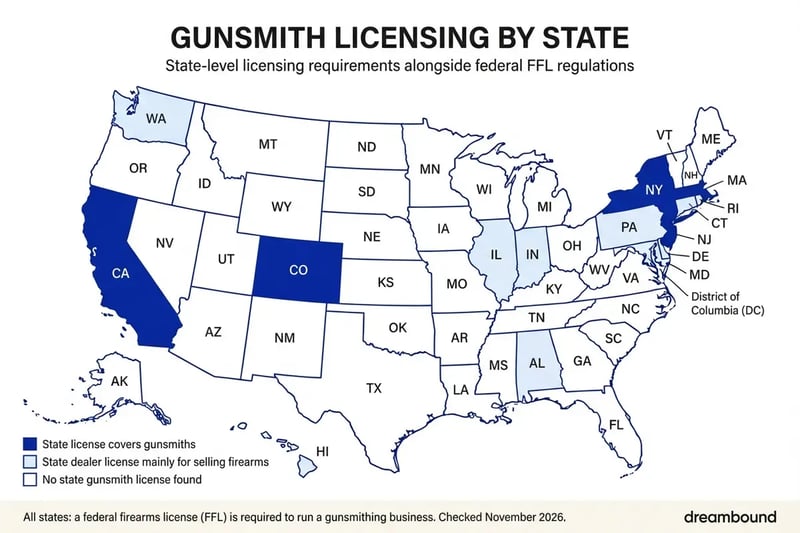
There's no national gunsmith exam. Most gunsmiths learn the trade at a gunsmithing school or community college, or by working under an experienced gunsmith. Programs run from a few months to about two years. Training doesn't require a license, but once you repair or customize other people's guns as your own business, you need a federal firearms license (FFL) from the ATF, and you must be 21 to get one. Six places also have their own license that covers gunsmiths: California, Colorado, the District of Columbia, Massachusetts, New Jersey, and New York.
Gunsmith Career Path, Step by Step
1. Make sure you can legally handle firearms
Gunsmiths handle guns every day, so you have to be legally allowed to possess them. Federal law bars people with felony convictions and certain other records from having firearms, which rules out the job. Gunsmithing schools check too: most admit students at 18 after a background check.
2. Build mechanical and machining basics
Gunsmithing is precision metalwork, with some woodwork for stocks. High school shop, machining, welding, and math classes all carry over, and so does time spent on a lathe or mill.
3. Choose how you'll train
You can earn a two-year associate degree at a community college, attend a private gunsmithing school, take an online certificate, add short summer classes, or learn on the job. In-person programs put you on shop machines, which online courses can't do. Our guide to how long it takes to become a gunsmith breaks down the timeline for each route.
4. Get bench experience in a working shop
Many new gunsmiths start as a bench technician or shop assistant at a gun store, range, or manufacturer, where the business already holds the federal license. You'll do cleaning, part swaps, and diagnosis before you're trusted with barrel and trigger work. This is also where you build the reputation that brings in customers later.
5. Add armorer courses for the guns you'll service
Manufacturers train technicians on their own models through short armorer courses. Many are limited to law enforcement, military, or dealer employees, so working at a gun shop can be what qualifies you.
6. Get a federal firearms license before you work on your own
To run your own gunsmithing business, apply to the ATF for a Type 01 license, which includes gunsmiths. You must be at least 21, and an ATF investigator interviews you in person before the license is approved. If your state has its own gunsmith or dealer license, apply for that too.
7. Set up your shop to stay compliant
Your shop has to meet local zoning. A home shop can work if zoning allows it and part of the home is open to the public, since federal rules don't count a private home with no public area as business premises. Once you're licensed, you log any customer's gun that stays overnight, and you need a different license if you start refinishing or building guns for sale.
Do You Need a License to Be a Gunsmith?
Yes, once it's a business. ATF's questions and answers for gunsmiths say anyone engraving, customizing, refinishing, or repairing firearms as a business "is considered to be a gunsmith within the definition of a dealer." Federal rules count part-time work too. The license is for the business, not a test of skill, and ATF's eligibility rules include no training or exam requirement.
Can you be a gunsmith without a license?
Yes, in some situations. You can work on your own guns, and you can work as an employee in a licensed shop. Federal law also excludes "a person who makes occasional repairs of firearms, or who occasionally fits special barrels, stocks, or trigger mechanisms," according to 18 U.S.C. § 921. The line is crossed when the work becomes a regular business meant to earn a living and a profit. The law doesn't define "occasional," so ask ATF if repairs for other people are becoming steady work.
Type 01 or Type 07?
License | Who needs it | Cost on the ATF license page |
|---|---|---|
Type 01, dealer (includes gunsmiths) | Selling guns, plus repairs and custom work on customers' guns | $200 for the first three years, then $90 to renew |
Type 07, manufacturer | Building, completing, or refinishing guns that will be sold | $150 for three years, then $150 to renew |
ATF treats Cerakote coating as manufacturing when it's done on firearms for sale or distribution. Mounting a scope on a customer's own rifle, including drilling for it, stays gunsmith work under a Type 01.
How to apply for a gunsmith FFL
According to ATF's application page, the process works like this:
- Apply on ATF Form 7 (5310.12) with the fee, fingerprint cards, and passport-style photos.
- Certify local compliance. You confirm that state and local law allow your business and that you've notified your chief local law enforcement officer, usually the police chief or sheriff.
- Meet an investigator. An ATF Industry Operations Investigator interviews you in person.
- Wait for a decision. ATF says it approves or denies a complete application within about 60 days. Zoning violations are a common reason for denial.
Recordkeeping and other federal rules
If you return a gun to its owner the same business day, or the owner waits while you work, you don't have to log it. If you keep it overnight or longer, it goes into your acquisition and disposition record, the logbook of every gun in and out, as 27 CFR 478.125 requires. Federal law doesn't require a background check when you return a gun to the person who brought it in, but some states have their own transfer rules.
Two other federal programs apply only to some gunsmiths:
- NFA work. Dealing in machine guns, suppressors, or short-barreled rifles also takes a special occupational tax, an annual federal fee of $500 for a dealer, according to ATF's NFA questions and answers. A licensed gunsmith can take in an NFA firearm just to repair and return it, and ATF suggests an approved Form 5 for each direction.
- ITAR registration. Most commercial firearms moved to Commerce Department control in 2020, and the State Department's fact sheet says most gunsmiths don't have to register. Registration, which costs $3,000 a year as of 2026, matters mainly if you make, export, or broker items still on the U.S. Munitions List, such as automatic weapons.
Firearm rules change, so confirm your plans with ATF and your state's licensing agency before you open a shop.
Gunsmith License Requirements by State
The FFL rule applies in every state. When we checked state laws in November 2026, six jurisdictions had a license that clearly covers gunsmith work:
State | What a gunsmith needs from the state | Issued by |
|---|---|---|
California | A spot on the state's list of exempted federal licensees and a Certificate of Eligibility, a state background clearance; selling to the public takes a full dealer license | |
Colorado | State Firearms Dealer Permit, required since July 1, 2025 for Type 01 licensees, including gunsmiths; Type 07 shops need it only if they sell at retail | |
District of Columbia | Dealer's license for anyone "selling, purchasing, or repairing" firearms | Metropolitan Police Department (D.C. Code § 7-2504.01) |
Massachusetts | License "to be in business as a gunsmith"; applicants must be 21 and complete the state's online dealer training | Local licensing authority, usually the police chief (M.G.L. c.140 § 122) |
New Jersey | Retail firearms dealer license; the state's definition of a retail dealer includes gunsmiths | Superior Court judge, on State Police forms (N.J. rules) |
New York | Gunsmith license | County licensing officer, such as the NYPD in New York City (Penal Law § 400.00) |
Ten more states license gun dealers, but mostly for selling guns. If you'll sell firearms as well as repair them, plan on one of these:
State | State license | Notes for repair-only shops |
|---|---|---|
Alabama | Pistol dealer privilege license and pistol retail dealer license | Tied to selling pistols (Department of Revenue handbook) |
Connecticut | Local permit to sell pistols and revolvers at retail | Repair-only transfers to and from gunsmiths are exempt from the state's authorization-number rule (CGS ch. 529) |
Delaware | License to sell deadly weapons; a new State Police dealer license starts phasing in by July 1, 2028 | Both cover selling or transferring (24 Del. C. ch. 9, SB 300) |
Hawaii | County license to sell and manufacture firearms | Renewed every year (HRS § 134-31) |
Illinois | Firearm Dealer License Certification | State Police rules exclude shops that mainly service guns and return them only to the customer (430 ILCS 68/5-15) |
Indiana | Retail handgun dealer's license | Covers selling and transferring handguns (IC 35-47-2) |
Maryland | Regulated Firearms Dealer's License | The law's definition of a dealer includes repair, so ask the State Police Licensing Division (Public Safety § 5-106) |
Pennsylvania | License to sell firearms | Tied to selling; issued by the city police chief or county sheriff (18 Pa.C.S. § 6112) |
Rhode Island | Dealer's license | Tied to selling pistols and revolvers (R.I. Gen. Laws § 11-47-39) |
Washington | State firearms dealer license | Required for anyone who sells firearms (Department of Licensing) |
No state gunsmith license found (35 states): Alaska, Arizona, Arkansas, Florida, Georgia, Idaho, Iowa, Kansas, Kentucky, Louisiana, Maine, Michigan, Minnesota, Mississippi, Missouri, Montana, Nebraska, Nevada, New Hampshire, New Mexico, North Carolina, North Dakota, Ohio, Oklahoma, Oregon, South Carolina, South Dakota, Tennessee, Texas, Utah, Vermont, Virginia, West Virginia, Wisconsin, and Wyoming.
Several of these states repealed older dealer licenses, and many bar cities from adding firearm licenses of their own. Ordinary business registration and zoning still apply everywhere.
Gunsmithing Schools and Training Programs
A gunsmithing associate degree takes about two years of full-time study. Diplomas and certificates run from one semester to about 16 months. These in-person programs were enrolling for 2026-27, based on each school's own pages:
School | Location | Credential and length | Published cost |
|---|---|---|---|
Pennsylvania Gunsmith School | Pittsburgh, PA | Master Gunsmithing diploma, about 16 months (2,496 hours) | $36,800 tuition |
Trinidad State College | Trinidad, CO | Associate of Applied Science (73 credits) or certificate, four semesters | $183.75 per credit for Colorado residents after the state stipend, $306.40 for nonresidents |
Montgomery Community College | Troy, NC | Associate of Applied Science (76 semester hours) or diploma | $76 per credit in-state, $268 out-of-state |
Murray State College | Tishomingo, OK | Associate of Applied Science, two years; fall entry only, up to 30 students | About $172 per credit with fees (fall 2025 estimate); nonresidents get a tuition waiver for this program |
Yavapai College | Prescott, AZ | Associate of Applied Science (67 credits) or certificate, four semesters | $168 per credit in-state, $351 out-of-state |
Pine Technical & Community College | Pine City, MN | Diploma (37 credits) or Associate of Applied Science (70 credits); selective admission | Not listed on its program page |
Black River Technical College | Pocahontas, AR | One-semester certificate, one-year technical certificate, or two-year associate degree | Not listed on its program page |
Colorado School of Trades | Lakewood, CO | Associate of Occupational Studies in Gunsmithing; new classes start every month | $27,000 tuition, or about $32,150 with tools and insurance |
Lenoir Community College | Jones County Center, NC | Gunsmithing diploma, two years; shorter certificates | Not listed on its program page |
Older school lists may still include Lassen Community College in California, which has ended its gunsmithing program.
Can you learn gunsmithing online?
You can learn the theory online, but not the machining. Sonoran Desert Institute, an accredited online school, lists its Certificate in Firearms Technology, Gunsmithing at two 16-week semesters and $13,880 in total. Penn Foster sells a self-paced gunsmith career diploma for $1,139 and says students take about six months on average. The American Gunsmithing Institute sells video courses starting at $3,997 for its 175-hour first level, though it describes itself as non-accredited and non-degree-granting. Plan to pair any online course with shop time.
NRA short-term gunsmithing classes
The NRA lists four colleges that host its short-term gunsmithing schools: Black River Technical College, Montgomery Community College, Murray State College, and Trinidad State College. Classes usually last from a few days to two weeks, and most run in summer. Each school sets its own prices and gives you a certificate of completion. In 2026, Murray State charged $350 to $700 per class, and Trinidad State charged $400 for its Smith & Wesson revolver armorer course. These classes work well for adding one skill, such as checkering (cutting a grip texture into a wood stock) or lathe work, but they don't replace a full program.
Gunsmith apprenticeships
The U.S. Department of Labor's list of apprenticeable occupations includes gunsmith, with an 8,000-hour term, about four years of full-time work. Registered gunsmith apprenticeships are still rare, though Montgomery Community College has announced one with the firearms company OA Defense. Most apprenticeships are informal: a shop owner hires you and teaches you at the bench.
Can you be a self-taught gunsmith?
Yes. No law requires formal training, and some gunsmiths learn from books, videos, and their own guns. You still need bench time under someone experienced before customers will trust you with their firearms, and certificates from armorer courses or a program help prove your skill.
How to Become a Certified Gunsmith
No federal agency certifies gunsmiths, and the FFL doesn't measure skill. The certifications you'll see in job ads come from three places:
- School credentials: a diploma, certificate, or associate degree from a gunsmithing program.
- Manufacturer armorer courses: GLOCK's one-day armorer course costs $300 and comes with a three-year certificate. It's open to law enforcement, military, private security, GLOCK dealer and range employees, and GLOCK Sport Shooting Foundation members. FN America's one-day FN 509 pistol armorer course costs $325 and is limited to law enforcement, military, and dealer employees.
- Course certificates: NRA short-term classes and private course providers issue their own certificates of completion.
How Much Does It Cost to Become a Gunsmith?
Tuition is the biggest variable. At the published 2026-27 rates, Montgomery's 76-credit associate degree comes to about $5,800 in tuition for North Carolina residents. Yavapai's 67-credit degree comes to about $11,300 for Arizona residents. Trinidad State's 73-credit degree comes to about $13,400 for Colorado residents, plus about $750 in course fees. Pennsylvania Gunsmith School's diploma costs $36,800.
Trinidad State estimates about $2,800 for first-semester tools, and Murray State estimates $1,500 to $2,000 per semester. When you open your own shop, the Type 01 license costs $200, and state licenses, insurance, and equipment come on top. For lower-cost routes, see our guide to the cheapest and fastest gunsmith programs.
How Much Do Gunsmiths Make?
The Bureau of Labor Statistics doesn't publish a gunsmith wage. It counts gunsmiths in a broad group, "installation, maintenance, and repair workers, all other," which had a national median of $49,230 a year, or $23.67 an hour, in May 2025, according to its wage estimates. Because that group includes many other repair jobs, use it as a rough guide. That hourly figure is a wage, not a shop rate: self-employed gunsmiths set their own prices, and their income depends on their specialty and how much work they bring in. For more on the job's upsides and drawbacks, read our take on whether gunsmithing is a good job.