How to Become a CNA in Florida: Steps, Cost, and Exam
See if you qualify for Certified Nursing Assistant programs
Answer a few questions in 2 minutes. Free, no commitment.
To become a CNA in Florida, you complete a state-approved nursing assistant program (or qualify to challenge the exam without one), pass a Level 2 fingerprint background screening, and pass the two-part Prometric competency exam. Once you pass and your screening clears, the Florida Board of Nursing adds you to the state Nurse Aide Registry and issues your certificate. Florida also lets eligible candidates skip formal training and challenge the exam directly. What surprises most people is not the training but the cost: the exam, the background check, and the optional practice tests stack up beyond tuition.
Key Points
- Florida gives you two ways in: finish a state-approved training program, or qualify as a challenger and sit the exam without formal training.
- State-approved programs run 120 hours total, 80 hours of classroom instruction and 40 hours of supervised clinical practice.
- Every applicant clears a Level 2 fingerprint background screening before testing.
- The Prometric exam has two parts, a 60-question written test and a hands-on clinical skills test, and you must pass both.
- After you pass and your background check clears, the Board of Nursing adds you to the Nurse Aide Registry, usually within a few weeks.
What a CNA Does in Florida
A certified nursing assistant provides hands-on daily care to patients under the direction of a registered nurse or licensed practical nurse. In Florida, that work happens in nursing homes, hospitals, assisted living facilities, home health agencies, and doctors' offices.
Day to day, a CNA usually:
- Helps patients bathe, dress, and groom
- Takes and records vital signs
- Assists patients with eating and drinking
- Helps patients move, walk, and reposition, including range-of-motion support
- Watches for changes in a patient's condition and reports them to the nursing staff
The job is physical and spends most of the day at the bedside. That hands-on nature is why Florida ties certification to a skills exam you perform in front of evaluators, not a written test alone.
How to Become a CNA in Florida
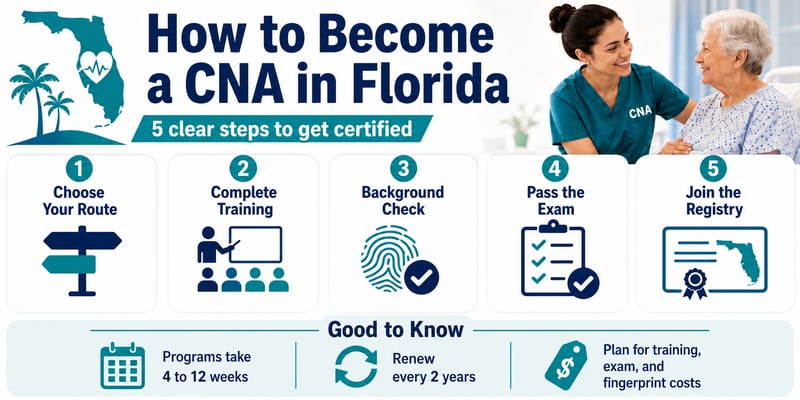
The path runs through five stages, from confirming you are eligible to landing on the state registry.
Step 1: Meet the Eligibility Requirements
Florida gives you two main routes, and you only need one.
- Training route (most common): complete a state-approved CNA training program, then sit the exam.
- Challenger route: sit the exam without a Florida training program. To qualify as a challenger, you must be at least 18 years old or hold a high school diploma or GED.
Florida also recognizes routes for people with other nursing training and for those whose certification has lapsed, so if you have a nursing background already, check which route fits before you apply.
Dreambound is free to use, and it lets you line up Florida CNA programs side by side by cost, length, and schedule so you can see what each one includes before you commit.
Step 2: Complete a State-Approved Training Program
If you take the training route, Florida law requires a minimum of 120 hours of instruction, split into:
- 80 hours of classroom learning
- 40 hours of supervised clinical practice
Most full-time programs run 4 to 12 weeks, and tuition usually lands between $1,500 and $2,500 depending on the school and what the price covers. You can compare state-approved programs in Miami, Orlando, Tampa, and Jacksonville, along with Lakeland, Cape Coral, Deltona, North Port, and Palm Bay. Before your first day, it helps to know what to buy for a CNA class.
If you are going the challenger route, you can move straight to the background screening.
Step 3: Pass the Level 2 Background Screening
Every Florida CNA applicant clears a Level 2 background screening before testing. You give your fingerprints electronically at an FDLE-approved Livescan provider, who sends them to the Florida Department of Law Enforcement and the Care Provider Background Screening Clearinghouse.
The steps:
- Start your screening through the Clearinghouse to get your ORI number.
- Book an appointment with an FDLE-approved Livescan vendor.
- Bring your ORI number and a valid photo ID.
- Pay the fees: a $60 Clearinghouse processing fee plus the vendor's separate service fee.
The review usually finishes within 5 to 7 business days after the Clearinghouse receives your results.
Step 4: Register for and Pass the Prometric Exam
Once you are eligible, register for the exam through Prometric and pay the testing fee. Your application stays valid for one year.
The exam has two parts:
- Written test: 60 multiple-choice questions, 90 minutes, offered in English or Spanish, with an audio version available if you request it on your application.
- Clinical skills test: you perform five assigned skills in front of evaluators and must pass all of them.
On test day, arrive at least 30 minutes early, wear scrubs and closed-toe shoes, and bring two valid IDs and your admission letter. You get three attempts to pass each part; fail a part three times and you must complete a 120-hour state-approved program before testing again. You also need to pass both parts within two years of each other.
Step 5: Get on the Florida Nurse Aide Registry
After you pass, Prometric sends your scores to the Board of Nursing, which takes about a week. The Board then processes your file and can take up to four weeks to issue your certificate and add you to the registry. Plan for roughly five weeks from your exam date to holding your certificate.
Florida CNA Salary and Job Outlook
Nationally, nursing assistants earn a median of $39,530 a year, with the lowest 10% under $31,390 and the highest 10% above $50,140 (BLS, May 2024). In Florida, the figure is about $37,510 a year, or $18.03 an hour, a little below the national median. Your actual pay depends on your setting, shift, and experience.
Demand is steady rather than fast-growing. Nationally, BLS projects 2% growth from 2024 to 2034, but about 211,800 openings a year, most of them from workers leaving the field or retiring. In a high-population state like Florida, that replacement demand is what keeps CNA hiring consistent across nursing homes, hospitals, and home health agencies.
What Becoming a Florida CNA Actually Costs
Most guides quote tuition and stop there. Here is the full cost stack, including the exam fees that surprise people, drawn from the Prometric Florida candidate bulletin:
- Both exam parts together (clinical skills and written): $155
- Written test only: $35
- Clinical skills test only: $120
- Reschedule (five or more business days ahead): $30
- Written test review: $25
- Optional written practice exams: $10 each, or $25 for all three
- Optional clinical skills readiness tests: $5 to $7 each, or $25 for the full set
- Background screening: $60 Clearinghouse fee plus the Livescan vendor's separate fee
- Training program, if you take that route: typically $1,500 to $2,500
Add it up before you start so the fees beyond tuition do not catch you mid-process. The challenger route skips tuition, but you still pay the exam and background-screening fees. You may not cover all of this yourself, though, since some Florida applicants qualify for workforce funding or employer-paid training.
Looking Up or Renewing a Florida CNA License
Once you are certified, the Florida Nurse Aide Registry is where your status is verified by employers and the public. A few things worth knowing:
- Renewal: your certification renews every two years, and you complete at least 24 hours of in-service training during each two-year period.
- A lapsed certificate cannot be used to work until you renew it, so track your expiration date.
- Name or address changes: you update the registry at no charge, though a new certificate showing a name change carries a $25 fee.
Paying for CNA Training in Florida
Cost should not be the thing that stops you. Florida residents may qualify for help through the Workforce Innovation and Opportunity Act (WIOA), administered locally through CareerSource centers. If you qualify, WIOA can cover tuition, books, supplies, and exam fees. Your local CareerSource office can walk you through eligibility, and this guide on accessing government funding for education is a useful starting point.
There is also a federal angle worth knowing: if a Florida nursing home hires you within 12 months of your certification, it is required to pay your training and testing costs. It is a fair question to raise during interviews.
CNA Career Paths in Florida
A CNA credential is also a starting point. Many CNAs move on to become a medical assistant, an LPN, or a registered nurse, building on the bedside experience they gained early.
Another option is becoming a travel CNA, which pairs the same certification with work in different cities and facilities. Florida also lets some people start working in a licensed facility as a Personal Care Attendant while they work toward CNA certification. Under the state's PCA rule, that means 16 hours of classroom training plus 8 hours of supervised simulation before any hands-on resident care, a way to earn while you train.
Frequently Asked Questions
How long does it take to become a CNA in Florida?
Most state-approved programs take 4 to 12 weeks (120 hours total: 80 classroom and 40 clinical). After testing, the registry step adds a few weeks, so many people finish within a couple of months.
How much does it cost to become a CNA in Florida?
Training usually runs $1,500 to $2,500, plus the $155 two-part exam fee and the $60 background-screening fee (plus the vendor's fingerprint fee). Going the challenger route skips tuition but not the exam and screening costs.
How much does a CNA make in Florida?
In Florida, nursing assistants earn about $37,510 a year ($18.03 an hour), a little below the national median of $39,530 (BLS, May 2024). Your pay depends on your employer, setting, and shift.
Do you need a high school diploma to become a CNA in Florida?
Not always. As a challenger, you qualify if you are at least 18 years old or hold a high school diploma or GED. Most training programs, though, ask for a diploma or GED to start.
Can you take a CNA course online in Florida?
You can complete the classroom hours through a hybrid program, but the 40 clinical hours must be done in person at a healthcare facility. If you want a hybrid option, you can compare program formats on Dreambound.
Planning Your CNA Path in Florida
The training itself rarely surprises people. The cost stack does: the exam, the background check, and the optional practice tests add up beyond tuition, and knowing those numbers up front lets you budget before day one.
Keep the employer angle in mind too. If a Florida nursing home hires you within your first year, federal law puts those training and testing costs back on the employer, which is worth asking about when you interview. When you are ready to compare your options, look at Florida CNA programs on Dreambound by cost, schedule, and city to find the one that fits your budget and timeline.