Key Points
- In-person and hybrid HHA training costs $0 to about $2,200, and agency training can be free, as it is at New York's Health Department-approved programs.
- Public college and adult education programs charge about $610 to $2,195 before supplies and state fees.
- Federal rules require at least 75 hours of training, including 16 hours of supervised practice and a skills test run by a registered nurse.
- A full-time program can finish in about two weeks and some take about four, while evening programs run about 6 to 12 weeks.
- Home health and personal care aides earned a median of $17.21 an hour in May 2025, so a $610 course equals about 35 hours of pay.
How Much Does HHA Certification Cost?
The home health aide certification cost for an in-person or hybrid program that meets the 75-hour minimum runs from $0 to about $2,200. Agency training can be free, and public colleges charge about $610 to $2,195. Supplies and a CPR class added about $206 at one college, and some states charge a fee.
How much is HHA training once the extras are in? The answer depends on the route, and the gap between a free agency class and a public college course can top $2,000.
Home health aide training cost by route (prices as posted, checked November 2026):
At several schools, tuition leaves out supplies and fees. Plan for these as well:
- Kingsborough Community College lists a $51.25 textbook, $35 scrubs, and a $120 CPR class.
- Registration or administrative fees run $20 to $75, depending on the school.
- The National Center for Competency Testing (NCCT) charges $70 for its Certified Home Health Aide exam. It matters mainly if an employer asks for it.
- New Jersey's state application and certification fee is $65 or $80.
Cheapest HHA Programs
The cheapest HHA training is free agency training, where agencies offer it. After that, public colleges and school district adult education programs post some of the lowest prices.
Public HHA programs and the prices posted on their websites (checked November 2026):
Prices change by term, so check the school's website before you apply. To see what's offered closer to home, compare home health aide schools near you.
How to Get HHA Training for Free
Free home health aide training comes from two places. Home care agencies train their own aides, often with a job offer at the end, and workforce programs pay tuition for people who qualify.
- Agency training: Health Department-approved programs in New York can't charge tuition. Selfhelp's free HHA training, one of those programs, ends with a job offer for qualified graduates. Before you sign up anywhere, ask whether you'll owe anything if you leave the job early.
- WIOA: Funding under the Workforce Innovation and Opportunity Act (WIOA) can pay for training at approved schools. Local job centers give priority to people on public assistance, other low-income people, and people with limited reading, writing, or math skills. Ask about WIOA funding at an American Job Center near you. If you don't qualify, look into other ways to access government funding for education.
- Not HHA training: Massachusetts' free online Personal and Home Care Aide State Training (PHCAST) course trains homemakers and personal care homemakers only. Its own site says home health aides require additional training.
- Federal aid: Workforce Pell Grants, available since July 1, 2026, cover programs of 150 to 599 clock hours lasting 8 to under 15 weeks that a state's governor has certified. A clock hour is about an hour of class, lab, or supervised practice. Most HHA courses run 75 to 120 of them, too few to qualify.
Fastest HHA Programs: How Long Is HHA Training?
HHA training takes at least 75 hours, the federal minimum, which works out to about two weeks at 40 hours a week. Some full-time and hybrid programs take about four weeks, and evening programs take about 6 to 12 weeks.
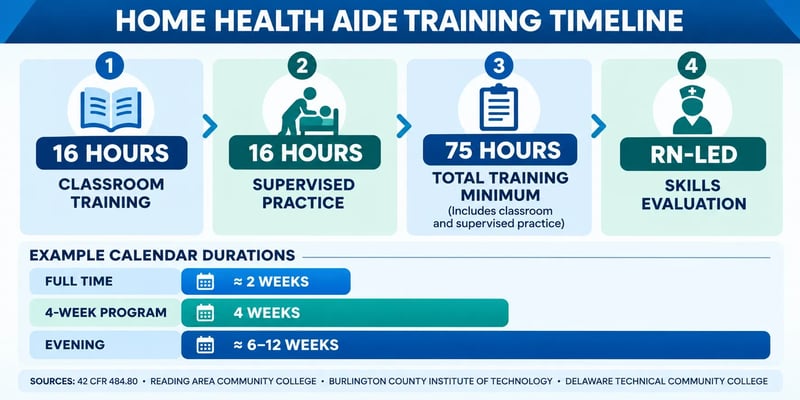
- Reading Area Community College runs 77 hours over four weeks. New York gives Health Department-approved programs 60 days from a trainee's first day, and evening programs in New Jersey and Delaware run about 6 and 12 weeks.
- If you already have caregiving experience, you may not need the full course. Medicare's rules for home health agencies, 42 CFR 484.80, let an agency hire an aide who passes a competency evaluation, the same nurse-run skills check trainees take. Ask agencies whether they offer that route in your state.
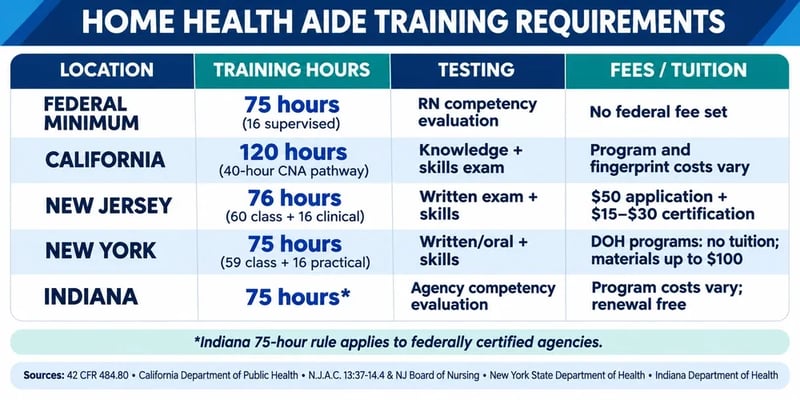
- State minimums can add time. California requires 120 hours, or 40 for aides who hold an active certified nursing assistant (CNA) certificate, and New Jersey requires 76. Burlington County Institute of Technology charges New Jersey CNAs $305, plus its $75 registration fee, for a shorter 10-hour course.
State Rules That Change the Cost and Timeline
Federal requirements are only the floor. Some states add hours, a state exam, or fees.
California adds the most hours of the states shown here, and New Jersey adds a state Board of Nursing exam and fee. If you plan to work in either state, our California HHA guide and New Jersey HHA guide take you through the steps.
How to Pick a Low-Cost Program That Counts
A cheap program is only a good deal if it qualifies you to work. Check these points before you pay:
- Ask which state agency approved the program, or which home care agency runs it.
- Confirm at least 16 hours of supervised practice in person, with a nurse.
- Make sure the nurse-run skills test is part of the program.
- Ask for the total cost, including supplies, a background check, and any state fee.
- For free agency training, get any repayment terms in writing.
- Skip email "certifications." Some sites sell an HHA certificate for about $99 to $139, finished in two or three days, with no hands-on hours or nurse skills test.
- Before paying for an online diploma, check your state. One national online HHA diploma says it doesn't meet requirements in California, the District of Columbia, New Jersey, New York, or Mississippi.
The cheapest option can also be the one that counts. A free agency class that ends with a nurse-run skills test is worth more than a $139 certificate that skips the supervised practice.
Is HHA Training Worth the Cost?
Home health and personal care aides earned a median of $35,800 a year, or $17.21 an hour, in May 2025. At that rate, a $610 course equals about 35 hours of work, and a $2,195 course about 128 hours. Free agency training pays back from your first shift.
The Bureau of Labor Statistics (BLS) projects 18% growth from 2025 to 2035, about 760,500 openings a year. The lowest 10% earned under $27,040, and the highest 10% over $45,040. Location, experience, and employer type help explain that spread, and our breakdown of what affects home health aide pay covers all three.