1-Year Medical Certificate Programs That Pay Well: 6 Options for 2026
See if you qualify for training programs
Answer a few questions in 2 minutes. Free, no commitment.
You Do Not Need 4 Years to Break Into Healthcare
Most people assume a healthcare career means years of school and mountains of debt. That is not the whole picture. In 2026, there are legitimate, accredited medical certificate and degree programs you can complete in 12 months or less, many of which lead to jobs that pay $40,000 to $67,000 a year or more.
The programs on this list are not shortcuts. They are real, nationally recognized credentials that employers actively seek. Whether you are changing careers, entering the workforce for the first time, or leveling up from an entry-level role, these fast-track options are worth a serious look.
Important distinction: Most of these are certificates or diplomas, not bachelor's degrees. That matters because the terminology on many healthcare sites is blurry. Here, we will be clear about exactly what each credential is and what it qualifies you to do.
Credential
CNAs must pass a state-approved competency exam to earn their certification. Requirements vary by state, but most programs take 4 to 12 weeks to complete.
🎓TSC Career Institute | CNA Training Program
EKG / Cardiac Monitor Technician (3 to 6 Months)
What You Will Do
EKG technicians operate electrocardiogram machines to monitor heart activity. They work in hospitals, cardiologist offices, and cardiac care units, often as part of a broader healthcare team.
Salary and Job Growth
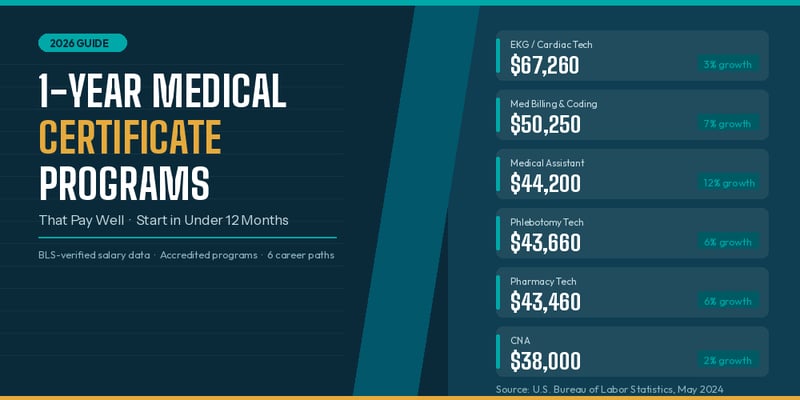
The BLS groups this role under cardiovascular technologists and technicians, with a median annual wage of $67,260 in May 2024 — the highest on this list. Employment is projected to grow 3% from 2024 to 2034, consistent with the national average, driven by rising demand for cardiac diagnostics among an aging population.
Certification
The Cardiovascular Credentialing International (CCI) offers the Certified Rhythm Analysis Technician (CRAT) credential for EKG technicians.
Pharmacy Technician (5 to 6 Months)
What You Will Do
Pharmacy technicians assist pharmacists with dispensing medications, processing prescriptions, managing inventory, and working with insurance claims. They work in retail pharmacies, hospitals, and specialty pharmacy settings.
Salary and Job Growth
The BLS reports a median annual wage of $43,460 in May 2024 for pharmacy technicians, with projected employment growth of 6% from 2024 to 2034, faster than the average for all occupations.
Certification
The Pharmacy Technician Certification Board (PTCB) offers the Certified Pharmacy Technician (CPhT) credential, which is the most widely recognized national certification.
🎓 CCI Training Center | Pharmacy Technician Certificate
What Every Healthcare Job Seeker Should Know
1. Accreditation determines your eligibility for certification exams. Always verify that your program is accredited by a recognized body such as CAAHEP, ABHES, or ACEN. Without proper accreditation, you may be ineligible to sit for national certification exams — regardless of how much time or money you invested.
2. Financial aid is available for short programs. Pell Grants and workforce development funds under the Workforce Innovation and Opportunity Act (WIOA) are available for many certificate programs. Ask each school directly about eligibility. Learn more at the U.S. Department of Labor WIOA page.
3. Stackable credentials accelerate your career. Many learners start as CNAs, earn their medical assistant certificate, and then add billing and coding. Each step builds on the last and increases your earning power without starting over from scratch.
How to Choose the Right Program
Not all 1-year programs deliver the same outcome. Before you enroll, ask these questions:
- Is the program accredited? Check with CAAHEP, ABHES, or the relevant accrediting body for your field.
- Does it include a clinical externship? Hands-on hours are often required for national certification exams.
- What is the job placement rate? Schools with active employer partnerships will have a measurable track record.
- Is financial aid available? FAFSA-eligible programs qualify you for federal Pell Grants, regardless of program length.
- Is it offered online, on-campus, or hybrid? Flexibility matters if you are working while you study.
Quick Salary Reference (BLS, May 2024)
All figures are median annual wages from the U.S. Bureau of Labor Statistics. Job growth projections are for 2024 to 2034.
- Medical Assistant: $44,200 | 12% growth
- Phlebotomy Technician: $43,660 | 6% growth
- Medical Billing and Coding: $50,250 | 7% growth
- Certified Nursing Assistant: ~$38,000* | 2% growth
- EKG / Cardiac Technician: $67,260 | 3% growth
- Pharmacy Technician: $43,460 | 6% growth
*BLS reports wages for the broader nursing assistants and orderlies category. Individual CNA wages may vary by state and employer.
Ready to Take the Next Step in 2026?
Healthcare is one of the most resilient industries in the U.S. economy. The jobs listed here are not just accessible. They are also in demand, well-compensated relative to training time, and often serve as the foundation for longer-term career growth.
You can launch a new healthcare career in under a year. The key is choosing an accredited program aligned with your goals, your schedule, and your financial situation.