Key Points
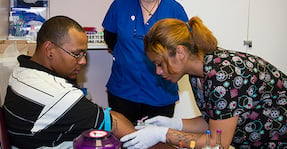
- A phlebotomist draws blood using venipuncture and capillary (finger or heel) collection, then prepares the samples for lab analysis.
- The work happens in hospitals, diagnostic labs, blood donation centers, and clinics.
- The national median wage is about $43,660 a year, or $20.99 an hour, based on May 2024 BLS data.
- Most training programs take about 4 to 12 weeks, with some self-paced online options running longer.
- Most employers want a national certification such as the NHA CPT or ASCP PBT, and four states require a license.
What Does a Phlebotomist Do Each Day?
A phlebotomist's main job is drawing blood, but the role covers the full process of collecting a safe, correctly labeled sample. On a typical shift, a phlebotomist will:
- Verify the patient's identity and check the collection order.
- Explain the draw and answer questions to calm anxious patients.
- Choose the right site and method (venipuncture or finger stick) for the patient's age and veins.
- Prepare the equipment: needles, tubes, and tourniquet.
- Clean the site and follow infection-control steps.
- Draw the blood while following safety protocols.
- Label each specimen with the patient's information, date, and time.
- Watch the patient for dizziness or fainting and give post-draw care.
- Prepare and send specimens to the lab, and log the details in the patient's record.
In some settings, phlebotomists also run point-of-care tests, collect samples for drug screening, or help with blood donations. The common thread is accuracy: a mislabeled or mishandled sample can change a patient's test results, so attention to detail matters in every step.
Where Do Phlebotomists Work?
Phlebotomists work anywhere blood is collected. The most common settings are hospitals, diagnostic laboratories such as Labcorp and Quest Diagnostics, blood donation centers, and physicians' offices. Some work in nursing facilities, for insurers, or on mobile collection teams that travel to patients' homes. Hospitals employ the largest share, which is why hospital experience is a common starting point.
What Skills Does a Phlebotomist Need?
Phlebotomy rewards a blend of hands-on skill and people skill. The core ones are:
- Manual dexterity and hand-eye coordination to find veins and draw cleanly.
- Attention to detail to verify identity, pick the right tubes, and label every sample correctly.
- Communication and empathy to explain the draw and steady patients who fear needles.
- Composure to stay calm and professional in a busy medical setting.
The technical part can be taught in a few weeks. The interpersonal part, putting a frightened patient at ease, is often what separates a good phlebotomist from a great one. If that mix sounds like you, phlebotomy is one of the quickest ways to find out whether healthcare is your field.
Phlebotomist Salary and Job Outlook
Phlebotomists earn a national median wage of $43,660 a year, or $20.99 an hour, according to May 2024 BLS data. The lowest 10% earn under $34,860, and the highest 10% earn more than $57,750, with pay varying by location, employer, and experience. Demand is steady too: employment is projected to grow 6% from 2024 to 2034, faster than average, with about 18,400 openings each year. For a fuller breakdown, see our guide to the job outlook for a phlebotomist.
This steady demand shows up in student interest. According to Dreambound's Student Choice and Interest Report, phlebotomy was the most-chosen vocational program on the platform in both 2024 and 2025.
How Do You Become a Phlebotomist?
The path is short compared with most healthcare roles. Most people start by meeting the basic requirements, usually being at least 18 with a high school diploma or GED, plus a background check and proof of immunizations. Next comes a training program covering anatomy, venipuncture technique, specimen handling, and infection control, with hands-on practice that builds toward supervised blood draws. Most programs run about 4 to 12 weeks, though some self-paced online options take longer.
After training, most employers want a national certification, even in states that do not require one by law. The most recognized are the Certified Phlebotomy Technician (CPT) from the [National Healthcareer Association](https://www.nhanow.com/certification/nha-certifications/certified-phlebotomy-technician-(cpt)), the Phlebotomy Technician (PBT) from the American Society for Clinical Pathology, and the Registered Phlebotomy Technician (RPT) from American Medical Technologists. Four states, California, Louisiana, Nevada, and Washington, also require a state license or certification, so check your state's rules before you choose a program.
Where to Train: Phlebotomy Programs on Dreambound
If the role sounds like a fit, Dreambound lets you compare phlebotomy programs at no cost by format, length, and how each one handles your clinical hours. A few to start with:
Frequently Asked Questions