Key Points
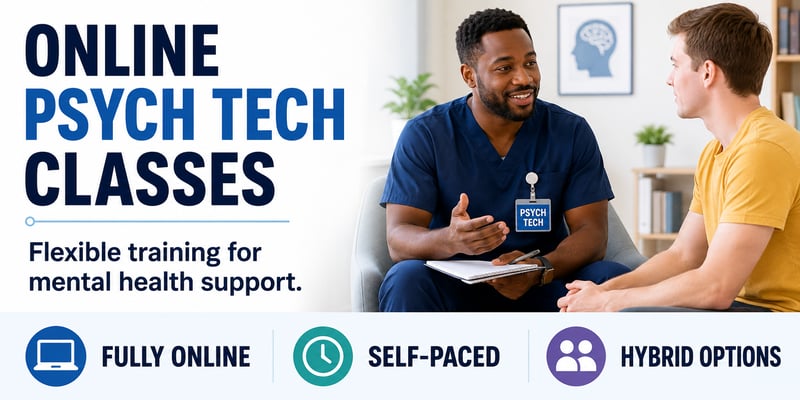
- You can complete psychiatric technician coursework fully online, covering patient care, documentation, de-escalation, ethics, and an introduction to psychopharmacology.
- Fully online programs prepare you for national certification and entry-level support roles; state licensure, in states like California, requires a hybrid program with in-person clinical hours.
- Online certificate programs typically take from a few weeks to several months, depending on pace and clinical requirements.
- Costs vary widely; fully online certificate programs on Dreambound currently run from $2,700 to $3,000 total.
- Psychiatric technicians earn a national median of $42,590 a year, with 20% projected job growth from 2024 to 2034.
Can You Become a Psychiatric Technician Fully Online?
Partly, and the difference matters before you pay for a program. You can complete the entire classroom portion of psychiatric technician training online. Whether you can finish the whole credential online depends on your state and your goal.
In most of the country, employers hire psychiatric technicians and mental health support workers based on a certificate plus national certification, and a fully online program can get you there. In the few states that license the role, including California, Colorado, Kansas, and Arkansas, the picture changes. California, for example, requires a state-approved program of at least 1,530 hours, including 954 hours of supervised clinical experience, which cannot be done online. There, the realistic route is a hybrid program, with theory online and clinical hours completed in person at a local site.
So the honest answer is straightforward: fully online works well if your goal is national certification and an entry-level support role, while licensure states call for a hybrid program. Knowing which of those you are aiming for before you enroll will save you both time and money.
Online vs Hybrid vs In-Person Classes
Not every online program works the same way. The right format depends on your state, your schedule, and how your target employers view clinical experience.
If you are not sure which applies to you, start by checking whether your state licenses psychiatric technicians. That one answer usually decides whether a fully online certificate is enough or whether you need a hybrid program.
What You Will Learn in Online Psych Tech Classes
Online programs cover the knowledge and applied skills entry-level mental health roles require. Most structure the coursework around a few core areas:
- Patient safety protocols, observation techniques, and clinical documentation
- Therapeutic communication, professional boundaries, and building rapport
- Crisis prevention, intervention strategies, and de-escalation
- Patient rights, ethics, cultural competence, and confidentiality
- An introduction to psychopharmacology, common medications, and side-effect awareness
Programs built around the Registered Behavior Technician track also cover applied behavior analysis principles, data collection, behavior reduction strategies, and skill-acquisition programming under a Board Certified Behavior Analyst.
Online Psych Tech Programs
Dreambound pulls online psychiatric technician and mental health support programs into one place so you can compare cost, length, and format and apply to the ones that fit. Two fully online options are the most direct fit for this path.
Mental Health Support Specialist - MedCerts
- Format: Fully online, self-paced, 24/7 access
- Length: 14 weeks
- Tuition: $3,000 total ($260 to start), with monthly payment options
- Detail: Prepares you for entry-level psychiatric technician and mental health support roles in hospitals, residential treatment, and outpatient settings. Financial aid options include MyCAA, WIOA workforce funding, and Department of Defense Credentialing Assistance.
Behavior Technician Specialist - MedCerts
- Format: Fully online, self-paced, 24/7 access
- Length: 12 weeks
- Tuition: $2,700 total ($234 to start), with monthly payment options
- Detail: Covers the 40-hour training requirement for the Registered Behavior Technician (RBT) credential. The RBT path also requires a supervised on-the-job competency assessment before certification. Financial aid options include MyCAA, WIOA, and military funding.
Looking further ahead? Columbia Southern University's online MS in Mental Health and Wellness is a graduate option for people who already hold a bachelor's and want to move into research, intervention strategy, or leadership later. It is non-clinical and does not lead to licensure, so it is not an entry-level class, but it is worth knowing about if an advanced path is your goal.
If you would rather train locally or need in-person clinical hours, see psychiatric technician classes near you.
RBT vs Psychiatric Technician: Which Online Path Fits?
Both credentials lead to hands-on behavioral health work, but they serve different populations and follow different certification tracks.
A Registered Behavior Technician works in applied behavior analysis, carrying out behavior intervention plans designed by a Board Certified Behavior Analyst, mostly with clients who have autism spectrum disorder or developmental disabilities. This path means completing a 40-hour training program approved by the BACB, passing a competency assessment, and passing the RBT exam.
A psychiatric technician works across broader mental health settings, including inpatient psychiatric units, residential treatment, and crisis stabilization. The work covers milieu management, crisis response, group facilitation, and medication support under supervision. Certification runs through the American Association of Psychiatric Technicians at Levels 1 through 4, and some states require separate licensure.
If your interest is specifically autism and ABA, the RBT track is the direct path. If you want broader exposure across mental health settings, the psychiatric technician credential is more versatile.
How to Enroll in an Online Psych Tech Program
The process is short, and most of it can be done from home:
- Pick your path. Decide between the psychiatric technician route for broad mental health care or the RBT route for ABA work.
- Check the prerequisites. Most programs require you to be 18 or older with a high school diploma or GED, plus a background check. Programs with clinical components may also require immunizations, a TB test, and CPR certification.
- Choose an accredited online or hybrid program. Look for recognition by the AAPT, or alignment with BACB requirements if you are pursuing the RBT. Confirm how clinical hours are arranged before you enroll, especially in rural areas where placement sites can be limited.
- Complete the coursework and any clinical hours. Fully online programs are self-paced; hybrid programs schedule your clinical rotations at a local site.
- Earn your credential. Pursue AAPT certification at the level that fits your experience, or, for the RBT, pass the competency assessment and the BACB exam. Check your state board if your state requires a license.
- Apply for jobs. Lead with your de-escalation training, patient-safety experience, any clinical rotations, and your flexibility on shifts. You can find psychiatric technician jobs near you through O*NET's local job finder.
Cost, Pay, and Job Outlook
Cost depends on format and school. Fully online certificate programs on Dreambound run from $2,700 to $3,000 total, while community college certificate and degree programs range more widely. For a side-by-side look at the lowest-cost and quickest routes, compare the cheapest and fastest psychiatric technician programs.
Psychiatric technicians earn a national median of $42,590 a year, with differential pay common for nights, weekends, and high-acuity units. BLS projects 20% growth for psychiatric technicians from 2024 to 2034, much faster than the 3% average for all jobs (the broader psychiatric technicians and aides category is projected at 16%). The role also keeps the door open to later moves into LPN, RN, social work, or counseling.