Is Military Officer a Good Job? Pros and Cons (2026)

See if you qualify for Military Studies programs
Answer a few questions in 2 minutes. Free, no commitment.
A career as a military officer is an honorable and respected profession that offers a unique opportunity to serve one's country, develop leadership skills, and experience unparalleled camaraderie. This year, the role is evolving with new technologies, updated benefits, and emerging career fields. However, the fundamental challenges of military life remain.
This guide explores the updated pros and cons of becoming a military officer, the essential qualifications, and the modern career outlook to help you make an informed decision.
Transitioning to Civilian Life
The transition out is harder than most officers expect, and it is a real cost of the career rather than a footnote at the end of it. Military life supplies structure that civilian work does not: a clear chain of command, a defined mission, an unambiguous rank, and a peer group that understands the job without explanation. Losing all of that at once is disorienting even for people who left voluntarily and on good terms.
The practical difficulties are specific. Civilian workplaces make decisions slowly and by consensus rather than by order. Job titles and responsibilities are vague by military standards. Translating command experience into terms a hiring manager understands takes real effort, and the camaraderie built through shared hardship rarely has an equivalent in an office.
Support programs exist and they help, but they do not remove the adjustment. Plan for it as part of the career rather than as something to handle in the last few months.
Pros and Cons at a Glance
Pros | Cons |
|---|---|
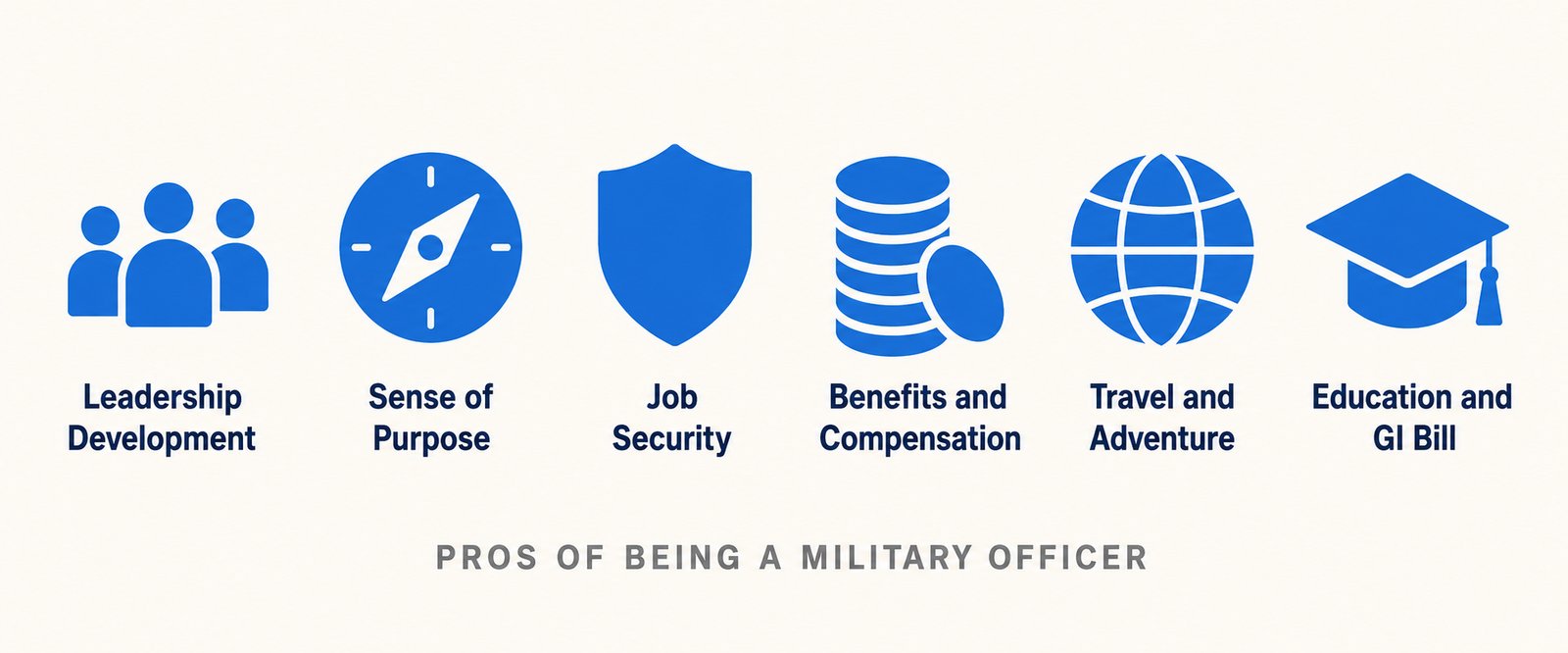
Leadership development | Long deployments |
Sense of purpose | High-stress environment |
Job security | Limited control over assignments |
Updated benefits and compensation | Potential for injury or death |
Travel and adventure | High operational tempo |
Education benefits and the GI Bill | Transitioning to civilian life |
Essential Skills and Qualifications for Pursuing a Career as a Military Officer
- Leadership: The ability to lead, motivate, and take care of your team is the cornerstone of being an officer.
- Decision-Making: Officers must make quick, effective decisions, often with incomplete information and under extreme pressure.
- Communication: Clear and concise communication is crucial for conveying orders, coordinating with other units, and reporting up the chain of command.
- Physical Fitness: Maintaining a high level of physical fitness is a non-negotiable requirement to meet the demands of the job.
- Critical Thinking: The ability to analyze complex problems and develop innovative solutions is vital for navigating modern military challenges.
- Technical and Analytical Acumen: With the rise of new technologies, skills in data analysis, cyber operations, and other technical fields are increasingly important for officers.
Career Outlook: New Roles and Opportunities
The career outlook for military officers is dynamic, with the services creating new roles to address modern warfare domains. The U.S. Army, for example, established the 49B "AI/ML Officer" specialty, with the first selections beginning in January 2026 to build a data-centric force.
Similarly, the U.S. Space Force has formalized new career fields like Orbital Warfare, Space Electronic Warfare, and Space Battle Management to develop warfighting expertise in the space domain. To keep experienced leaders, services are also offering significant financial incentives. In 2025, the Navy announced substantial retention bonuses for key communities like Surface Warfare and Aviation Department Heads, with some packages worth up to $150,000.
Officer Career Paths
Two distinct officer tracks exist. Commissioned officers are the generalist leaders described throughout this article: they command units, hold broad authority, and rotate through command and staff assignments across a career. Warrant officers are technical specialists who stay deep in one field, aviation, intelligence systems, cyber, and maintenance among them, rather than moving up a general leadership ladder. The Army has said it is considering opening the new AI/ML specialty to warrant officers as well.
A term you will encounter that is not a third track: staff officer describes an assignment rather than a category. A commissioned officer serving on a battalion or brigade staff, planning and coordinating rather than commanding, is working as a staff officer, and most officers alternate between staff and command roles throughout a career.
Support Systems: Mental Health and Civilian Transition
The Department of Defense has expanded programs designed to support officer well-being and career transitions.
- Mental Health: The Embedded Mental Health (EMH) program is growing across the services. This model places licensed mental health professionals directly within operational units to provide immediate, on-the-ground clinical care and reduce the stigma of seeking help.
- Civilian Transition: The DoD SkillBridge program offers transitioning service members, including officers, the chance to gain civilian work experience through internships and apprenticeships during their final months of service. A 2025 directive expanded these opportunities to include federal agencies like the Department of Homeland Security, providing a direct pathway to post-military careers.
Factors to Consider Before Deciding on a Career as a Military Officer
- Personal Values and Goals: A military career is more than a job; it's a commitment to a life of service and duty. Ensure this aligns with your core values.
- Lifestyle and Family: Consider the impact of frequent moves and long deployments on your family. Open communication and a strong support system are essential.
- Risk Tolerance: Assess your comfort level with the inherent dangers of military service.
- Long-Term Career Plans: Think about how a military career fits into your long-term goals. While programs like SkillBridge ease the transition, it's important to have a plan.
- Student Loan Repayment: Recent legislative changes have impacted eligibility for certain DoD student loan repayment programs. The authority for these benefits is now limited to officers who were commissioned on or before December 31, 2024. Prospective officers should verify current incentive programs before committing.
Frequently Asked Questions
What is the difference between enlisted personnel and officers?
Enlisted service members do the technical and operational work of the military and can join after high school. Officers plan and direct that work, hold command authority, and need a bachelor's degree to commission. Pay scales are separate, and officers generally earn more at equivalent years of service. Many officers begin as enlisted and commission later through Officer Candidate School.
Do you need a college degree to become a military officer?
Yes, for a commission. All three standard paths assume a bachelor's degree: ROTC and the service academies build the degree into the path, and Officer Candidate School requires you to already hold one. Warrant officer programs are the exception, since they select for technical expertise and generally do not require a four-year degree.
What is the biggest downside of being a military officer?
Loss of control over where you live and when you are away. Assignments and deployments follow the needs of the service, not your preferences, which means relocations every few years and extended separations from family. Officers consistently name that lack of control, more than the workload or the risk, as the hardest part to sustain over a full career.
Do military officers get GI Bill benefits?
Yes. Officers qualify for the Post-9/11 GI Bill on the same active-duty service basis as enlisted members, and can transfer entitlement to a spouse or child with Department of Defense approval and an added service commitment. How you commissioned can affect what service counts toward eligibility, so confirm your specific situation with the VA.
Is it hard to transition from being a military officer to a civilian job?
It is a real adjustment, though leadership experience transfers well. The common difficulties are cultural rather than technical: slower consensus-driven decision making, vaguer roles, and the loss of the structure and peer group military life provides. Programs like DoD SkillBridge let you gain civilian work experience before you separate, which shortens the gap considerably.
What new officer career fields are available in 2026?
The Army established the 49B AI/ML Officer area of concentration, with the first selections running through the Volunteer Transfer Incentive Program in January 2026 and reclassifications expected by the end of fiscal year 2026. The Space Force has formalized Orbital Warfare, Space Electronic Warfare, and Space Battle Management as career fields. Both reflect a broader shift toward technical specialization in the officer corps.
Final Thoughts
Becoming a military officer is a significant decision that offers a unique blend of traditional honor and cutting-edge opportunity. The career provides substantial benefits, including updated pay, expanded family leave, and pathways into high-tech fields like artificial intelligence and space operations. However, it also demands immense personal sacrifice, resilience in high-stress environments, and flexibility in the face of deployments and relocations.
Before pursuing this path, it is essential to carefully assess your skills, personal values, and long-term goals against the modernized pros and cons. If you decide that a career as a military officer is the right choice, preparing for the academic and physical requirements is your first step. Dreambound helps students find and compare vocational training programs that can build a strong foundation for this challenging and rewarding career.