Key Points
- A security guard is a trained professional who protects property, assets, and people by monitoring, patrolling, and enforcing rules to prevent crime and ensure safety.
- The process starts with a job at a licensed security company. The employer or the new hire then files the registration with the South Carolina Law Enforcement Division (SLED), which includes completing a 6-hour training course and passing state and federal background checks.
- Applicants must be 18 or older (21 for armed and school district officers), U.S. citizens, and hired by a licensed security business.
- The state-mandated training is a minimum of 6 hours, which includes 4 hours of classroom instruction and 2 hours of company-specific orientation.
- The median security guard salary in South Carolina was $35,460 as of May 2025.
- All security guards must be registered with SLED. This registration, often called a "guard card," is mandatory and must be renewed annually. School security officers have a separate biennial recertification requirement.
What Does a Security Guard Do?
A security guard, or security officer, is a trained professional responsible for maintaining a safe and secure environment. Their primary role is to deter, detect, and report incidents such as theft, vandalism, and unauthorized access.
Daily duties often include:
- Patrolling and inspecting property to protect against fire, theft, and other hazards.
- Monitoring surveillance cameras and alarm systems.
- Controlling access for employees, visitors, and vehicles at entry points.
- Responding to emergencies, such as medical issues or safety threats, and coordinating with police or fire departments.
- Writing detailed daily activity logs and incident reports.
- Enforcing property rules and providing assistance to visitors.
South Carolina law gives registered officers "the authority and arrest power given to sheriff's deputies," but only on the property where they are employed. State regulations limit that power. Officers report any arrest to the local law enforcement agency once the suspect and the scene are secured, and they cannot transport prisoners or chase suspects off the protected property. When they discover a crime, they must secure the scene and notify police.
Where Do Security Guards Work?
South Carolina law recognizes two kinds of security employers. Contract security businesses provide guard service to clients for a fee, while proprietary security businesses employ officers to guard their own property.
Nationally, the largest employers of security guards in 2025 were the following, according to the Bureau of Labor Statistics:
- Investigation, guard, and armored car services: 58%
- Educational services (state, local, and private): 7%
- Healthcare and social assistance: 6%
- Retail trade: 5%
- Accommodation and food services: 4%
Requirements to Become a Security Guard in South Carolina
SLED is the state agency that licenses security businesses and registers the officers they employ. The requirements for a South Carolina security guard license, officially a security officer registration, are set in Title 40, Chapter 18 of the South Carolina Code:
- At least 18 (21 to carry a firearm or to work for a school district)
- U.S. citizen
- Employed by a licensed security business
- A SLED-approved pre-employment drug test
- One set of fingerprints for state and FBI criminal history checks
- Good moral character; no felony or crime of moral turpitude; no military discharge "with other than honorable conditions"
The statute sets a high school diploma requirement for security business owners and private investigators, but not for security officers.
How to Become a Security Guard in South Carolina: A Step-by-Step Guide
The path to becoming a security guard in South Carolina is regulated by the South Carolina Law Enforcement Division (SLED). The process is employer-driven, meaning you must be hired before you can be trained and registered.
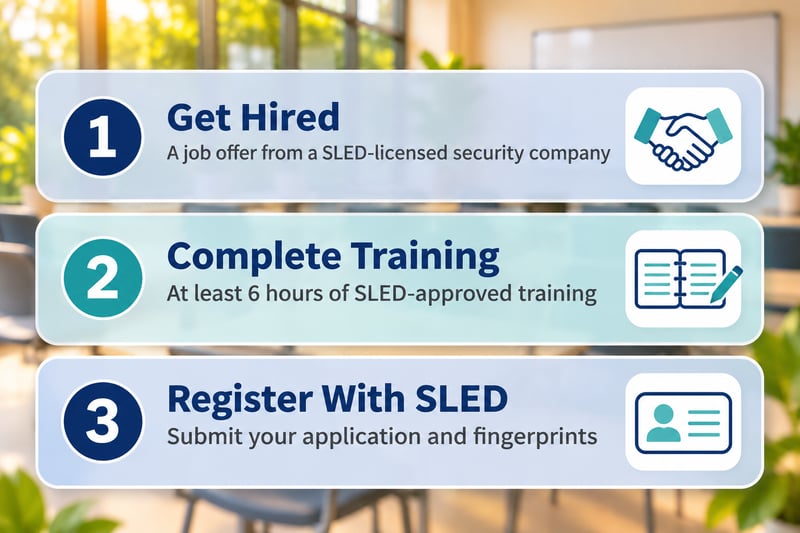
Step 1: Meet Basic Requirements and Get Hired
Before you can be trained, you must meet the requirements listed above and receive a conditional offer of employment from a SLED-licensed security company.
To get your first job, search online job boards for "Unarmed Security Officer" in South Carolina. Highlight your reliability and customer service skills on your resume. Once a company hires you, it provides your training and either files your registration or has you file it.
Step 2: Complete SLED-Mandated Training
Your new employer will put you through the state-mandated "Primary Basic" training course. This course is taught by a certified private security company training officer and requires a minimum of six hours of documented training.
The training is broken down into:
- 4 hours of classroom instruction covering post orders, officer registration, ethics and professionalism, situational awareness and observation, law enforcement relations, note taking and reports, discovered criminal activity, crime scene preservation, workplace violence and emergency response, and violent event threats.
- 2 hours of company orientation covering company policies and assignment-specific duties.
Patrol procedures, arrest, and use of force are taught in a separate SLED course, Primary Plus, and officers may not use force against another person without it. Under state regulations, the basic training must be completed, a written exam scored, and your application received by SLED before you begin duties at a client site. In a March 22, 2017 memo, SLED released revised Primary Basic and Primary Plus curricula that clarified armed officers may make arrests and revised the firearm qualification scores.
Step 3: Pass Background Checks and Get SLED Registration
After you complete the training, your application, one set of fingerprints, and proof of training go to SLED. State law lets your employer file the application and pay the fee, or require you to do it. SLED's security officer registration application states that the fingerprints are used to check FBI criminal history records.
Under Section 40-18-80 of the state code, you may work for up to 30 days after SLED receives your application. During this provisional period, you have no arrest authority and cannot carry a firearm. If SLED does not issue your registration within 30 days, you must stop working until it is approved. Upon approval, you will be issued an official SLED Security Officer Registration, which is your license to work.
Armed Security Officer Requirements in South Carolina
An armed security license in South Carolina is a SLED armed security officer registration. The main rules:
- Age and registration: Under state law, an officer who carries a firearm must hold a SLED security weapons permit, be at least 21, and already be licensed or registered as a security officer. The permit lasts one year.
- Firearms training: Before carrying on duty, you complete a SLED-approved course of at least four hours, taught by a private security company certified training officer or a law enforcement firearms instructor, including a supervised and documented range demonstration. SLED requires armed officers to requalify every year after that.
- Passing score: SLED's Primary Plus curriculum requires a score of 80%, or 40 hits, on a 50-round course of fire.
- How you carry: An armed officer may carry only "in an open and fully-exposed manner" while in uniform on duty, or in a vehicle traveling directly to or from a post. Concealed carry off duty and out of uniform requires a separate SLED Security Concealed Weapons Permit, which SLED may issue when it finds the permit would help the officer perform assigned duties.
- Firearm type: State regulations define a firearm as a handgun. Rifles and shotguns are prohibited unless SLED approves them in writing.
South Carolina Security Guard Licensing and Renewal
Licensing, officially called registration, is mandatory in South Carolina and is managed by SLED.
- The unarmed, armed, and replacement card fees come from South Carolina's private security regulations, which list both officer fees as annual. The upgrade and temporary officer fees come from SLED's registration application. Fees are paid by business check, cashier's check, or money order.
- Registration is valid for one year, and officers can work only while employed by a licensed security business. In 2016, SLED ended the transfer of registrations between employers. An officer who changes employers must give the new employer documentation of all training received; if those records cannot be obtained, the new employer must conduct and document the minimum training again. Registration cards must show a recent photo and be fully laminated.
- Renewals must reach SLED 30 to 60 days before the card expires. A late filing makes the card invalid.
- An officer who is arrested must report the arrest to SLED within 72 hours.
As of May 2025, security officers working in school districts have additional requirements, including being at least 21 years old and completing a recertification every two years. These rules come from S.269, enacted as Act No. 36 of 2025.
Security Guard Salary in South Carolina
According to May 2025 Occupational Employment and Wage Statistics from the Bureau of Labor Statistics, security guards in South Carolina earned a median annual wage of $35,460, or $17.05 an hour. The middle 80% earned between $27,420 and $48,850, and about 16,610 security guards worked in the state. Nationally, the median was $38,020, or $18.28 an hour. BLS projects 1% growth in security guard jobs from 2025 to 2035, with about 156,000 openings a year nationally.
Of the metro areas in the table, Columbia employs the most security guards. Outside the metro areas, BLS reports a $61,530 median for the 360 guards in the Northwestern South Carolina nonmetropolitan area, the highest of any South Carolina area. The Charlotte metro area, which crosses into South Carolina, employs 12,020 guards at a $35,010 median. BLS does not publish separate pay figures for armed and unarmed guards.
Career Paths for South Carolina Security Guards
With experience, you can move into roles such as:
- Armed Security Officer: A role that involves carrying a firearm to protect high-value sites or clients.
- School Security Officer: A specialized role requiring additional training and biennial recertification to work in educational settings.
- Site Supervisor: Managing a team of security officers at a specific location, handling scheduling, and acting as the point of contact.
- Patrol Officer: A mobile role, driving a company vehicle to inspect multiple properties or respond to alarms.
- Loss Prevention Specialist: A specialized role in retail focused on preventing theft and fraud.
- Security Manager: Overseeing all security operations, staff, and technology for a company or a large district.
- Private Investigator: With further training and licensure, you can move into investigative work.
Officers who want a degree can look at criminal justice programs. Dreambound, which compares vocational and degree programs from schools across the country, lists two online options: the AS Criminal Justice from Southern New Hampshire University and the BS in Criminal Justice from Walden University. Neither replaces the SLED training your employer provides.