Key Points
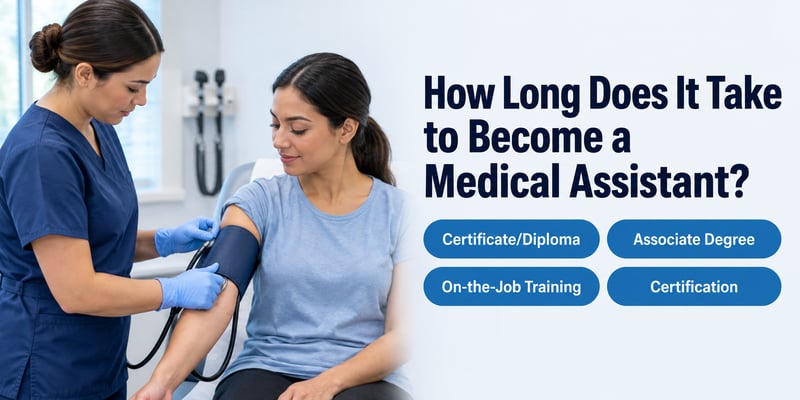
- Certificate and diploma programs: typically 9 months to about 1 year, with accelerated full-time schedules finishing sooner.
- Associate degree programs: about 2 years, including general education courses.
- On-the-job training: some employers hire without a formal program, particularly in states with fewer regulatory requirements.
- Certification (CMA through the AAMA, or RMA through AMT) typically follows shortly after program completion.

Certificate/Diploma Program Timeline
A certificate or diploma program is the fastest formal training path, and a postsecondary nondegree award is what the Bureau of Labor Statistics lists as typical entry-level education for the occupation. The BLS Occupational Outlook Handbook puts medical assistant programs at about 1 or 2 years, with the certificate at the shorter end.
So how long is medical assistant school in practice? The clearest yardstick is clock hours. The American Medical Technologists education route for the RMA exam and Washington State's minimum for a medical assistant-certified program both set the bar at 720 hours of instruction including at least 160 hours of externship, and the MAERB requires the same 160-hour practicum for CAAHEP accreditation. At 20 classroom hours a week, 720 hours is about 36 weeks, or 9 months. At a full-time 40-hour week it is closer to 18 weeks, which is where accelerated schedules come from. The same program can take a few months or a year depending on the weekly pace.
Coursework covers medical terminology, anatomy, and pharmacology, plus clinical skills such as vital signs and blood draws and administrative skills such as scheduling and records. The externship comes last, in a working clinic or office. A course that skips it, or runs only a few weeks, will not meet the 720-hour floor. The cheapest and fastest medical assistant programs listed on Dreambound show how much length varies between schools granting the same award.
Associate Degree Timeline
An associate degree in medical assisting takes about 2 years of full-time study. The medical assisting coursework is the same as in a certificate program, including the externship. What adds the time is the general education block the college requires for any associate degree, such as English composition, math, and a science course, which a certificate program leaves out.
That extra year suits some students better than the certificate route. Credits earned in a degree program may transfer to a later program, depending on the receiving school, which matters if you expect to move into nursing or health administration later. BLS lists a postsecondary nondegree award as the typical entry-level education, so the degree is a choice about where you want to be in five years, not a requirement for the first job.
Part-time study stretches either path; an evening certificate program can run as long as a full-time degree, so compare schedules, not award names. A separate comparison of a medical assistant degree versus a certificate or diploma goes into cost and transfer differences in more detail.
On-the-Job Training: The Path With No Formal School
Medical assisting, unlike licensed roles such as nursing, does not require a state license everywhere. The Bureau of Labor Statistics states it directly: "Medical assistants who do not have postsecondary education may learn their skills through on-the-job training or an apprenticeship," and "Some states require that medical assistants graduate from an accredited program, be licensed or certified, or meet other prerequisites." Where no state rule applies, an employer may hire a high school graduate and train them in the office. The U.S. Department of Labor lists medical assistant among the common apprenticeable occupations in healthcare, and a registered apprenticeship pays from the point of hire.
The states that regulate the role show how the shortcut narrows:
- Washington requires a Department of Health credential to practice as any type of medical assistant. The medical assistant-registered credential needs no program; a supervising practitioner attests to the applicant's competency. On-the-job training is possible, but only under a state registration.
- Arizona rule R4-16-401 requires, before employment, an approved training program, or an unapproved program plus a certification exam from an accredited certifying organization, or a training program designed and offered by a physician under A.R.S. 32-1456(D).
- California does not license medical assistants, but the Medical Board requires training by a supervising practitioner or an approved school before a medical assistant performs technical supportive services such as injections.
On-the-job training puts you on a payroll from the point of hire, and it is the slowest path to a portable credential: AMT's work-experience route to the RMA requires 3 years of employment as a medical assistant within the past 7. The Dreambound guide on how to become a medical assistant without a degree covers what employers who train in-house ask for.
Certification Timeline
Certification is not required in most states, but BLS notes that employers may prefer or require it, so plan the timing before you finish school.
The CMA (AAMA) is tied to accredited schooling. To sit for the exam you must be a student or graduate of a program accredited by CAAHEP or ABHES, unless you qualify through a prior CMA, an educator pathway, or the AAMA's alternative pathway. Timing works in your favor: AAMA eligibility rules let completing students register as soon as all classroom coursework is done, before the externship ends, and anyone applying within 12 months of graduation counts as a recent graduate. The fee is $125 for AAMA members and $250 for nonmembers.
The RMA through American Medical Technologists accepts more routes: graduates of the past 4 years, or students scheduled to graduate, from a 720-hour program with a 160-hour externship; 3 years of work experience within the past 7; military medical training; or teaching experience. The $150 fee covers the application, exam, and first annual fee. AMT processes applications in 1 to 2 business days, approvals stay valid for a year, and results are available after the exam. Washington and Arizona regulators also accept the CCMA from the National Healthcareer Association and the NCMA from the National Center for Competency Testing.
The exam itself is one sitting. What certification adds is application processing, a test date, and your study time. Because the CMA and RMA both allow registration before graduation, the exam can fall in the same month you finish, with study overlapping the externship.
Total Realistic Timeline by Path
Typical length runs from the first day of training to the point you can apply for work. The certification column reflects state rules, not what any given employer asks for.
Register for the CMA or RMA before graduation if you want the credential in hand for your first application. You can compare medical assistant schools near you on Dreambound and filter by program length, format, and start date to see which of these ranges the schools in your area publish.
Medical Assistant Salary and Job Outlook
Medical assistants earned a median annual wage of $45,690, or $21.97 an hour, in May 2025, according to the Bureau of Labor Statistics Occupational Outlook Handbook profile for medical assistants. The same profile's Job Outlook tab projects employment of medical assistants (SOC 31-9092) to grow 13 percent from 2025 to 2035, from 833,900 to 941,500 jobs, with about 109,700 openings a year on average over the decade. Pay varies by state and work setting; the Dreambound medical assistant salary guide breaks the national figure down by state.
Frequently Asked Questions