Key Points
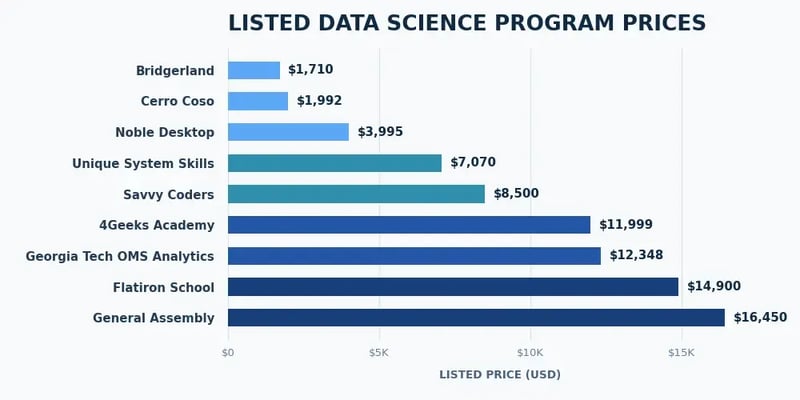
- Bootcamp-length data science and data analytics programs listed on Dreambound cost $1,710 to $16,450 and run about 12 to 33 weeks, against $12,348 total tuition for Georgia Tech's online master's.
- BLS lists a bachelor's degree as the typical entry-level education for data scientists, and some employers require or prefer a master's or doctorate, so a bootcamp works best on top of a degree you already hold.
- Data scientists earned a median $120,230 in May 2025, and BLS projects 35% growth from 2025 to 2035 with about 24,800 openings a year.
- No school can guarantee you a job, as the FTC puts it, and in 2024 the CFPB found one bootcamp had advertised 71% to 86% placement while its own reporting showed closer to 50%.
- Workforce Pell Grants, available from July 2026, fund short programs only at accredited institutions that show 70% completion and 70% employment in the second quarter after exit, a fair test for any bootcamp.

What a Data Science Bootcamp Is (and What It Is Not)
A data science bootcamp is a short, cohort-based training program, usually 12 to 33 weeks across the bootcamp-length programs listed on Dreambound, that teaches Python or R, SQL, statistics, and introductory machine learning and ends in a portfolio and a certificate of completion rather than a degree.
Three kinds of schools run them. Private schools such as General Assembly, Flatiron School, and 4Geeks Academy sell full bootcamps, and community and technical colleges such as Cerro Coso Community College and Bridgerland Technical College run certificate-length versions. University-branded bootcamps were the third group, and many were operated by 2U, which announced in December 2024 that it would wind down all of its boot camps after partnering with more than 50 universities and producing about 96,000 graduates.
Formats run full-time and part-time, live online and in person, and self-paced at some colleges; Bridgerland describes its program as self-paced and competency-based. Data science and data analytics bootcamps are not the same product, either. Analytics programs center on SQL, spreadsheets, and dashboards, science programs add statistical modeling and machine learning, and many programs carry the analytics name, so match the program to the job title you want.
Prerequisites are set by each school, so read the program page rather than assuming there are none. The same test applies to coding programs, which is the subject of are coding bootcamps worth it.
What a Data Science Bootcamp Costs in 2026
Listed prices on Dreambound split into three tiers. Full bootcamps from General Assembly, Flatiron School, and 4Geeks Academy list $11,999 to $16,450. Mid-priced programs from CCS Learning Academy, Savvy Coders, and Unique System Skills Bootcamps list $7,070 to $8,995. Certificate-length programs from Noble Desktop, SAM Consulting Services, Cerro Coso Community College, and Bridgerland Technical College list $1,710 to $3,995.
The cheapest and fastest data analytics programs guide covers that low-cost tier program by program. For one outside benchmark, Forbes Advisor put the average bootcamp at $11,182 as of July 2025.
Income share agreements and deferred tuition plans are loans. In April 2024 the CFPB determined that one online bootcamp's income share agreements were loans with an average finance charge of $4,000, after the school had told students they were not loans and carried no finance charge. The order cited failures to disclose the finance charge and annual percentage rate under the Truth in Lending Act, so ask for the amount financed, the finance charge, and the APR in writing before signing anything.
Federal aid is new to this category. From July 2026, the Workforce Pell Grant rule covers programs of 8 to under 15 weeks and 150 to 599 clock hours at accredited institutions that a state governor and the Department of Education approve, so ask a college program whether it qualifies. A program at a school that is not an accredited institution cannot.
Do Data Science Bootcamps Get You Hired? How to Read Job Placement Claims
The FTC's guidance on vocational schools puts it plainly: "Remember that a school is not an employment agency. No school can guarantee you a job when you graduate." Placement numbers are the school's claim, and the 2024 CFPB case shows why they need checking.
In its April 2024 enforcement action, the CFPB found that one online bootcamp had advertised that 71% to 86% of students were placed in jobs within six months of graduation while its non-public reporting to investors consistently showed placement closer to 50%. The order carried a $64,235 penalty for the school and $100,000 for its CEO, a permanent ban on consumer lending for the school, and a ten-year ban on student lending for the CEO.
The market behind those numbers has also changed. When 2U announced its exit, its interim CEO said that "demand for entry-level tech roles has decreased while the pool of available, experienced tech talent has expanded," and Inside Higher Ed reported boot camp closures that included Epicodus in early 2024 and Momentum Learning's Triangle boot camp in August 2024.
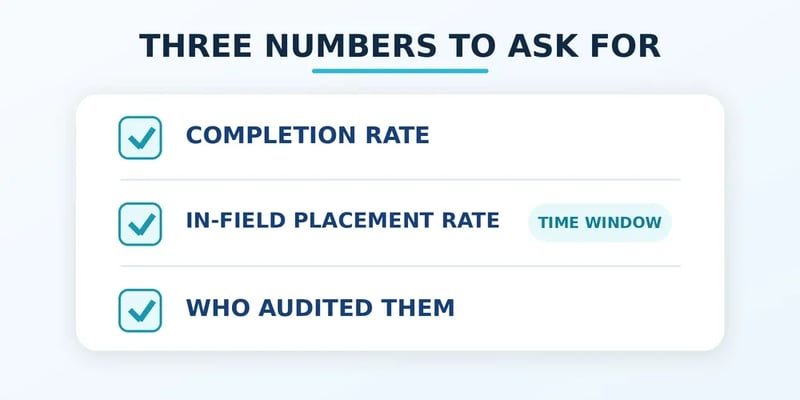
One standard fixes the reporting problem. The Council on Integrity in Results Reporting (CIRR) requires member schools to report 100% of student outcomes, with no selective reporting, under six standards that end with annual third-party audits. A real outcomes report answers five questions: what share of starters graduated, what share of graduates got in-field jobs, in what time window, at what salary, and who checked the numbers.
This page cites no graduate salary figure because none of the programs reviewed publishes an audited one, and a school's own success stories are marketing until someone outside the school audits them. A job guarantee is a refund contract with conditions, and application quotas, location limits, prior-degree requirements, and deadlines decide whether the refund ever pays out, so read the conditions before counting the guarantee as a benefit.
Data Scientist Salary and Job Outlook
BLS reports a median wage of $120,230 a year, or $57.80 an hour, for data scientists as of May 2025, with 275,600 jobs in 2025. Employment is projected to grow 35% from 2025 to 2035, much faster than the average for all occupations, adding about 95,400 jobs over the decade with about 24,800 openings a year on average.
The credential line in the same handbook decides the bootcamp question: "Data scientists typically need at least a bachelor's degree in mathematics, statistics, computer science, or a related field," and some employers require or prefer a master's or doctoral degree.
The median describes the occupation, not bootcamp graduates, and BLS has no separate data analyst occupation, so no analyst wage appears here. On the AI question, the projection that runs to 2035 already accounts for the current market and still shows growth well above the all-occupation average.
Bootcamp vs Degree vs Certificate
The three paths differ in credential, price, and time, and the cheapest one doubles as the shortest test of whether you like the work.
The comparison that decides most cases: the two priciest bootcamps in the tiers above, at $14,900 and $16,450, cost more than Georgia Tech's online master's, but the master's requires a bachelor's degree and takes two to three years. A bootcamp's real competitor for a degree holder is the master's, and its real competitor for everyone else is a degree program, which the bachelor's degree in data analytics guide covers.
The free-or-cheap trial comes first. Finish the Google Data Analytics certificate, and if six months of SQL and spreadsheets held your interest, the bootcamp or degree decision gets easier.
Pros and Cons of a Data Science Bootcamp
Pros:
- Shorter than any degree path: 12 to 33 weeks for the listed bootcamp-length programs against 24 to 36 months for Georgia Tech's online master's.
- Some programs cost under $4,000, including Noble Desktop, Cerro Coso Community College, and Bridgerland Technical College.
- The field's outlook is strong on federal data: 35% projected growth and about 24,800 openings a year (BLS).
- Part-time and self-paced formats exist, Bridgerland's program among them, so training can run alongside a job.
- Some schools publish audited outcomes under CIRR, which gives you numbers you can check.
Cons:
- A bootcamp is not the credential BLS lists as typical for data scientists, and some employers require a master's or doctorate.
- Placement claims are unaudited at most schools, and the 2024 CFPB order shows how far an advertised rate can sit from the internal one.
- Income share agreements are loans with finance charges, and the CFPB found an average finance charge of $4,000 in the 2024 case.
- Providers are closing or pulling out, from 2U's exit to the 2024 closures Inside Higher Ed reported, which matters if your guarantee depends on the school existing in three years.
- 2U's own leadership reported lower demand for entry-level tech roles and a larger pool of experienced candidates.
Who a Data Science Bootcamp Is Worth It For (and Who Should Skip It)
A data science bootcamp tends to be the right fit if:
- You already hold a bachelor's degree in any field and need applied skills and a portfolio, not a credential.
- You are employed and the goal is an internal move to an analyst or data role, so your outcome does not depend on the school's placement rate.
- The program publishes audited outcomes or qualifies for Workforce Pell, and the price sits below a master's you could get into.
- You have finished a low-cost certificate and want a cohort, deadlines, and instructor feedback.
A data science bootcamp is probably not the right choice if:
- You have no degree and want the data scientist title itself; a bachelor's degree is the path BLS describes, and an associate in data analytics is the first step toward it.
- The deciding factor is a job guarantee whose conditions you have not read.
- The tuition matches or exceeds an online master's you would qualify for.
- The only financing offered is an income share agreement without the amount financed, finance charge, and APR in writing.
If you are still choosing the field itself, IT support vs data analytics and data analytics vs software developer compare the training and pay side by side.
How to Vet a Data Science Bootcamp Before You Pay
- Ask, in writing, the FTC's three questions: what percentage of students complete the program, how many graduates find jobs in their chosen field, and the average starting salary, plus the time window behind each.
- Ask who audited those numbers. CIRR members report 100% of outcomes and submit to annual third-party audits, and a school that reports only its best cohorts has not answered the question.
- Apply the Workforce Pell bar: 70% of starters finishing within 150% of the normal time, 70% of completers employed in the second quarter after exit, and tuition no higher than the earnings gain.
- Get the amount financed, finance charge, and APR in writing for any income share agreement or deferred tuition plan; missing finance charge and APR disclosures were part of the CFPB order.
- Read the job guarantee's conditions. No school can guarantee a job, and the guarantee is a refund contract.
- Confirm accreditation in the Department of Education's accreditation database and the school's license with its state agency, as the FTC advises, then ask whether the program qualifies for Workforce Pell.
- Confirm who operates the program and what happens to your cohort if the operator exits, given 2U's wind-down and the 2024 closures.
- Check the cancellation window and any fees beyond tuition, which the FTC lists as books, equipment, uniforms, lab fees, and graduation fees.
Data Science Bootcamps and Programs on Dreambound
Dreambound lists data science and data analytics programs with their published tuition and format side by side, so the $1,710 to $16,450 range on this page comes from the same listings you would compare before applying. The eight programs below were chosen to cover the full price range and both credential levels, and the marketplace lists more.
Bootcamps and Short Certificates
- Format: Online
- Tuition: $1,710 total
- Self-paced, competency-based curriculum
- Format: Online
- Tuition: $1,992 total
- Financial aid may be available for those who qualify
- Format: Online
- Tuition: $3,995 total
- Format: Online
- Tuition: $11,999 total